The Masako Maneuver Exercise
The Masako Maneuver is a targeted rehabilitative exercise designed to close that gap by forcing the throat muscles to work harder. By anchoring the tongue forward, you are essentially "weightlifting" with your pharyngeal constrictors.

For patients living with dysphagia (difficulty swallowing), the act of eating can feel like a mechanical failure. Often, this is due to a "weak" swallow—where the base of the tongue doesn't retract far enough to meet the back of the throat (the pharyngeal wall). This gap prevents food from being pushed down efficiently, leading to residue left in the throat or, worse, aspiration.
The Masako Maneuver is a targeted rehabilitative exercise designed to close that gap by forcing the throat muscles to work harder. By anchoring the tongue forward, you are essentially "weightlifting" with your pharyngeal constrictors.
How to Perform the Masako Maneuver
This exercise is a "dry" swallow technique, meaning it is performed without any external bolus.
- Sit upright with your shoulders back.
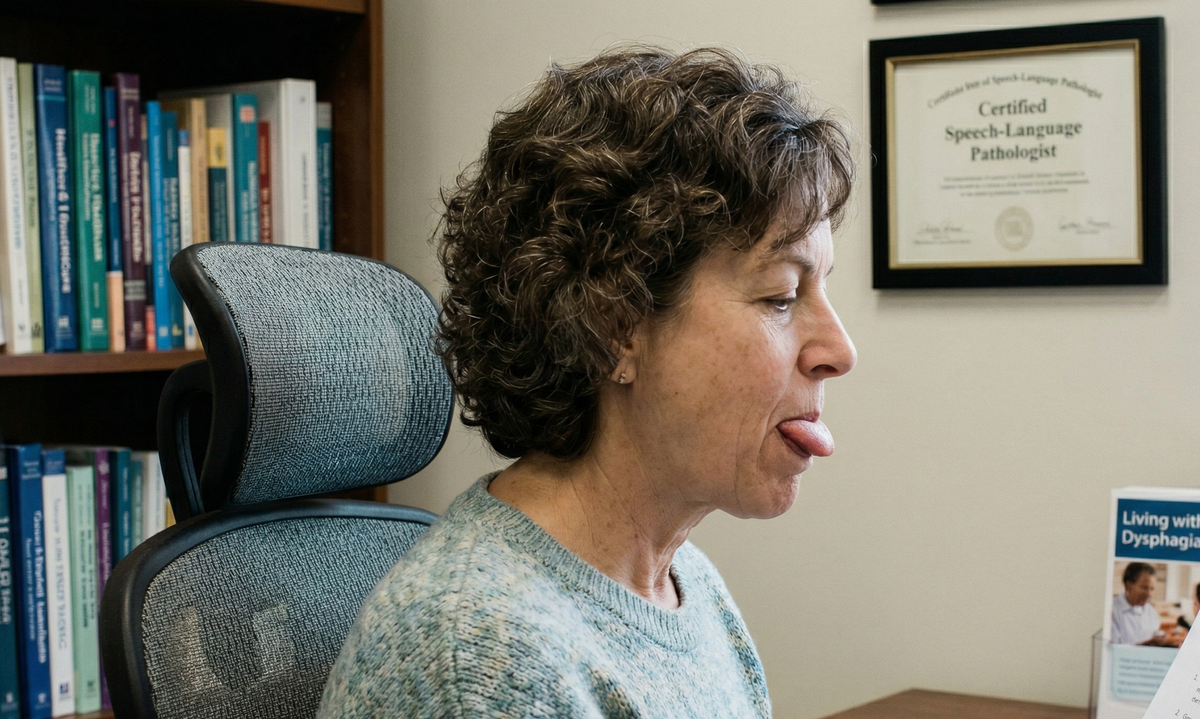
- Protrude the tip of your tongue slightly between your front teeth.
- Gently bite down on your tongue to hold it firmly in place.
- Attempt to swallow your saliva while maintaining your tongue's position. You should feel a strong "pull" in the back of your throat.
- Perform 5 to 10 repetitions per set. Like any strength training, the goal is to reach mild muscle fatigue.
Why It Works for Dysphagia
The Masako Maneuver is a staple in swallow therapy because it addresses the physics of a safe swallow:
- Compensatory Hypertrophy: Since the tongue cannot move backward to help, the muscles of the pharyngeal wall must bulge forward more aggressively to complete the swallow.
- Pharyngeal Pressure: Over time, this increases the pressure used to clear food, reducing the "stuck" feeling many patients experience after a meal.
- Safety First: Because this maneuver narrows the airway slightly, it must never be performed with food or liquid. It is a gym workout for your throat, not a way to eat.
Note: This exercise should be performed under the guidance of a Speech-Language Pathologist (SLP) to ensure it is appropriate for your specific swallow physiology.