The Masako Maneuver Dysphagia Exercises
The Masako Maneuver is a targeted rehabilitative exercise designed to close that gap by forcing the throat muscles to work harder. By anchoring the tongue forward, you are essentially "weightlifting" with your pharyngeal constrictors.

For patients living with dysphagia (difficulty swallowing), the act of eating can feel like a mechanical failure. Often, this is due to a "weak" swallow—where the base of the tongue doesn't retract far enough to meet the back of the throat (the pharyngeal wall). This gap prevents food from being pushed down efficiently, leading to residue left in the throat or, worse, aspiration.
The Masako Maneuver is a targeted rehabilitative exercise designed to close that gap by forcing the throat muscles to work harder. By anchoring the tongue forward, you are essentially "weightlifting" with your pharyngeal constrictors.
Who This Exercise Is Actually For
The Masako Maneuver is specifically designed for people whose dysphagia stems from reduced pharyngeal wall contraction — meaning the back of the throat doesn't squeeze firmly enough during swallowing. It's commonly prescribed after stroke, head and neck cancer treatment, or age-related muscle weakening (presbyphagia).
It is not appropriate for everyone. People with cervical spine issues, significant jaw pain, or certain post-surgical anatomies may not be suitable candidates. If you haven't been assessed by an SLP, this exercise is not something to start independently — the mechanism that makes it effective (narrowing the pharynx during the swallow) is also the reason it can be harmful if used incorrectly.
How to Perform the Masako Maneuver
This exercise is a "dry" swallow technique, meaning it is performed without any external bolus.
- Sit upright with your shoulders back.
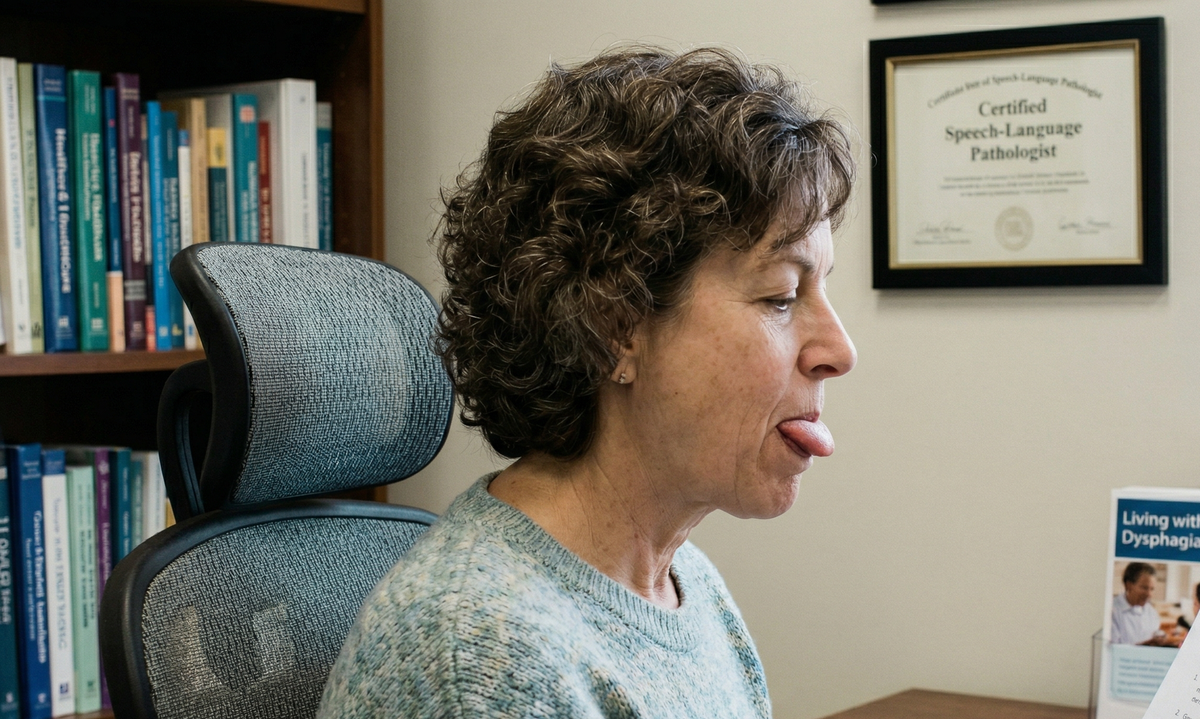
- Protrude the tip of your tongue slightly between your front teeth.
- Gently bite down on your tongue to hold it firmly in place.
- Attempt to swallow your saliva while maintaining your tongue's position. You should feel a strong "pull" in the back of your throat.
- Perform 5 to 10 repetitions per set. Like any strength training, the goal is to reach mild muscle fatigue.
How the correct way should feel like:
On the first few attempts, many people feel the pull only faintly or not at all — this usually means the tongue isn't held far enough forward. The target sensation is a distinct, effortful tightening at the very back of the throat, almost like the feeling of suppressing a gag. Mild muscle fatigue after a set of 10 is the goal. If you feel nothing, recheck your tongue position.
What to watch for as a caregiver:
If you're supporting someone through this exercise, correct form is visible: the tongue tip should be lightly but clearly held between the teeth throughout the swallow, and the person's throat should visibly tighten. Excessive jaw tension, the tongue pulling back before the swallow completes, or any coughing during the exercise are signals to pause and check with the treating SLP.
How long until it works?
Research suggests that consistent practice over 6–8 weeks begins to produce measurable changes in pharyngeal wall movement. Most SLP programmes prescribe the Masako alongside other exercises (such as the Shaker or Effortful Swallow) rather than as a standalone intervention — it targets one specific muscle group, and a full swallow involves many.
Progress is typically measured through follow-up clinical swallowing assessments, not by how eating feels day to day. It's common to feel no subjective difference for several weeks, even when objective improvement is occurring.
Why It Works for Dysphagia
The Masako Maneuver is a staple in swallow therapy because it addresses the physics of a safe swallow:
- Compensatory Hypertrophy: Since the tongue cannot move backward to help, the muscles of the pharyngeal wall must bulge forward more aggressively to complete the swallow.
- Pharyngeal Pressure: Over time, this increases the pressure used to clear food, reducing the "stuck" feeling many patients experience after a meal.
- Safety First: Because this maneuver narrows the airway slightly, it must never be performed with food or liquid. It is a gym workout for your throat, not a way to eat.
Combining With Other Exercises
The Masako is rarely prescribed in isolation. The Masako Maneuver is frequently paired with exercises like the Effortful Swallow (which targets overall swallowing pressure) and the Shaker Exercise (which strengthens the suprahyoid muscles). Your SLP will typically design a programme that targets multiple aspects of your swallow pattern rather than relying on one exercise alone.
Note: This exercise should be performed under the guidance of a Speech-Language Pathologist (SLP) to ensure it is appropriate for your specific swallow physiology.
References
Byeon, H. (2016). Effect of the Masako maneuver and neuromuscular electrical stimulation on the improvement of swallowing function in patients with dysphagia caused by stroke. Journal of Physical Therapy Science, 28(7), 2069–2071. NCBI
Kamalakannan, S., & Renuka, V. (2024). Effect of Masako maneuver along with orofacial exercise on swallowing ability and quality of life in subjects with post-stroke dysphagia. International Journal of Physiotherapy and Rehabilitation Sciences. Researchgate
Lazarus, C. L. (2013). The efficacy of the Masako (tongue-hold) maneuver: A pilot study [Thesis, Boston University]. OpenBU. BU.edu
Ni, B.-Y., Jin, H.-P., & Wu, W. (2024). Therapeutic effects of deep pharyngeal electrical stimulation combined with modified Masako maneuver on aspiration in patients with stroke. NeuroRehabilitation, 54(3). doi.org
Pryor, J. (2013, updated 2024). The Masako maneuver. National Foundation of Swallowing Disorders. National Foundation of Swallowing Disorder