
SavvyBloom Dysphagia Cup Review: Should You Buy It?
A full review of the SavvyBloom dysphagia cup, one of the most functional dysphagia cups you can find.

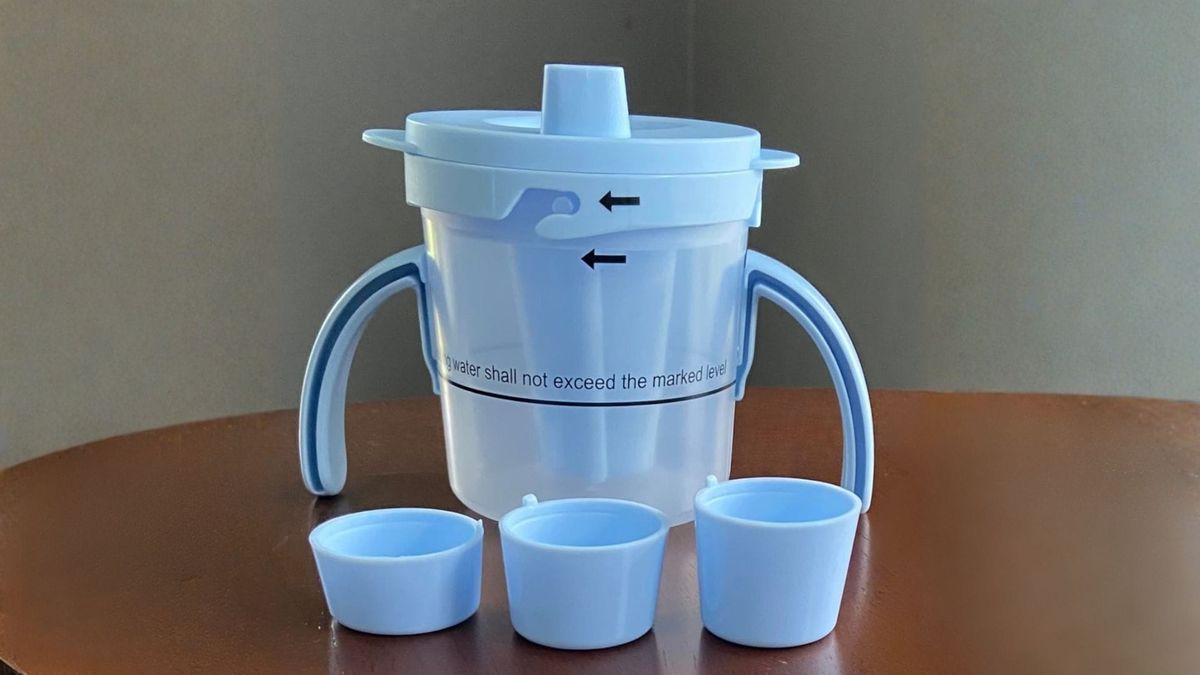
From our first dysphagia cup recommendations article, one of the most-asked-about products among our readers is the SavvyBloom Dysphagia Cup.
Let's review all the pros and cons of this particular dysphagia cup and whether it is worth buying.
| Best for | Moderate dysphagia, caregiver-assisted drinking |
| IDDSI levels | Works well for Levels 3–5 |
| Capacity | 7.4 oz |
| Rating | ⭐⭐⭐⭐ 4.1/5 |
| Buy if | You need flow control + caregiver handles |
| Skip if | The person drinks independently or needs larger volume |
Here is what we liked about it
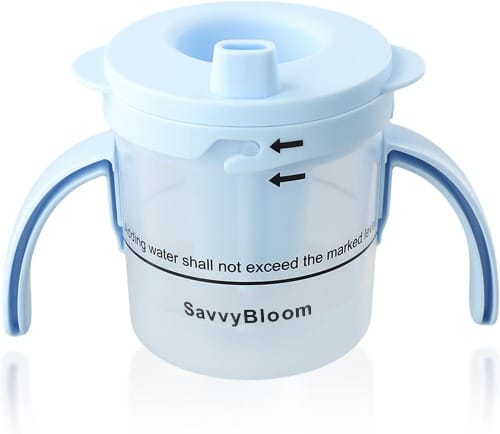
Looking modest and a bit "unconvincing" with its pale blue and transparent colors, SavvyBloom Sippy Cup is actually one of the most functional dysphagia cups you could find.
The design is mindful, with a nose-rest on top of the cup so the cup fits neatly, making it leak-proof and protecting against spills into the nostrils.
Understanding the flow regulators
The three small insert cups that come with the SavvyBloom are the feature that sets it apart from a regular sippy cup — and the one most caregivers don't fully understand until they've used them.
Here's how they work: each regulator sits inside the main cup and acts as a reservoir. When you tilt the cup, only the liquid held inside the regulator reaches the spout — nothing more. Tilt it back upright, and it refills for the next sip. You're not restricting flow so much as you're controlling sip volume, which is a meaningful distinction.
What does each size actually look like?
- 5cc is roughly one teaspoon. Think of it as a very cautious, controlled sip — about the amount of liquid you'd offer on a spoon. This is the starting point for anyone with significant swallowing difficulty.
- 10cc is closer to two teaspoons — a small but more comfortable sip for most adults, and the size many caregivers settle on for daily use.
- 15cc is about one tablespoon — a normal-sized sip for someone with mild to moderate difficulty who still needs some flow control.
Which regulator matches which IDDSI level?
The cup doesn't come with IDDSI guidance, so here's a practical starting point — though always defer to your speech-language pathologist's recommendation:
| Regulator | Suggested starting point |
|---|---|
| 5cc | Moderate to severe dysphagia; IDDSI Levels 0–1 (thin to slightly thick liquids that move fast and are hard to control) |
| 10cc | Mild to moderate dysphagia; IDDSI Levels 1–2 |
| 15cc | Mild difficulty or late-stage recovery; IDDSI Level 2–3 |
Does it actually reduce aspiration risk?
This is important to be honest about: the regulators slow and limit the volume of each sip, which gives the swallowing reflex more time to engage. That helps. But the cup does not thicken liquid, and it doesn't compensate for a severely delayed swallow reflex on its own. It's a mechanical aid, not a clinical intervention. If your loved one has been prescribed thickened liquids by an SLP, you still need to thicken the liquid before pouring it into this cup — the regulator and thickener work together, not instead of each other.
What you only learn from actually using it
In the hand
The cup is light — almost surprisingly so for something with three handles. For someone with limited grip strength, that's a genuine advantage; there's very little weight to manage. The handles are positioned at different heights, which means you can attach whichever one works best for your loved one's reach and strength. In practice, most people end up using just the middle handle or having the caregiver hold the outer ones during assisted drinking.
One thing to mention: the handles clip on with a slight snap, and getting that alignment right the first couple of times takes a minute. Once you've done it a few times, it becomes automatic, but if dexterity is an issue for the caregiver as well, budget a little extra patience at first.
Washing and durability
The cup is machine washable up to 60°C — so a normal dishwasher cycle is fine, but avoid high-heat or sanitising settings. The regulator inserts are small and can get lost easily if they go in loose on the top rack. A mesh laundry bag or dedicated small-parts basket in the dishwasher is worth it. After repeated washing, the insert cups hold up well — no warping reported with normal use.
The nose nook in practice
The nose nook on the lid is genuinely useful, but it works best when the person is sitting upright or at a 45-degree incline. For someone who is fully reclined in bed, the angle of the cup changes, and the nook offers less benefit. In that position, a caregiver needs to be more deliberate about tilting slowly and waiting between sips. The cup was clearly designed with a hospital chair or dining chair position in mind — worth knowing before you rely on it for bedside use.
The lid
And the last part about potential extra support with this cup. Some might find the lid a bit fiddly to attach securely. This is real, especially in the early days. The trick is to align the lid flat before pressing down — if you try to press one side first, it won't seal properly. Once you know this, it stops being a problem. But it's not intuitive, and the instructions don't explain it.
One honest note to add:
Every person's swallowing pattern is different. What works seamlessly for one person may need adjustment for another. If you're unsure which regulator size to start with, ask your SLP to trial it during a session — most are happy to test equipment in clinic before you commit to using it at home.