Adaptive Eating Utensils for Dysphagia: What Can Help at Mealtimes and What to Buy
Review of 9 adaptive eating utensils, from maroon spoons to weighted cutlery & red plateware for dementia and dysphagia patients.

The first mealtime after my mother's dysphagia diagnosis, I put the food in front of her and handed her a standard teaspoon. She picked it up, filled it, and spilled half of it before it reached her mouth. Her hand was shaking from the stroke. The spoon was too deep. The bowl was too light. The plate slid across the table when she tried to push food onto the spoon.
I replaced the teaspoon the next day. Then the plate. Then the bowl. It took several weeks and several wrong purchases before we had a setup that actually worked. This guide is what I wish had existed at the beginning.
Adaptive eating equipment doesn't replace the clinical management of dysphagia — the IDDSI level, the thickened drinks, the positioning. But the right equipment makes safe mealtimes significantly easier, for both the person eating and the caregiver supporting them. The wrong equipment — or the use of standard equipment when adaptive equipment is needed — adds difficulty and risk to every meal.
Before You Buy: Two Things to Know
Adaptive equipment addresses the motor side of eating, not the swallowing side. A maroon spoon helps someone with poor lip closure safely get food off the spoon. It does not address what happens once the food is in the mouth. The IDDSI level prescribed by the SLP addresses the swallowing side. Both matter, and neither replaces the other.
An occupational therapist is the right clinical contact for equipment recommendations. If your loved one was discharged from the hospital after a stroke or neurological event, an OT assessment may have been offered — or can be requested. An OT can assess grip strength, hand control, and arm mobility, and recommend specific equipment far more precisely than a general guide. This article gives you a practical starting point. An OT gives you the individualised answer.
Spoons — The Most Important Piece of Equipment for Level 3–4 Dysphagia
For anyone eating at IDDSI Level 3 (Liquidised) or Level 4 (Puréed), the spoon is the primary utensil — more important than the plate, the bowl, or anything else on the table. The wrong spoon adds difficulty. The right spoon removes it.
1. Maroon Spoon — Dysphagia-Specific Shallow Bowl
The maroon spoon is the most clinically specific item in this guide. It was designed specifically for feeding therapy — not as a general adaptive utensil, but as a tool that addresses the specific oral motor challenges that accompany dysphagia.
What makes it different from a standard teaspoon:
A standard teaspoon has a bowl that is too wide and too deep — it loads more food than the mouth can manage safely in one bolus, and the depth makes it hard to slide food off cleanly with the lips. The maroon spoon's narrow, shallow bowl holds approximately half a teaspoon — a controlled, manageable amount — and the flat profile allows food to slide off easily with minimal lip pressure.
Who it helps most:
- People with poor lip closure — the most common oral motor challenge after stroke
- People with tongue thrust or oral hypersensitivity
- Anyone where controlling the amount of food per bite is a safety priority
- People at IDDSI Level 4 (Puréed), where the bolus size directly affects swallowing safety
Available in two sizes: Small (slightly less than ½ teaspoon) for assessment or early feeding; Large (slightly more than ½ teaspoon) for daily use. The long handle allows for caregiver-assisted feeding at a comfortable distance.
Important note: The maroon spoon is durable plastic — it can withstand rough biting. It is not recommended for people with a severe bite reflex.
Best for: Level 4 puréed diet, post-stroke oral motor challenges, caregiver-assisted feeding, early stages of dysphagia management.
Watch out for: The shallow bowl means less food per bite — meals take longer. This is by design, not a flaw. Build extra time into mealtimes rather than loading the spoon to compensate.
2. Weighted Spoon Set — For Tremors and Parkinson's
For someone with dysphagia alongside hand tremors — whether from Parkinson's disease, essential tremor, or post-stroke — the standard challenge is that the food falls off the spoon before it reaches the mouth. A weighted spoon addresses this by adding enough mass to the utensil that the tremor's effect on the spoon head is reduced.
How it works: Each piece in the set weighs approximately 7 ounces — significantly heavier than a standard spoon. The extra weight provides resistance against the tremor motion, keeping the spoon head more stable during the journey from plate to mouth. A 2019 PubMed study comparing five types of adaptive utensils for people with Parkinson's and essential tremor found that participants preferred the weighted spoon with standard handle — rating it highest for performance, neatness, and ease of use alongside the electronic stabilising option.
What's included: Typically a 4-piece set — tablespoon, soup spoon, fork, and knife. The soup spoon has a deep bowl specifically to reduce spilling during the spoon-to-mouth movement.
Who it helps most:
- People with Parkinson's disease, particularly those with resting tremor affecting the dominant hand
- People with essential tremor
- Anyone where food consistently falls off the spoon between the plate and the mouth
- Post-stroke patients with residual hand tremor
Best for: Dysphagia alongside Parkinson's or essential tremor, self-feeding independence, Level 5–6 food textures where the person is using utensils independently.
Watch out for: The extra weight helps with tremor but can be tiring for someone with significant arm weakness or fatigue. If the person tires easily during meals, the weighted set may increase fatigue rather than reduce it — start with one meal and assess before committing to every mealtime.
3. Swivel / Angled Spoon — For Limited Wrist Mobility
The swivel spoon rotates 360° — the spoon head stays level regardless of how the wrist and hand are positioned during the movement from plate to mouth. This addresses a specific problem: someone who can grip and move a spoon but cannot rotate their wrist to keep the bowl of the spoon upright during the arm movement.
Who it helps most:
- People with limited wrist rotation after a stroke
- People with arthritis affecting wrist mobility
- Anyone who consistently tips the spoon during the arm movement to the mouth
What to look for: A 360° rotation with a smooth, low-resistance pivot. A non-slip handle. Dishwasher safe. Bendable models also allow the angle to be adjusted for left- or right-hand use or for specific reach requirements.
Best for: Level 5–6 textures where independent self-feeding is the goal and wrist mobility is the limiting factor.
Watch out for: The swivel mechanism needs regular cleaning — food residue in the pivot joint affects rotation. Check the manufacturer's cleaning instructions before purchasing.
Plates and Bowls — Keeping Food on the Plate and on the Spoon
The second most common mealtime problem after the wrong spoon is a plate that slides, a bowl that tips, or a flat surface that gives the person nothing to push food against when loading the spoon. All three are fixable with simple equipment.
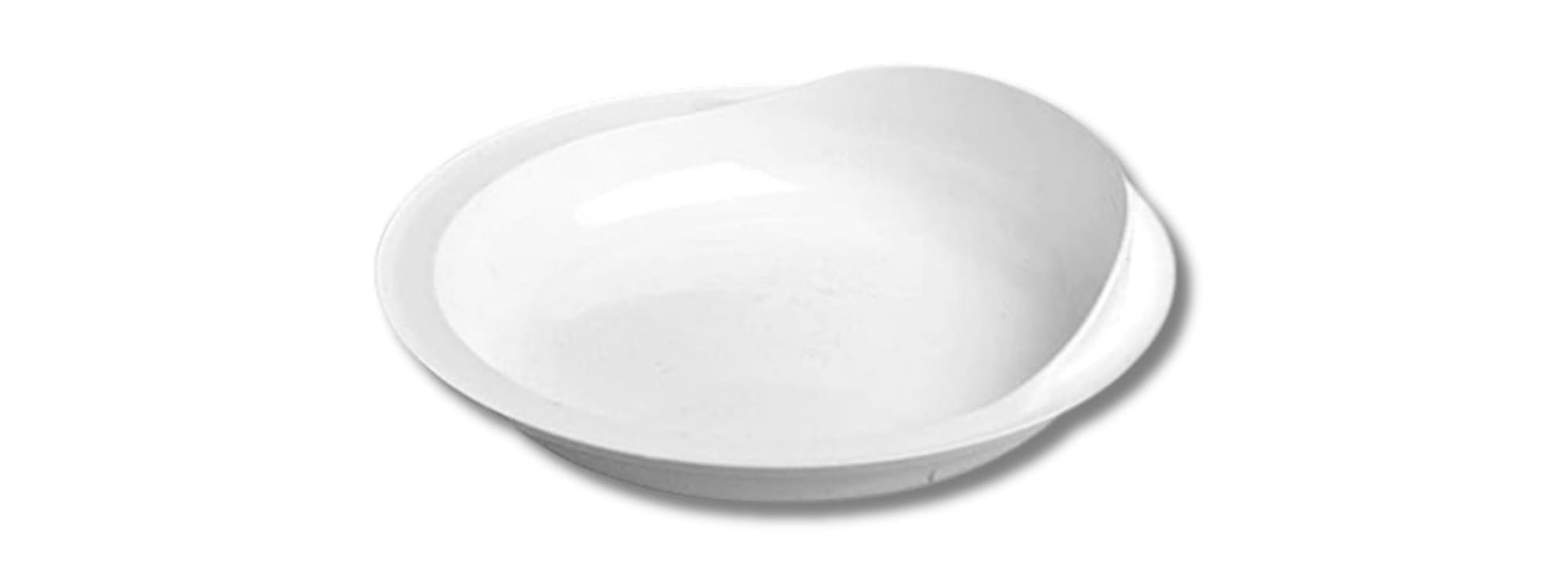
4. Scoop Bowl with Suction Base
The scoop bowl has two features that work together: a curved interior lip that allows food to be pushed against it and onto the spoon or fork, and a suction cup base that fixes the bowl to the table surface so it doesn't move during that pushing action.
Why the suction base matters: Loading a spoon requires pushing food against a surface. If the bowl moves every time the person pushes against it, independent self-feeding becomes significantly harder or impossible. The suction base removes that variable entirely — the bowl stays exactly where it is placed.
Who it helps most:
- People eating at IDDSI Level 5 (Minced and Moist), where loading a spoon requires pushing action
- People with one-handed function after a stroke — the suction base replaces the stabilising hand
- Anyone where the plate or bowl consistently sliding is causing difficulty or discouragement
Best for: Self-feeding at Level 5–6, one-handed function, anyone where bowl stability is a consistent problem.
Watch out for: The suction base requires a smooth, flat, clean table surface to work correctly. It will not adhere to textured surfaces, tablecloths, or place mats. Always place directly on a clean, smooth table.
5. Plate Guard — Clips Onto Existing Plates
A plate guard is a curved rim that clips onto the edge of a standard dinner plate — creating a raised surface the person can push food against to load a spoon or fork. It turns any plate into a scooping plate without replacing the plate itself.
Why this matters practically: The person can continue eating from their own plates — the same plates the family uses, in the same colours, in the same settings. This is a small dignity detail that is worth more than it might seem. A specialised medical-looking bowl signals a difference. A plate guard on a normal plate signals modification, not replacement.
Who it helps most:
- Anyone already using plates they're comfortable with, who needs a pushing surface added
- People eating at Level 5–6, where loading a fork or spoon from a flat plate is difficult
- Caregivers who want the most unobtrusive modification possible
Best for: Level 5–6 textures, maintaining normal mealtime appearance, and one-handed function.
Watch out for: The guard clips onto the plate rim — check that the clip fits the thickness of your existing plates before purchasing. Most standard dinner plates fit, but some designs with wide or narrow rims don't.
6. Non-Slip Dycem Mat
Dycem is a thin, brightly coloured non-slip material — placed under a plate or bowl, it prevents sliding on any table surface, including tablecloths and textured surfaces where suction bases don't work.
Why it's worth having even if you already have a suction bowl: The Dycem mat works under anything — plates, bowls, cups, cutting boards. It's the most versatile stability solution, and the one OTs most consistently recommend as a first purchase because it doesn't require the person to change their existing equipment at all.
It also works under the dysphagia cup — a flow-control cup that slides when pushed, creating difficulty even if the cup itself is correct. Dycem under the cup removes that variable.
Who it helps most:
- Anyone with one-handed function, tremor, or reduced arm strength who pushes equipment across the table
- Anyone on a tablecloth where suction bases are ineffective
- Caregivers who want one solution that works under everything
Best for: Universal use — under any plate, bowl, or cup at any IDDSI level.
Watch out for: Dycem needs to be rinsed regularly — food residue on the surface reduces its non-slip effectiveness. Rinse after each meal and allow to dry flat. Dishwasher safe on the top rack.
Utensil Handles — When Grip Is the Problem
For some people with dysphagia, the swallowing difficulty is the primary challenge. For others — particularly those with stroke, Parkinson's, arthritis, or general weakness — the grip challenge arrives alongside or before the swallowing difficulty. Standard utensil handles are narrow, smooth, and designed for a full-strength grip. Neither condition helps someone with reduced hand strength or reduced fine motor control.
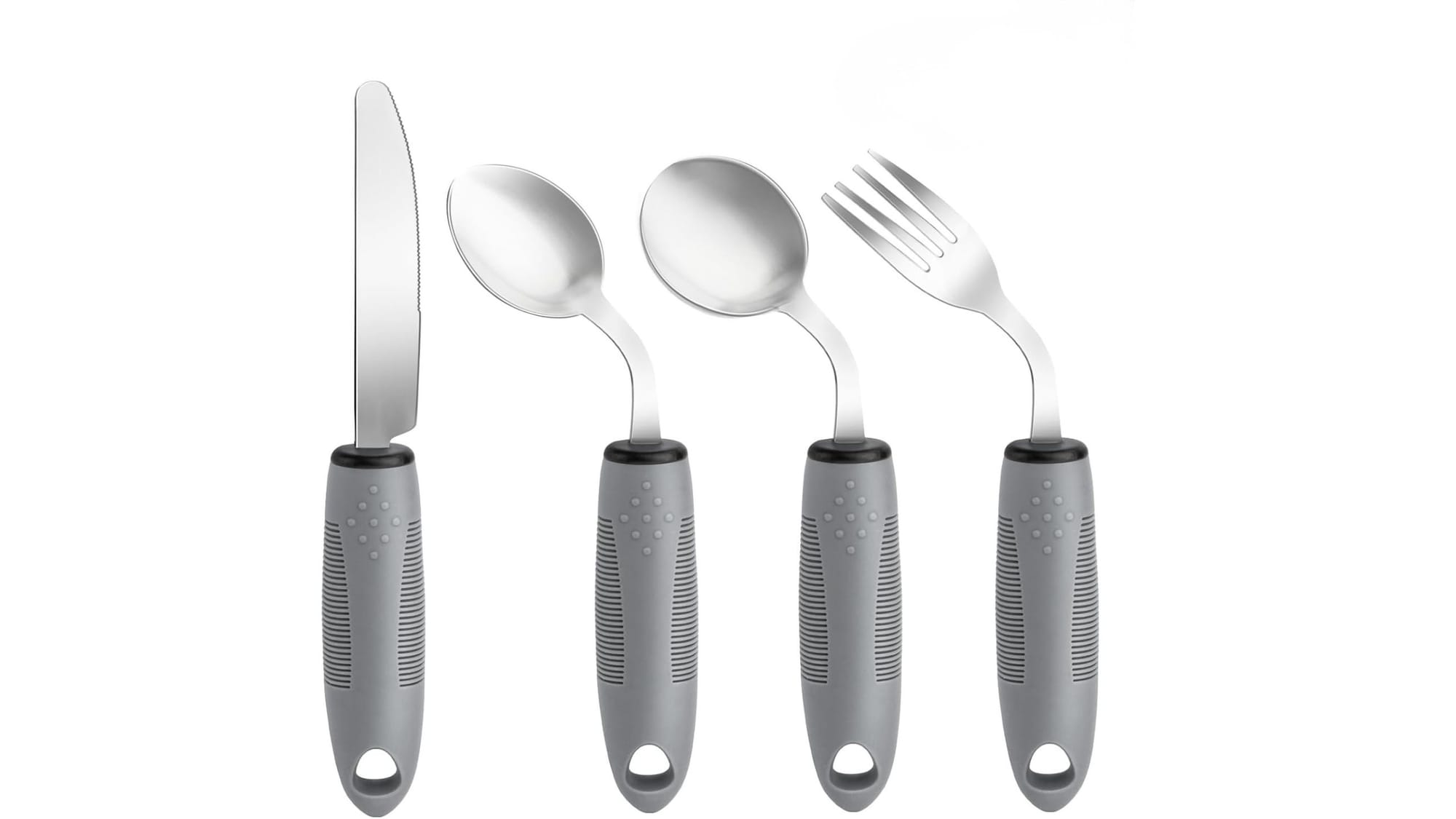
7. Built-Up Handle Cutlery Set
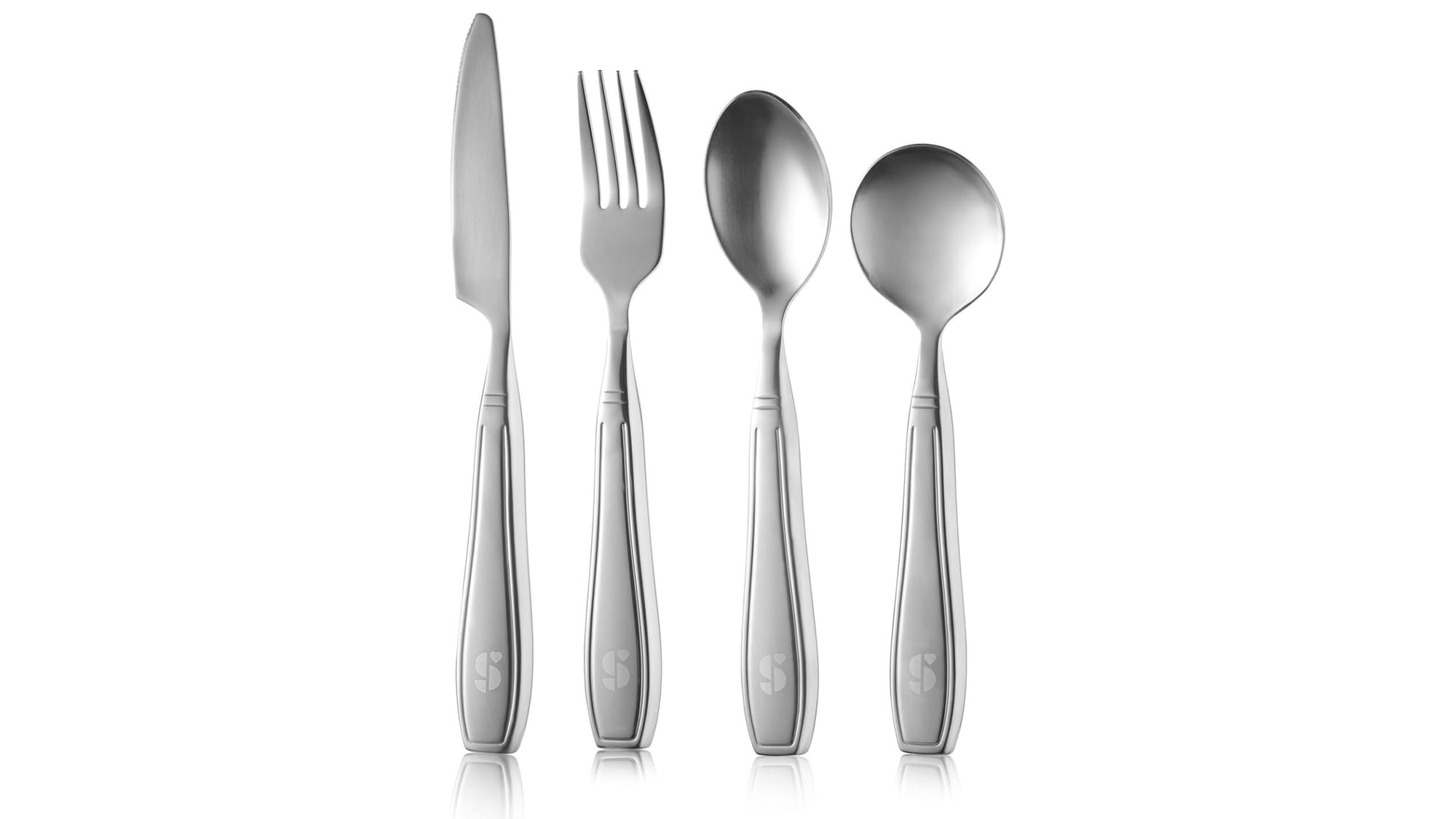
Built-up handle cutlery has wide, ergonomic, non-slip handles — typically 2–3 times the diameter of a standard utensil handle. The wider grip requires significantly less pinch strength and fine motor control to hold securely. The non-slip surface prevents the utensil from rotating in the hand during use.
What's included: Typically a 4-piece set — fork, knife, tablespoon, teaspoon. Some sets include a rocking knife — a curved blade that cuts with a rocking motion rather than a sawing motion, requiring less wrist control and less stabilising force from the other hand.
Who it helps most:
- People with arthritis — reduced joint stress from the wider grip
- People with reduced grip strength after a stroke
- People with reduced fine motor control from any cause
- Anyone who consistently drops standard utensils during meals
Best for: Level 5–7 textures where independent self-feeding is the goal and grip strength or fine motor control is the limiting factor.
Watch out for: Built-up handles work by reducing grip requirements — if the person has very severe grip loss or cannot hold any handle independently, a universal cuff or utensil holder that attaches the utensil to the hand may be more appropriate. Discuss with the OT.
8. Foam Tubing — DIY Built-Up Handles (Budget Option)
Foam tubing — the same material used in occupational therapy clinics worldwide — slides over any standard utensil handle, increasing its diameter without purchasing a new utensil set. It is the most cost-effective way to trial whether built-up handles help before committing to a full adaptive cutlery set.
How to use it: Cut a length of foam tubing and slide it over the handle of any standard spoon, fork, or knife. The foam compresses slightly on grip, providing both a wider surface area and a slightly cushioned, non-slip grip. Standard foam tubing diameter is approximately 1.6cm — fitting most standard cutlery handles.
Why this is worth mentioning even alongside the built-up handle set: The foam tubing allows you to adapt the person's existing cutlery — including the maroon spoon and weighted spoon above — rather than replacing them. A maroon spoon with foam tubing on the handle addresses both the oral motor challenge and the grip challenge simultaneously, with equipment the person is already familiar with.
Best for: Trialling built-up handles before purchasing, adapting existing preferred utensils, budget-conscious caregivers, anyone whose grip varies day to day and needs flexibility.
Watch out for: Foam tubing is not dishwasher safe and degrades with repeated washing. Replace every few months or when the foam becomes compressed or discoloured.
Specialty: Red Plateware for Dementia
This one is different from everything else in the article — it doesn't address motor function or grip. It addresses a cognitive and perceptual challenge specific to dementia.
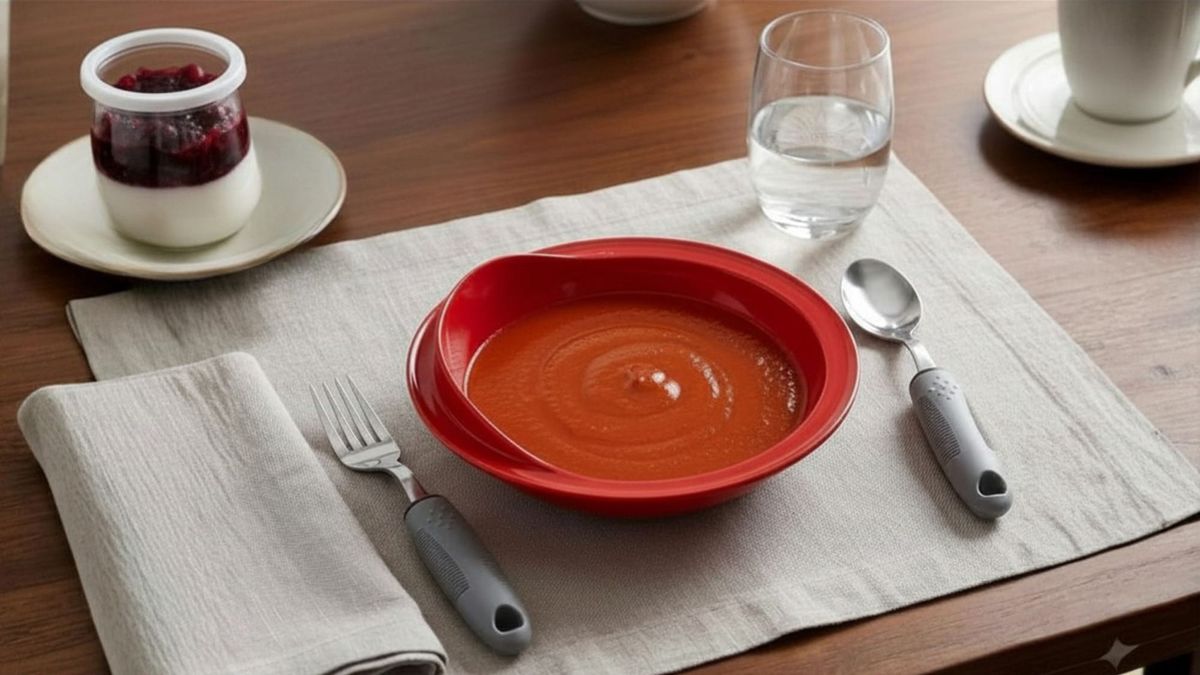
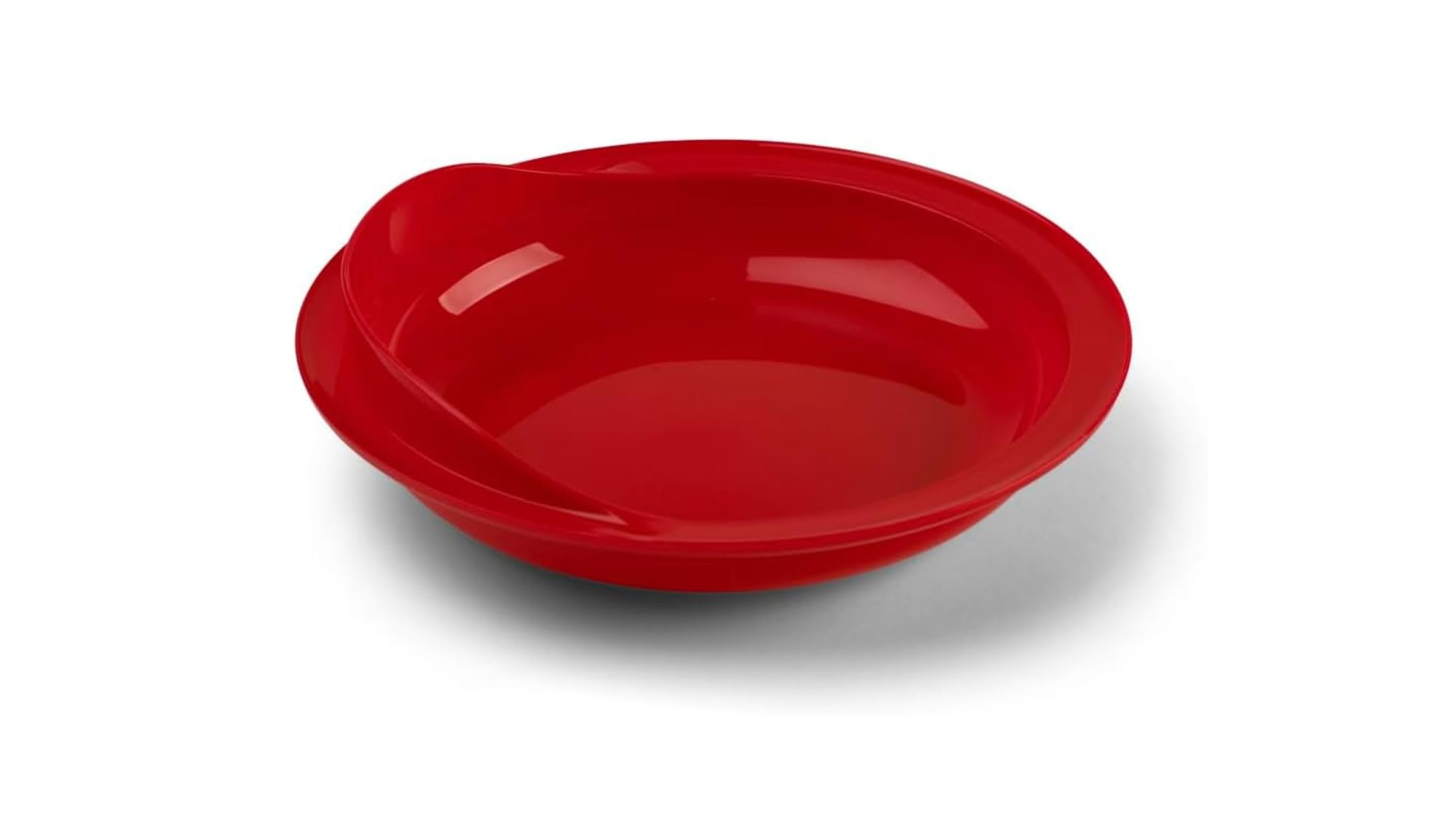
People with dementia frequently experience reduced appetite and reduced food intake — not always because they cannot eat, but because white or cream food on a white plate against a white tablecloth provides insufficient visual contrast for someone whose perceptual processing has been affected by dementia. The food and the plate effectively disappear into each other.
Research has shown that red plateware significantly increases food and drink intake in people with dementia — with some studies finding increases of up to 24% more food eaten and significantly more fluid consumed compared to standard white plates. The high contrast between the red plate and the food, and between the red cup and the drink, provides the visual cue that helps the person with dementia identify and engage with what is in front of them.
Who it helps most:
- People with dementia who are eating less than they should without a clear physical reason
- People with dementia who push food around the plate without eating it
- Anyone where reduced visual contrast is contributing to poor intake
Important note: Red plateware addresses visual contrast — it does not address IDDSI texture or swallowing safety. The food served on a red plate still needs to be at the correct IDDSI level. The plate changes what is seen; the IDDSI level changes what is safe to swallow.
Best for: Dementia and dysphagia combined — the combination we covered in our dementia and dysphagia guide.
Watch out for: Ensure the set is BPA-free and dishwasher safe. Check that the contrast is genuinely high — some "red" plateware is more terracotta or dark orange, which provides less contrast than true red.
Quick Reference: Which Equipment for Which Situation
| Problem at Mealtimes | Equipment | Link |
|---|---|---|
| Too much food per bite, poor lip closure, tongue control | Maroon Spoon | Amazon |
| Hand tremor — food falls off spoon | Weighted Spoon Set | Amazon |
| Can't rotate wrist to keep spoon level | Swivel / Angled Spoon | Amazon |
| Nothing to push food against when loading spoon | Scoop Bowl with Suction | Amazon |
| Wants to use existing plates, needs a pushing surface | Plate Guard | Amazon |
| Everything slides on the table | Non-Slip Dycem Mat | Amazon |
| Can't grip standard utensil handles | Built-Up Handle Cutlery | Amazon |
| Wants to try wider handles on existing utensils first | Foam Tubing | Amazon |
| Dementia — not engaging with food on the plate | Red Plateware | Amazon |
Frequently Asked Questions
Does adaptive equipment replace an occupational therapy assessment?
No — and if an OT assessment is available, it should come before purchasing equipment. An OT can assess grip strength, arm mobility, and fine motor control and recommend specific equipment matched to the individual's actual limitations. This guide is a practical starting point for caregivers who need to act before an OT appointment is available, or who want to understand the options before that conversation.
Can someone use more than one type of adaptive equipment simultaneously?
Yes — and most people do. A maroon spoon with foam tubing on the handle, served in a scoop bowl on a Dycem mat, is a complete setup that addresses oral motor control, grip, food pushability, and table stability simultaneously. The equipment works together.
Which item should I buy first?
The Dycem non-slip mat first — it is the most universally useful, the least expensive, and works under everything else. If a single piece of equipment makes mealtimes more manageable immediately, it is the mat. The spoon second — the maroon spoon for Level 3–4, the weighted spoon for anyone with tremor at Level 5–6.
Does the maroon spoon work for adults or is it designed for children?
Both. The maroon spoon is used in adult dysphagia management and feeding therapy. The large size is the appropriate choice for adults — the small size is designed for assessment situations or very early stages of oral feeding. The long handle on the large version works well for both self-feeding and caregiver-assisted feeding in adults.
Is weighted cutlery appropriate for someone with arm weakness?
Weighted cutlery helps with tremor by adding mass that resists the tremor motion. For someone with arm weakness rather than tremor, the extra weight may increase the effort required to lift the spoon — making fatigue worse rather than better. If tremor and weakness are both present, start with one meal using the weighted set and assess fatigue before using it at every mealtime. Discuss with the OT.
Can red plateware be used alongside a dysphagia cup?
Yes — red cups and mugs alongside red plates is the most consistent approach for someone with dementia. The same contrast principle that helps with food on the plate helps with drink in the cup. Our dysphagia cups guide covers the flow-control cup options that can be used alongside the red plateware.
References
Sharma, S., et al. (2019). Adapted feeding utensils for people with Parkinson's-related or essential tremor. PubMed. https://pubmed.ncbi.nlm.nih.gov/30915973/
Héroux, M. E., et al. (2019). Tremor control devices for essential tremor: A systematic literature review. PMC. https://pmc.ncbi.nlm.nih.gov/articles/PMC6898897/
Dunne, T. E., et al. (2004). Visual contrast enhances food and liquid intake in advanced Alzheimer's disease. Clinical Nutrition, 23(4), 533–538. https://doi.org/10.1016/j.clnu.2003.09.015
American Speech-Language-Hearing Association. (n.d.). Adult dysphagia (Practice Portal). https://www.asha.org/practice-portal/clinical-topics/adult-dysphagia/
National Foundation of Swallowing Disorders. (n.d.). Adaptive feeding devices for dysphagia management. https://swallowingdisorderfoundation.com/adaptive-feeding-devices/