
IDDSI Liquid Levels 0–4: What Each Level Is and Who Needs It
IDDSI liquid Levels 0–4 explained — what each consistency looks like, who is typically prescribed it, and what test confirms it at home.

When a speech-language pathologist hands you a discharge letter that says "Level 3 moderately thick liquids" — or when you hear the words "thickened drinks" for the first time — the immediate question is rarely "which thickener should I buy?"
It's "what does that actually mean?"
This page answers that question. What each IDDSI liquid level is, what it looks like in a glass, what test confirms it, and who is typically prescribed it — and why. The product and testing questions have their own dedicated guides. This one starts at the beginning.
What Are IDDSI Liquid Levels?
The IDDSI (International Dysphagia Diet Standardisation Initiative) framework classifies liquid consistency from Level 0 through Level 4. Drinks are measured from Levels 0 to 4, while foods are measured from Levels 3 to 7.
Each level describes a specific viscosity — how fast or slowly the liquid flows — and is identified by a number, a text label, and a colour code. The levels replace the old descriptive terms like "nectar-thick" and "honey-thick", which varied between countries, hospitals, and clinicians. Each level is based on evidence. The previous UK descriptors were based on a consensus of expert opinion, not research evidence.
The IDDSI liquid level is always prescribed by a speech-language pathologist following a formal swallowing assessment. It is not something to estimate, borrow from another person's prescription, or change without clinical review. If you don't know the prescribed level, the discharge letter or the treating SLP are the correct sources.
Why Liquid Consistency Matters
Thin liquids — plain water at Level 0 — flow very fast. For a healthy swallow reflex, that speed is manageable. For a compromised swallow reflex — after a stroke, with Parkinson's disease, in advanced dementia — thin liquid can move faster than the airway can close protectively, increasing the risk of aspiration.
Thickening a liquid slows its flow. A slower flow gives the swallow reflex more time to coordinate a safe response. The right level is the one that matches the speed the person's swallow reflex can reliably manage — not thicker than necessary, and not thinner than safe.
The framework is prescriptive, not restrictive. Patients should be prescribed all levels they can manage safely, which gives them a great variety of foods they can eat and drink and, as such, improves their quality of life.
The Five IDDSI Liquid Levels
Level 0 — Thin
Colour code: White
What it is: Unthickened liquid — plain water, juice, tea, coffee, milk exactly as they come. No modification needed. Level 0 is for thin liquids, such as water, milk, juice, coffee, tea, and soft drinks.
What it looks like: Flows freely and instantly when poured — exactly like water from a glass. No resistance, no coating, no slowing. Pours through a fork with no delay.
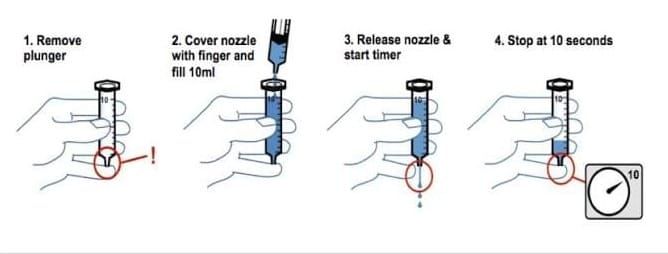
Syringe test: Less than 1ml remains in the syringe after 10 seconds of flow.
Who is prescribed Level 0:
Someone prescribed Level 0 for liquids has no liquid modification needed — their swallow reflex manages thin liquids safely. This may mean:
- They have dysphagia affecting food only — difficulty chewing or managing solid textures — but thin liquids pass safely
- They have recovered from dysphagia to the point where thin liquids are again safe
- They have never had a liquid swallowing difficulty — only a food texture difficulty
It's worth knowing that Level 0 is the hardest consistency for most people with dysphagia to manage — thin liquid flows fastest and gives the swallow reflex the least time to respond. Being prescribed Level 0 for liquids means the assessment confirmed the person can manage this speed safely. It is not the default — it is a clinical finding.
No thickener required at Level 0.
Level 1 — Slightly Thick
Colour code: Grey
What it is: Liquid that flows slightly more slowly than water — a barely detectable difference in most cases. Level 1 liquids are just slightly slower than water and might be prescribed if swallow coordination has been impacted.
What it looks like: Pours from a glass freely. Flows off a spoon in a continuous stream, very slightly slower than thin water. Still flows easily through a standard straw. The thickening is subtle — some people don't notice the difference immediately.
Syringe test: 1–4ml remains after 10 seconds.
Real-world examples of naturally Level 1 liquids: Tomato juice, eggnog, some meal replacement drinks, some thicker fruit nectars.
Who is prescribed Level 1:
Level 1 is typically prescribed for people with mild swallowing difficulty — where the swallow reflex is present and functional but slightly delayed, and thin liquid at full speed creates occasional difficulty. Common clinical profiles:
- Mild post-stroke dysphagia where the swallow reflex has mostly recovered but thin liquid occasionally causes coughing or throat clearing
- Early Parkinson's disease where swallow timing is slightly affected but not significantly impaired
- Age-related swallowing changes (presbyphagia) where the slight delay in reflex initiation makes thin liquid borderline unsafe
The prescription for Level 1 often comes with a note to review — as a transitional level between thin and mildly thick, it is frequently a step either downward from Level 2 as someone recovers, or upward from Level 0 as someone's condition progresses.
Level 2 — Mildly Thick
Colour code: Pink-red
What it is: Liquid that flows noticeably more slowly than water — a visible difference when poured from a spoon. Level 2 liquids are moving more slowly to provide extra control.
What it looks like: Pours in a slow, steady ribbon from a tilted spoon rather than a fast stream. Flows off a spoon continuously but slowly. Requires some effort to draw through a standard straw — flows more easily through a wide-bore straw. Still clearly pourable and drinkable from a cup.
Syringe test: 4–8ml remains after 10 seconds.
Real-world examples: No common drink is naturally Level 2 without thickener. Standard commercial thickener added to water, juice, or a hot drink at the manufacturer's Level 2 dose is the most common source.
Who is prescribed Level 2:
Level 2 is one of the most commonly prescribed liquid levels alongside Level 3. It is typically prescribed for people where thin liquids are clearly unsafe but only moderate thickening is required for safe swallowing. Common clinical profiles:
- Post-stroke dysphagia at a moderate stage — the swallow is functional but needs more time than thin liquid allows
- Parkinson's disease at a stage where swallow timing impairment is consistent and measurable
- Head and neck cancer affecting swallowing structures — where reduced sensation or movement requires a slower-moving liquid to allow safe triggering of the swallow
- Multiple sclerosis or other neurological conditions affecting swallow coordination
Level 2 is often a long-term prescription for stable conditions — it provides enough control without the palatability challenges of Level 3.
Level 3 — Moderately Thick
Colour code: Yellow
What it is: The thickest drinkable liquid consistency — slow-moving, dripping rather than flowing, but still able to be consumed from a cup. Level 3 is described as moderately thick — the same consistency as liquidised food.
What it looks like: Does not pour from a spoon in a continuous stream — instead drips slowly through fork prongs in separate dollops. Can be drunk from a cup but slowly and with effort. Cannot be drawn through a standard straw. Coats the back of a spoon noticeably.
Syringe test: 8ml or more remains after 10 seconds — significantly more than Levels 1 and 2.
Fork drip test: Dip a fork, lift horizontally. Slow, separate dollops fall through the prongs — not a continuous stream and not staying on the fork.
Real-world examples: Smooth drinking yogurt, some very thick smoothies (test to confirm), commercial thickener at the Level 3 dose in water or juice.
The Level 3 overlap: Level 3 is the only IDDSI level that covers both a liquid consistency (moderately thick) and a food texture (liquidised). A Level 3 thickened drink and a Level 3 liquidised food — such as smooth blended soup — test identically. This does not mean they are the same thing, or that the same number automatically applies to both. The food and liquid levels are always prescribed separately. Our IDDSI Food and Liquid Levels Guide covers this distinction in full.
Who is prescribed Level 3:
Level 3 is typically prescribed for people with moderate to moderately severe dysphagia where Level 2 is insufficient to prevent aspiration on instrumental assessment. Common clinical profiles:
- Post-stroke dysphagia where VFSS or FEES assessment confirmed aspiration of Level 2 liquid
- Parkinson's disease at a stage where swallow initiation is significantly delayed
- Dementia with significant swallowing impairment — where the cognitive component of managing liquid adds to the physical swallowing difficulty
- ALS/MND with bulbar involvement — where significant pharyngeal muscle weakness requires slow-moving liquid
- Head and neck cancer affecting swallowing significantly
Level 3 is the level most likely to be refused — the significant change in texture and the impact on palatability means drink refusal is a genuine clinical concern. Our thickened drink refusal guide covers this in detail.
Level 4 — Extremely Thick
Colour code: Pink
What it is: The thickest IDDSI liquid level — a consistency that holds shape completely and does not flow at all. Level 4 fluids have the same consistency as pureed foods.
What it looks like: Holds shape on a spoon — does not pour or flow when the container is tilted. Falls off a spoon in one movement rather than dripping through it. Cannot be drunk from a cup or straw — taken with a spoon. At this level, the liquid behaves like food in its delivery.
Syringe test: Does not flow — 10ml or close to it remains after 10 seconds.
Spoon tilt test: Load a teaspoon and tilt sideways. Level 4 slides off in one slow, cohesive movement — it does not pour.
Real-world examples: Very thick smooth custard, smooth hummus, thick smooth yogurt. Level 4 liquid typically requires a maximum dose of commercial thickener.
The Level 4 overlap: Like Level 3, Level 4 covers both a liquid consistency (extremely thick) and a food texture (puréed). An extremely thick drink and a puréed food test identically with the spoon tilt test. Again — the same number does not automatically mean both food and liquid are prescribed at Level 4. The food texture level is always assessed and prescribed separately.
Who is prescribed Level 4:
Level 4 liquid is a relatively uncommon prescription — most people requiring significant thickening are prescribed Level 3. Level 4 liquid is typically reserved for people where the VFSS or FEES assessment confirmed that even moderately thick liquid at Level 3 causes aspiration. Common clinical profiles:
- Severe post-stroke dysphagia with significant pharyngeal weakness confirmed on instrumental assessment
- Advanced ALS/MND with significant bulbar involvement — where only spoon-fed liquid can be managed safely
- Severe structural dysphagia following head and neck surgery
Level 4 liquid carries the highest palatability challenge — it is effectively a puréed food served in a cup. For people prescribed Level 4, maintaining adequate hydration is a significant clinical priority, and the involvement of a dietitian alongside the SLP is typically recommended.
Quick Reference: All Five Levels at a Glance
| Level | Name | Colour | What It Looks Like | Syringe Test | Taken With |
|---|---|---|---|---|---|
| 0 | Thin | White | Flows freely like water | Less than 1ml remains | Cup or straw |
| 1 | Slightly Thick | Grey | Flows slightly slower than water | 1–4ml remains | Cup or straw |
| 2 | Mildly Thick | Pink-red | Pours in a slow steady ribbon | 4–8ml remains | Cup or wide straw |
| 3 | Moderately Thick | Yellow | Drips in slow dollops through a fork | 8ml or more remains | Cup — slowly |
| 4 | Extremely Thick | Pink | Holds shape on a spoon — does not pour | Does not flow | Spoon only |
How the Level Is Determined
The IDDSI liquid level is prescribed by a speech-language pathologist following a formal swallowing assessment. The assessment may include:
A clinical swallowing evaluation — the SLP observes the person swallowing different consistencies and assesses the safety and efficiency of the swallow.
Instrumental assessment — a VFSS (videofluoroscopic swallowing study) or FEES (fiberoptic endoscopic evaluation of swallowing) that directly observes the airway during swallowing. This is the most accurate way to identify which liquid level is safe — including whether silent aspiration is occurring. Our swallowing assessment guide explains what both tests involve.
The level may change over time — improving as someone recovers post-stroke, or progressing to a lower level as a neurological condition advances. Regular SLP review is the appropriate way to manage this — not independent adjustment at home.
How to Verify the Level at Home
The IDDSI syringe flow test is the validated home testing method for Levels 0–3. A 10ml BD Slip Tip syringe is filled, held horizontally for 10 seconds, and the amount of liquid remaining confirms the level. Our IDDSI syringe flow test guide covers the full process step by step with photos.
For Level 4, the spoon tilt test is the primary check — load a teaspoon and tilt sideways. Level 4 slides off in one cohesive movement.
Always test at serving temperature — not preparation temperature. Starch-based thickeners in particular continue thickening as they cool. A drink that tests correctly at 65°C immediately after mixing may be a level thicker by the time it reaches the table at 45°C.
Which Thickener Achieves Each Level
Not all thickeners achieve all levels with equal reliability. Our thickener comparison guide covers the main commercial options at each level — starch-based, xanthan gum-based, and gel format — with honest notes on which works best for which drink type and which level.
The short version:
- Levels 1–2: Both starch and gum-based thickeners work well. Gum-based products are more consistent and stay clear.
- Level 3: Gum-based thickeners are significantly more reliable — starch-based products can overshoot or undershoot at this level depending on temperature and drink type.
- Level 4: Maximum dose of either type. Always verify with the spoon tilt test — at this level, small dose variations produce significant consistency differences.
Which Cup Works at Each Level
The cup matters as much as the thickener at Levels 1–3. A flow-control cup limits the volume of liquid per sip regardless of how fast the person drinks — significantly safer than a standard cup for anyone on a moderate to significant liquid prescription.
Our dysphagia cups guide covers cup options by IDDSI level. Our flow-regulating cups comparison covers the four main flow-control options in detail.
Frequently Asked Questions
Who decides which IDDSI liquid level someone needs?
The IDDSI liquid level is prescribed by a speech-language pathologist following a formal swallowing assessment. It is not something to self-diagnose, borrow from another person's prescription, or estimate from a description. If the level is unclear from the discharge letter, contact the treating SLP directly.
Can someone be prescribed different levels for food and liquid?
Yes — and this is the norm. Food texture levels and liquid consistency levels are always assessed and prescribed separately. Someone can eat Level 6 Soft and Bite-Sized food while needing Level 3 moderately thick liquids — the two prescriptions address different aspects of swallowing function. Our IDDSI Food and Liquid Levels Guide explains all the common combinations.
What is the difference between moderately thick and extremely thick?
Level 3 (Moderately Thick) is the thickest drinkable consistency — it can still be consumed from a cup, slowly. Level 4 (Extremely Thick) does not flow at all and must be taken with a spoon. The distinction matters practically because someone on Level 3 can still drink from an appropriate cup; someone on Level 4 requires spoon feeding for all liquids.
Can the prescribed level change over time?
Yes — in both directions. Post-stroke dysphagia often improves in the first three to six months, and the level may be revised upward (from Level 3 to Level 2, for example) as swallowing recovers. Progressive neurological conditions like Parkinson's or ALS typically require progression to lower levels over time. Any change in the prescribed level must follow a formal SLP reassessment — not caregiver or family observation alone.
What if my loved one refuses thickened drinks?
Thickened liquid refusal is one of the most common and serious challenges in dysphagia management — particularly at Level 3 where the palatability impact is most significant. Our thickened drink refusal guide covers why refusal happens, what practically works, the Frazier Free Water Protocol, and when to escalate to the clinical team.
Is thin liquid (Level 0) the safest level?
No — this is a common misconception. Level 0 is the hardest consistency for most people with dysphagia to manage safely. Thin liquid flows fastest and gives the swallow reflex the least time to respond. Being prescribed Level 0 means the swallowing assessment confirmed it is safe for that specific person — it is not a default starting point.
What does the IDDSI colour coding mean?
Each IDDSI level has a designated colour that appears on the framework poster, individual level handouts, and many commercial dysphagia products. The colours allow quick identification of the prescribed level at a glance — particularly useful in care settings where multiple caregivers are involved. The IDDSI colour-coded poster and individual-level handouts are available free to download on our IDDSI printable resources page.
References
International Dysphagia Diet Standardisation Initiative. (2019, updated 2024). Complete framework and detailed definitions V2.2. https://www.iddsi.org/framework
Cichero, J. A. Y., Lam, P., Steele, C. M., et al. (2017). Development of international terminology and definitions for texture-modified foods and thickened fluids used in dysphagia management: The IDDSI framework. Dysphagia, 32(2), 293–314. https://doi.org/10.1007/s00455-016-9758-y
Royal College of Speech and Language Therapists. (2024). The IDDSI framework. https://www.rcslt.org/members/clinical-guidance/the-iddsi-framework/
GPnotebook. (2024, October). International Dysphagia Diet Standardisation Initiative (IDDSI). https://gpnotebook.com/pages/gastroenterology/international-dysphagia-diet-standardisation-initiative-iddsi
American Speech-Language-Hearing Association. (n.d.). Adult dysphagia (Practice Portal). https://www.asha.org/practice-portal/clinical-topics/adult-dysphagia/