Thickened Liquids for Dysphagia: IDDSI Levels, Textures, and Which Thickener to Use
A practical comparison of the 6 most used food thickeners for dysphagia — starch, xanthan gum, and gel formats — with honest notes on when each one works best.

Living with dysphagia or swallowing difficulties doesn't mean you have to compromise on enjoying meals and staying properly hydrated. Food thickeners have become essential tools for managing these challenges safely, and the dysphagia community has spoken about their favorite products this year.
The first thickener we tried turned my mother's morning tea into something that looked and tasted like wallpaper paste. It took three different products before we found one that actually worked for her — and the difference wasn't just preference. It was whether she stayed hydrated or not.
Most guides start with the products. This one starts with the levels — because knowing which IDDSI liquid level has been prescribed tells you exactly what consistency you're aiming for, which makes the product choice much simpler.
What Are Thickened Liquids?
Thickened liquids are drinks — water, juice, tea, coffee, milk — that have had a commercial thickener added to slow their flow. The thickener increases the viscosity of the drink, giving the swallowing reflex more time to respond safely before the liquid reaches the airway.
Thin liquids at Level 0 — plain water — are the hardest consistency for most people with dysphagia to manage. They flow too fast for a compromised swallow reflex to coordinate a safe response. Thickening slows that flow to a level the person can manage safely.
The IDDSI framework classifies liquid thickness from Level 0 (thin) to Level 4 (extremely thick). The level is prescribed by a speech-language pathologist following a formal swallowing assessment — it is not something to estimate or borrow from another person's prescription.
IDDSI Liquid Levels 0–4: What Each One Looks Like
This is the most practically useful section of this guide. Understanding what each level actually looks like — and what test confirms it — means you can verify at home that what you've prepared is correct before serving it.
Level 0 — Thin
What it looks like: Flows freely and instantly — exactly like pouring water from a glass. No resistance, no slowing, no coating of surfaces.
Real examples: Water, black coffee, black tea, apple juice, sports drinks, most alcoholic drinks, clear broth.
Who it's for: Someone with no liquid prescription — normal unthickened drinks. Also prescribed for people whose dysphagia affects food only and who manage thin liquids safely.
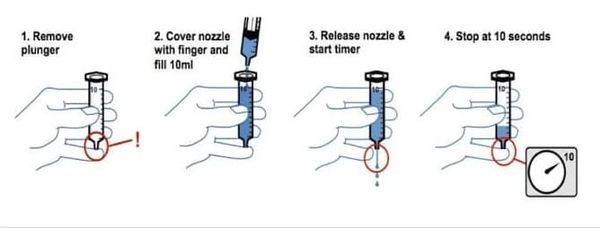
Syringe test: Less than 1ml remaining in the syringe after 10 seconds.
No thickener needed at this level.
Level 1 — Slightly Thick
What it looks like: Flows slightly slower than water — a barely noticeable difference. Pours freely but with a very slight resistance. Still flows easily through a standard straw.
Real examples: Tomato juice, some meal replacement drinks, eggnog, some thicker fruit juices. A few drinks are naturally at Level 1 without any thickener.
Who it's for: People who need minimal thickening — the swallow reflex needs just a little more time than thin liquid provides. Often prescribed after mild stroke or for early-stage neurological conditions.
Syringe test: 1–4ml remaining after 10 seconds.
Thickener approach: A very small amount of thickener — approximately half the standard dose for most products. The target is barely detectable thickening. Gum-based thickeners are more reliable at this level because the small dose is harder to control precisely with starch-based products.
Level 2 — Mildly Thick
What it looks like: Pours in a slow, steady ribbon from a spoon — noticeably thicker than water but still flows freely. Requires some effort to drink through a standard straw. Flows easily through a wide-bore straw.
Real examples: No common naturally occurring Level 2 drinks — this level requires a commercial thickener in most cases. Some thick smoothies may naturally reach Level 2 but must be tested to confirm.
Who it's for: People who need moderate thickening — the swallow reflex needs meaningfully more time than thin liquid provides but can still manage a drinkable consistency. One of the most commonly prescribed levels alongside Level 3.
Syringe test: 4–8ml remaining after 10 seconds.
Thickener approach: Standard dose according to manufacturer instructions for Level 2. Both starch and gum-based thickeners work well at this level — the choice comes down to preference, drink type, and budget.
Example products at this level:
- SimplyThick EasyMix Gel — gel format, clear result, consistent every time
- Thicken Up Clear — powder, stays clear, good in acidic drinks
- Thick-It Original — starch-based, affordable, widely available in pharmacies
1. SimplyThick EasyMix Gel Thickener
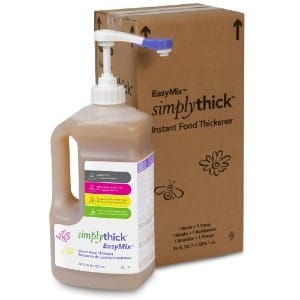
SimplyThick uses xanthan gum as its primary ingredient, making it a gel-based thickener that works instantly. This product is particularly good for people who need consistent, predictable results every time. The community recommends it because it doesn't continue thickening over time like starch-based products do, and it maintains clarity in beverages so you can still see what you're drinking.
Best for: people who need consistent results without measuring — particularly useful for caregivers managing multiple drinks per day, where dosing accuracy matters. Watch out for: the gel packets can be tricky to squeeze fully empty for people with reduced hand strength — press from the bottom of the packet upward to get every last drop. Practical note: the gel format means you can add it directly to a hot drink without the clumping risk that powder can occasionally cause. While gel-based thickeners do cost more per serving than powder alternatives, many users find the convenience and consistency worth the extra expense, especially for on-the-go situations.
2. Thicken Up Clear Instant Food & Drink Thickener
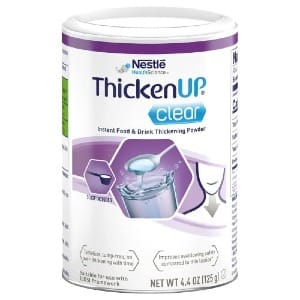
This xanthan gum-based powder thickener lives up to its name by keeping your beverages clear rather than cloudy. It's tasteless and odorless, which is excellent for maintaining the enjoyment of your meals. Compared to SimplyThick's gel format, this powder gives you more control over the exact consistency you need, making it easy to adjust to your personal preferences.
The instant mixing formula means you won't have lumps to worry about, and it remains stable in both hot and cold liquids. This versatility is particularly helpful with acidic drinks like orange juice or coffee, where some starch-based options might thin out slightly over time.
Best for: anyone who prioritises drink appearance — this is the thickener to use when the person is reluctant to drink thickened liquids because 'it looks wrong'. The drink genuinely looks normal. Watch out for: like all powders, it needs thorough stirring — add to the liquid first, then stir for a full 30 seconds before checking consistency. Practical note: performs particularly well in acidic drinks like orange juice, where starch-based alternatives would break down.
3. Thick-It Original Instant Food and Beverage Thickener (Non-Concentrated and Concentrated)
Thick-It Original is a modified cornstarch-based thickener that's been a trusted name in dysphagia management for years, and many people in the community appreciate its reliability and widespread availability.
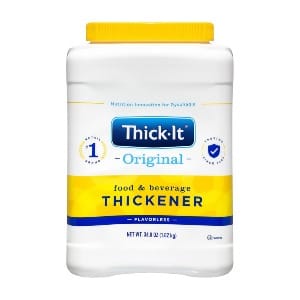
The non-concentrated version (the one with yellow packaging) is the original formula that's been helping people for decades. It comes in a generous 36-ounce canister and works beautifully for those new to using thickeners. It mixes smoothly without much effort, and you can find it in most pharmacies, making it convenient when you need a refill quickly.
Meanwhile, the concentrated version (the blue one) is a game-changer for regular users. Because it's more potent, you only need about half to two-thirds the amount of the non-concentrated version to achieve the same consistency.
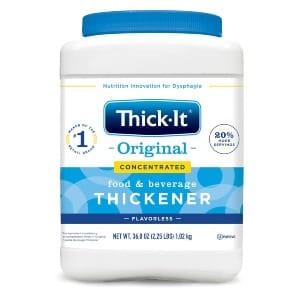
Both concentrated and non-concentrated are kosher/halal and gluten-free. They work well with hot and cold beverages, and the taste impact is minimal. The powder format also gives you flexibility to adjust consistency to your exact preferences.
Best for: budget-conscious long-term users and anyone who needs to buy from a physical pharmacy rather than online. The non-concentrated version is also the gentlest introduction for someone new to thickeners — the learning curve is forgiving. Watch out for: as a starch-based product, Thick-It continues thickening for up to 15 minutes after mixing — always prepare drinks slightly thinner than your target level and check again before serving. Practical note: the concentrated version is a significantly better value per serving but requires more precise measuring — a dedicated measuring spoon rather than a kitchen teaspoon makes a meaningful difference to consistency.
Level 3 — Moderately Thick
What it looks like: Drips slowly through fork prongs in separate dollops — not a continuous stream. Flows off a tilted spoon slowly. Can be drunk from a cup but slowly and with effort. Cannot be drawn through a standard straw.
Real examples: Smooth drinking yogurt, some thick smoothies (test to confirm), nectar. Most Level 3 drinks require a commercial thickener.
Who it's for: People who need significant thickening — thin or mildly thick liquids flow too fast for a safe swallow. Level 3 is the thickest drinkable consistency. One of the most commonly prescribed levels for moderate dysphagia.
Syringe test: 8ml or more remaining after 10 seconds.
Fork drip test: Dip a fork, lift it horizontally — liquid falls in slow, separate dollops through the prongs.
Thickener approach: Higher dose than Level 2. With starch-based products, prepare slightly thinner than Level 3 — they continue thickening for up to 15 minutes. With gum-based products, the final consistency is reached within 60–90 seconds.
Example products at this level:
- SimplyThick EasyMix Sachets — Moderately Thick — pre-measured, ideal for dining out and travel
- Thicken Up Clear — powder, stays clear, reliably stable in hot and cold drinks
- Thick-It Concentrated — starch-based, better value per serving than the standard version
- Purathick Natural — plant-based, clean label, individual sachets
4. SimplyThick EasyMix Sachet (Honey and Nectar-Like Thickness)
For those who prefer portion-controlled convenience, SimplyThick offers individual sachets pre-measured for specific consistency levels. The nectar-thickness sachets create a syrup-like consistency that's easier to swallow than thin liquids but still flows relatively freely.
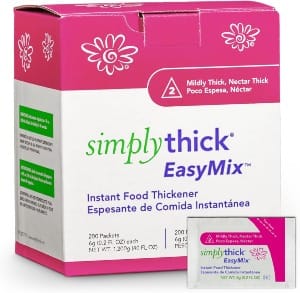
The honey-thickness version provides a thicker consistency similar to honey, moving more slowly and offering more control during swallowing.
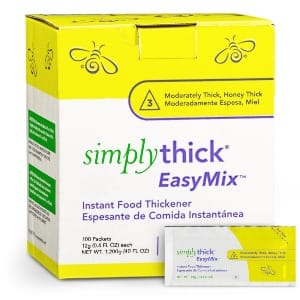
Best for: dining out, hospital visits, travel — any situation where you can't carry a bulk container. Watch out for: the nectar and honey sachets look almost identical — label them clearly or store them separately to avoid mixing up levels. Practical note: one sachet is calibrated for a standard 8oz drink — for larger cups or mugs, you'll need to calculate accordingly rather than assuming one sachet covers any size. They're particularly popular among users who need different thickness levels throughout the day, as you can easily pack exactly what you need. While the per-use cost is higher than that of bulk containers, the pre-measured accuracy eliminates guesswork and ensures you're getting the right consistency recommended by your healthcare provider.
5. Purathick Natural Thickener
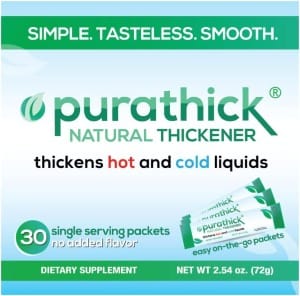
Purathick stands out for its focus on natural ingredients, using plant-based gums rather than synthetic alternatives.
Best for: people who are managing other dietary sensitivities alongside dysphagia, or anyone on a clean-label diet for personal or cultural reasons. Watch out for: natural gum-based products can occasionally vary slightly in performance across different liquid types — worth testing with your most common drinks before relying on it exclusively. Practical note: the individual sachet format means no measuring errors, which makes it a good choice for anyone who finds dosing from a bulk container stressful.
Level 4 — Extremely Thick
What it looks like: Holds shape completely on a spoon. Does not flow or pour when the container is tilted. Falls off a spoon in one movement rather than dripping. Cannot be drunk from a cup or straw — taken with a spoon.
Real examples: Smooth hummus, very thick smooth yogurt, thick smooth custard. Level 4 liquid is more like puréed food in its behaviour — it requires a spoon.
Who it's for: People who cannot safely manage any flowing liquid — the swallow reflex cannot coordinate a safe response to liquid that moves at all. Level 4 liquid is relatively uncommon — most people on significant thickening are prescribed Level 3.
Syringe test: Does not flow through the syringe — 10ml or close to it remains after 10 seconds.
Spoon tilt test: Load a teaspoon and tilt sideways. Level 4 slides off in one cohesive movement — it does not pour.
Thickener approach: Maximum dose — significantly more thickener than Levels 2 or 3. At this level, the consistency is close to puréed food. Always verify with the spoon tilt test — not just the dose.
Example products at this level:
- SimplyThick EasyMix Sachets — Honey Thick — pre-measured for Level 4, gel format
- Thick-It Clear Gel — gel format, familiar brand, pre-measured packets
- Thick-It Concentrated — powder, requires careful measuring at this level
6. Gel-Based Thick-It
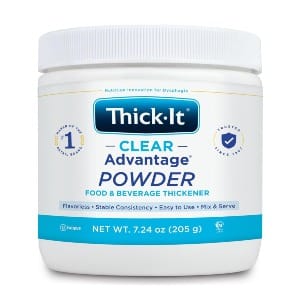
This newer gel formulation from Thick-It combines the brand's trusted reputation with the convenience of pre-measured gel packets. Compared to the original Thick-It powder (both concentrated and non-concentrated), the gel version eliminates mixing time and ensures consistency. You simply squeeze the desired amount into your beverage or food, no measuring spoons or stirring needed.
Is it better than the powder versions? That depends on your priorities and lifestyle.
Best for: the combination of the Thick-It brand familiarity — widely trusted in clinical settings — with the convenience of pre-measured gel. Worth considering as a transition product for someone moving from Thick-It powder who finds powder measuring difficult. Watch out for: the gel format costs significantly more per serving than the powder versions. Practical note: the squeeze packet makes single-handed preparation straightforward — useful for patients who are self-managing their own thickening.
Testing at Home — Always Verify Before Serving
The dose on the thickener packaging is a starting point, not a guarantee. Temperature, the type of drink, saliva, and mixing time all affect the final consistency. Always test before serving — not once when you first try a product, but every time.
The syringe flow test is the validated IDDSI method for Levels 0–3. Fill a 10ml BD Slip Tip syringe, hold horizontally, release, and time 10 seconds. The amount remaining tells you the level. Our IDDSI syringe flow test guide covers the full process step by step with photos.
The fork drip test is a quick visual check for Level 3 — dip a fork and lift it horizontally. Slow separate dollops = Level 3. Continuous stream = below Level 3. Nothing drips = Level 4.
Test at serving temperature, not preparation temperature. Starch-based thickeners in particular continue thickening as they cool. A drink that tests at Level 2 immediately after mixing may be Level 3 by the time it reaches the table.
The Three Types of Thickener — What Makes Them Different
Understanding the type of thickener tells you most of what you need to know about how it will behave.
Starch-Based Thickeners
Made from modified cornstarch or maltodextrin. The original thickener type — widely available in pharmacies, generally less expensive, and the most familiar to clinical teams that have been using them for decades.
How they behave: Continue thickening after mixing for up to 15 minutes. Broken down by amylase — an enzyme in saliva — which means the consistency in the mouth is slightly thinner than it was in the cup. Turns drinks cloudy or opaque. Less stable in acidic drinks (orange juice, coffee) where they can thin out over time.
Best for: Budget-conscious long-term users. Anyone who needs to buy from a physical pharmacy. A forgiving first introduction to thickeners — the learning curve is gentler than gum-based products.
Watch out for: Always prepare slightly thinner than your target level — they will continue thickening. Retest at serving temperature.
Xanthan Gum-Based Thickeners
Made from xanthan gum — a fermentation product widely used in food manufacturing. The clinical standard in most current hospital and SLP settings.
How they behave: Reach their final consistency within 60–90 seconds of mixing. Not broken down by saliva — the consistency in the mouth is the same as in the cup. Stay clear in drinks. Stable in acidic drinks. Stable in hot and cold liquids.
Best for: Anyone who needs consistent, predictable results. Anyone using thickener in acidic drinks. Anyone sensitive to drink appearance — gum-based thickeners keep drinks looking normal.
Watch out for: Not recommended for premature infants or medically fragile neonates. In adults, no significant documented safety concerns for long-term use.
Gel-Based Thickeners
Pre-measured gel packets — squeeze directly into the drink, no measuring required. The active ingredient is typically xanthan gum in a gel format.
How they behave: Same as xanthan gum powder but pre-measured and more convenient. Slightly more expensive per serving than powder but eliminates measuring errors entirely.
Best for: Travel, dining out, hospital visits, anyone who finds measuring powder stressful or inaccurate. Also useful for self-managing patients who thicken their own drinks independently.
The Six Products — Which Level and When
| Product | Type | Stays Clear | Best Level | Best For |
|---|---|---|---|---|
| SimplyThick EasyMix Gel | Xanthan gel | Yes | 1–3 | Consistent results, no measuring, hot and cold |
| Thicken Up Clear | Xanthan powder | Yes | 1–3 | Appearance-sensitive users, acidic drinks |
| SimplyThick Sachets — Moderately Thick | Xanthan gel | Yes | 3 | Travel, dining out, pre-measured Level 3 |
| SimplyThick Sachets — Honey Thick | Xanthan gel | Yes | 4 | Travel, dining out, pre-measured Level 4 |
| Thick-It Original | Starch powder | No | 2–3 | Budget users, pharmacy availability |
| Thick-It Concentrated | Starch powder | No | 2–4 | Regular users, better value per serving |
| Purathick Natural | Plant-based gum | Yes | 2–3 | Clean label, dietary sensitivities |
| Thick-It Clear Gel | Xanthan gel | Yes | 3–4 | Brand familiarity plus gel convenience |
Commercial Thickener or Homemade?
Many people ask whether naturally thick ingredients — cornstarch, potato flakes, puréed fruit — can replace commercial thickeners. Homemade options can work for some purposes, but there is one clinical concern worth naming directly.
The IDDSI level of a homemade thickener cannot be reliably verified without testing equipment, and the consistency can change significantly depending on the temperature, the specific ingredient used, and how long it sits before serving. For someone at risk of aspiration pneumonia — where getting the level wrong has direct clinical consequences — the inconsistency of homemade thickeners is a genuine safety consideration, not just a convenience issue.
If cost is the primary driver, the budget-friendly commercial options — Thick-It Original or Purathick — are a safer middle ground than homemade alternatives.
A thickener that works technically but makes every drink unpleasant contributes to the dehydration risk it was meant to prevent. If the first product you try isn't working, try a different type before concluding that thickened drinks are simply unpalatable. The difference between a starch and a gum-based thickener in the same drink is often the difference between a refused cup and a finished one.
Frequently Asked Questions
What is the difference between Thick-It and SimplyThick?
Thick-It Original is starch-based — it continues thickening after mixing, can turn drinks cloudy, and is broken down by amylase in saliva. SimplyThick uses xanthan gum — it reaches its final consistency within 60–90 seconds, remains clear, and is unaffected by saliva. Thick-It is generally less expensive and more widely available in pharmacies. SimplyThick produces more consistent, predictable results. For most everyday use, gum-based products are the better clinical choice — but Thick-It remains a practical option for budget-conscious users.
Can food thickeners be used in hot drinks?
All products in this guide are stable in hot drinks. The key difference is that starch-based thickeners hydrate faster in hot liquids and may overshoot your target consistency if you use the same dose as in cold drinks. Gum-based and gel products are more temperature-stable and require less dose adjustment.
How do I know which IDDSI level I need?
The IDDSI liquid level — Level 1 through Level 4 — must be determined by a speech-language pathologist following a formal swallowing assessment. It is not something to self-diagnose. If you don't yet have a prescribed level, request a referral through your GP before purchasing thickeners.
Are food thickeners safe for long-term use?
Gum-based thickeners are generally considered safe for long-term daily use in adults. One important exception: xanthan gum products are not recommended for premature infants or medically fragile neonates. For adults managing dysphagia, no significant safety concerns have been documented for long-term use, though regular SLP review is recommended as thickener needs can change over time.
Do food thickeners affect medication absorption?
Some medications may have their absorption affected when mixed with thickeners. Never mix medication directly into a thickened drink without checking with a pharmacist first. Our dysphagia medication guide covers this in detail, including which medications are most affected and what the alternatives are.
What is the difference between moderately thick and puréed?
Moderately thick is a liquid consistency — IDDSI Level 3 liquid. Puréed is a food texture — IDDSI Level 4 food. They have similar physical properties and pass similar IDDSI tests, but one is a drink and the other is food. They are not interchangeable and are always prescribed separately by the SLP. Our IDDSI Food and Liquid Levels Guide explains this in full.
References
Cichero, J. A. Y. (2013). Thickening agents used for dysphagia management: Effect on bioavailability of water, medication and feelings of satiety. Nutrition Journal, 12(54). https://doi.org/10.1186/1475-2891-12-54
Zargar, A., et al. (2023). Gum-based vs starch-based thickeners for dysphagia management. Nutrients, 15(14), 3279. https://www.mdpi.com/2072-6643/15/14/3279
IDDSI Framework. (2019, updated 2024). Complete framework and detailed definitions V2.2. https://www.iddsi.org/framework
American Speech-Language-Hearing Association. (n.d.). Adult dysphagia (Practice Portal). https://www.asha.org/practice-portal/clinical-topics/adult-dysphagia/