IDDSI Flow Test at Home: Step-by-Step Guide With Photos
How to do the IDDSI syringe flow test at home — step by step, with photos. Includes what each result means, when to test, and the exact syringe to use.


The first time I prepared a thickened drink, I had no way to know if I'd gotten it right. The instructions on the thickener container said "add 1.5 scoops per 150ml for Level 2," but was it actually Level 2? It looked about right. It felt about right. That wasn't good enough.
The IDDSI syringe flow test is a simple, validated method that tells you exactly what consistency level you've achieved — not approximately, not by feel, but with a measurable result you can check against the IDDSI framework. It takes about two minutes, requires a $1 syringe, and is the only reliable way to verify liquid consistency at home between clinical appointments.
Here's exactly how to do it.
How to Do the IDDSI Flow Test at Home
The IDDSI flow test using a syringe has been researched by multiple researchers, and its accuracy has been confirmed. Research from the Open Access Journal of Dysphagia shows that by using a syringe and timer, we can measure food and liquid thickness levels properly, making it easier to DIY at home.
Here's everything you need and the step-by-step process to do it right:
Materials needed:
- 10 mL syringe (preferably BD Slip Tip)
- Stopwatch or timer
- Your thickened liquid (at room temperature, 20-22°C)
- Clean measuring cup
- Paper towel for cleanup
Step-by-step instructions:
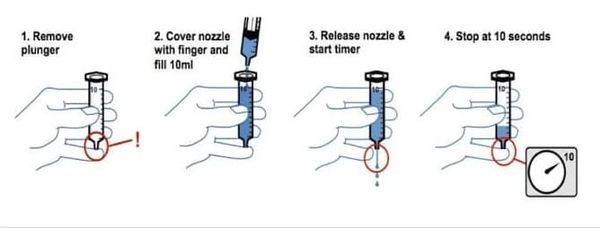
- Prepare your liquid: Ensure your thickened liquid is at room temperature and well-mixed. Temperature matters because hot liquids flow faster, while cold liquids flow more slowly.
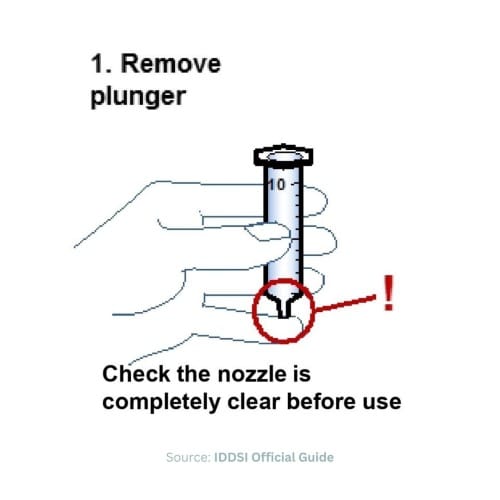
- Fill the syringe: Remove the plunger completely and use your finger to block the tip. Fill the syringe barrel with exactly 10 mL of liquid, ensuring no air bubbles are trapped.
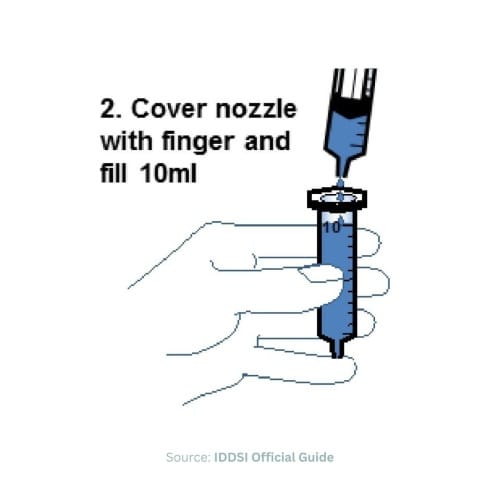
- Replace the plunger: Gently insert the plunger back into the syringe, being careful not to push any liquid out yet.
- Position and start: Hold the syringe vertically with the tip pointing down. Remove your finger from the tip and immediately start your timer.
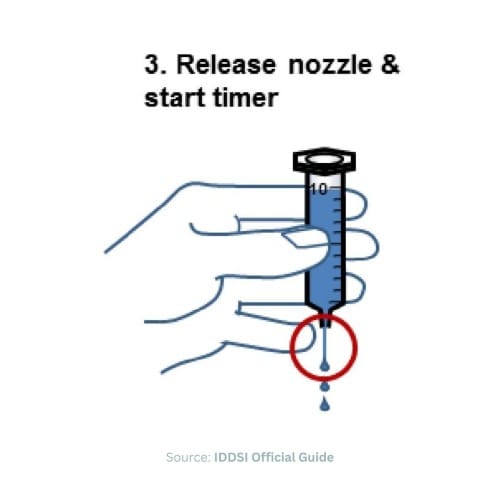
- Let gravity work: Don't push the plunger; let gravity alone move the liquid through the syringe. This is crucial for accurate results.
- Record the time: Stop timing when the liquid stops flowing or when you reach 10 seconds, whichever comes first.
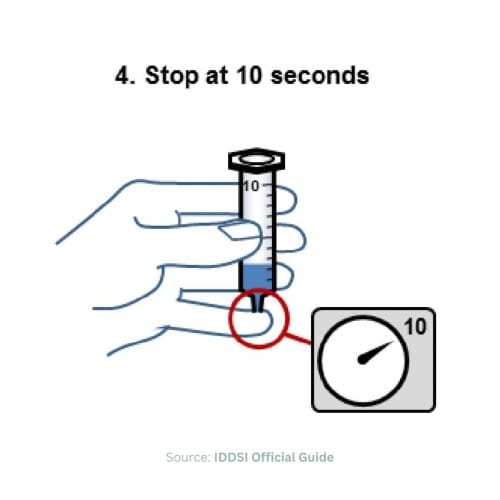
- Check how much liquid remains in the syringe: the more liquid that has stayed in rather than flowed out, the higher the IDDSI level. Cross-reference the amount remaining against the results table below. Repeat the test three times with the same sample and average the results — this is the IDDSI standard for accurate classification.
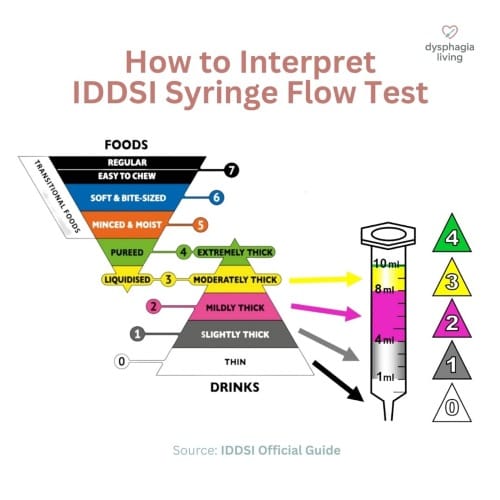
Here's how to interpret your syringe flow test results, based on the research:
- Level 0 (Thin liquids): Flows through the 10 mL syringe in less than 1 second, like water, coffee, or clear broth. These liquids flow almost instantly when you remove your finger from the syringe tip.
- Level 1 (Slightly thick liquids): Takes 1 - 4 seconds to flow through the syringe completely. After 10 seconds, there will be barely any liquid left. This consistency is similar to milk and should flow steadily but noticeably slower than thin liquids.
- Level 2 (Mildly thick liquids): Requires 4 - 8 seconds to flow completely. After 10 seconds, you will see about 4 - 7 mL of liquid left. These mildly thick liquids move in a continuous stream but take their time getting through the syringe.
- Level 3 (Moderately thick liquids): Takes 8 seconds or more to flow completely. After 10 seconds, you can still see most of the liquid has not flowed through the syringe. Moderately thick liquids often leave some residue in the syringe.
- Level 4 (Extremely thick liquids): No flow or minimal flow (less than 8 mL) within 10 seconds. These pudding-consistency liquids are too thick to flow through a syringe under gravity alone.
IDDSI standard emphasizes that this test should be performed three times for each sample, with results averaged for the most accurate classification.
When to Do the Flow Test
Always test at serving temperature, not preparation temperature. Liquids thicken as they cool and thin as they heat. A drink that passes the Level 2 test at 60°C may have dropped to Level 1 by the time it reaches the table. Always check the temperature that the person will actually drink it.
Test every batch. The same thickener at the same dose can produce slightly different results in different drinks — coffee behaves differently from orange juice, and whole milk behaves differently from water. A result confirmed for one drink does not carry over to another.
Test after reheating. Starch-based thickeners in particular can behave unpredictably when reheated — the consistency may thicken further rather than returning to the original level. Always retest after reheating and before serving.
Test when switching brands or drinks. If you change thickener brand, switch from starch to gum-based, or start thickening a new type of drink, test with the new combination before serving. Do not assume the same dose produces the same level.
Ideal Syringe for IDDSI Flow Test at Home
While you can technically use any 10 mL syringe, the most reliable and recommended option is the 10 mL BD Slip Tip syringe. This specific syringe type has been extensively tested and validated for IDDSI measurements, ensuring your home results match those obtained in clinical settings.
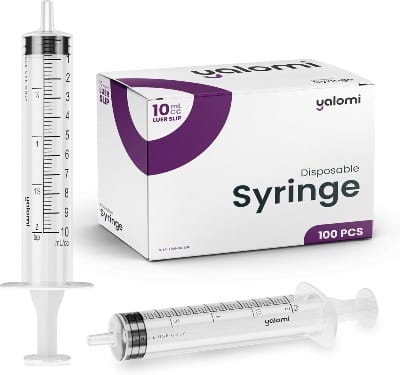
The BD Slip Tip design features a smooth, consistent bore diameter and slip-tip connection that eliminates variables that could affect flow rates. According to the IDDSI framework documentation, using standardized syringes is essential for reproducible results across different testing environments.
Where to buy a 10 mL BD Slip Tip syringe:
- Medical supply stores: Most local medical supply stores carry BD syringes
- Pharmacies: Many pharmacies can order them if they are not in stock
- Online: Amazon offers convenient home delivery of BD 10 mL Slip Tip syringes, often sold in packs of 10-50 syringes.
The investment in proper syringes is worth it. A pack of 10 syringes typically costs $15-25 and provides months of testing capability for most households.
to hydrate
Pushing the plunger. The syringe test measures gravity-driven flow only. Any pressure on the plunger — even a fingertip resting on it — produces a faster flow rate and a false lower-level result. Hold the syringe by the barrel only once the test begins.
Testing too soon after mixing. Gum-based thickeners reach full viscosity within 1–2 minutes of mixing. Starch-based thickeners continue to hydrate for up to 15 minutes. Testing immediately after mixing can give a falsely thin result. Wait for the manufacturer's recommended time before testing.
Air bubbles in the syringe. Air bubbles affect the fill volume and the flow rate. When filling the syringe, tap it gently and check that the 10ml mark is accurate before beginning the test.
Only testing once. The IDDSI standard specifies three tests averaged for accuracy. A single test has too much variability to be clinically reliable — small differences in technique, temperature, or timing affect the result. Three tests take four minutes and remove that variability.
Using a non-BD syringe. Different syringe brands have different internal bore diameters, which directly affect the flow rate. The BD Slip Tip 10ml syringe is the IDDSI-validated tool — results from other syringe types are not directly comparable to the IDDSI benchmarks.
What If I Don't Have a Syringe at Home?
Life happens, and sometimes you need to check liquid consistency without the ideal equipment. While these alternatives won't give you the precision of a proper syringe test, they can provide temporary guidance until you get the right tools.
Temporary alternatives for the IDDSI syringe flow test:
While the syringe test is the only validated method, the fork drip test is the IDDSI-specified alternative when a syringe is not available:
- Dip a clean fork into the liquid and lift it out
- Hold it horizontally and observe how the liquid falls
- Level 0 (thin): Flows through the tines immediately in a fast, continuous stream — like water off a fork
- Level 1 (slightly thick): Drips through the tines in a steady but slower stream
- Level 2 (mildly thick): Drops fall slowly through or between the tines — no continuous stream
- Level 3 (moderately thick): Liquid sits between the tines and falls in slow, heavy drops — barely moves
- Level 4 (extremely thick): Sits on the fork completely — does not drip through the tines at all
The fork drip test is significantly less precise than the syringe test — use it only as a temporary check and retest with the syringe as soon as possible. The spoon tilt test (used in our recipe guides) is appropriate for food consistency but should not be used as a substitute for the syringe test for liquids.
One critical note: these alternatives have a higher margin for error. In the context of dysphagia management — where getting the level wrong increases aspiration risk — the syringe test should be treated as the baseline, not an optional extra.
Read more about the Dysphagia Cups recommendation here: Best Dysphagia Cups for Safe Drinking based on IDDSI Levels
Getting consistent results takes a few attempts — most caregivers find that after three or four test sessions, the process becomes quick and instinctive. The syringe stays on the kitchen counter next to the thickener. The test takes two minutes. And the difference between knowing the consistency is right and hoping it is right is worth every one of those two minutes.
For the practical next steps, our guide to thickening everyday drinks covers which thickeners work best for which drinks — useful if your test results are inconsistent across different beverages. Our food thickeners comparison covers the main commercial thickeners. And if you're cooking modified meals at home, every recipe in our recipe section includes a spoon tilt test for food consistency, along with a syringe test for any thickened drinks served with it.
Frequently Asked Questions
What syringe do I use for the IDDSI flow test?
The IDDSI-validated syringe is the BD Slip Tip 10ml syringe. This specific syringe type has been tested and confirmed to produce results consistent with the IDDSI framework benchmarks. Other 10ml syringes have different internal bore diameters that affect flow rate — results from non-BD syringes are not directly comparable to the IDDSI level classifications. The BD Slip Tip is available on Amazon in packs of 10–50 syringes, typically costing $15–25 per pack.
How many times should I do the IDDSI flow test?
Three times, with the results averaged. This is the IDDSI standard for accurate classification. A single test has too much variability — minor differences in technique, temperature, or timing between tests affect the result. Three tests averaged gives a reliable classification. If all three results fall in the same level, you can be confident in the classification. If results vary across levels, identify the cause (temperature, mixing time, technique) and retest.
What does it mean if too much liquid is left in the syringe?
More liquid remaining in the syringe after 10 seconds means higher viscosity — thicker liquid. If 8ml or more remains, the liquid is at Level 3 or above. If virtually nothing flows, it is Level 4 or above. If the result is significantly higher than your target level — for example, aiming for Level 2 and getting Level 3 — reduce the thickener dose slightly, mix well, wait the full hydration time, and retest.
Can I reuse the syringe?
Yes — rinse thoroughly with warm water after each use, allow to dry fully, and store clean. Most caregivers get several months of use from a pack of 10 syringes with proper care. Replace the syringe if the barrel becomes discoloured, the plunger becomes stiff, or the tip shows any damage — these affect flow rate and test accuracy.
What is the difference between the syringe flow test and the spoon tilt test?
The syringe flow test measures liquid viscosity against validated IDDSI benchmarks — it gives a specific level classification (0, 1, 2, 3, or 4) with a measurable result. The spoon tilt test is used for food consistency — it checks whether a puréed food meets Level 4 (puréed) standards by observing whether it slides off a tilted spoon in one cohesive movement. The two tests measure different things. The syringe test is for liquids; the spoon tilt test is for foods. Our recipe guides use the spoon tilt test for each recipe; this guide covers the syringe test for drinks.
What if my result is between two levels?
Use the higher level — always err on the side of caution. If a result sits between Level 1 and Level 2, treat it as Level 2. If the intended level is Level 1 and you are consistently getting Level 2, reduce the thickener dose slightly and retest. If you cannot achieve the target level consistently, discuss with your SLP — the prescribed level may need reviewing, or a different thickener type may produce more consistent results.
References:
- Steele, C. M., et al. (2018). The influence of food texture and liquid consistency modification on swallowing physiology and function: a systematic review. Journal of Texture Studies, 29(4), 234-247. Retrieved from https://onlinelibrary.wiley.com/journal/17454603
- Cichero, J. A., et al. (2017). Development of international terminology and definitions for texture-modified foods and thickened fluids used in dysphagia management. Dysphagia, 32(2), 293-314. Retrieved from https://link.springer.com/article/10.1007/s00455-016-9758-y
- International Dysphagia Diet Standardisation Initiative. (2024). IDDSI Testing Methods and Framework. Retrieved from https://www.iddsi.org/testing-methods
- American Speech-Language-Hearing Association. (2024). IDDSI Implementation and Testing Guidelines. Retrieved from https://www.asha.org/practice-portal/clinical-topics/adult-dysphagia/
- National Foundation of Swallowing Disorders. (2024). Home Testing Protocols for Liquid Consistency. Retrieved from https://swallowingdisorderfoundation.com/home-testing-protocols/