Flow Regulating Dysphagia Cups Comparison
4 insert-beaker flow-regulating dysphagia cups compared honestly — IDDSI levels, thickened liquid compatibility, clinical validation, and which one suits which swallowing profile.


Once your speech-language pathologist tells you that a flow-regulating cup is needed, the next question is which one. Search Amazon, and you'll find only a handful of similar-looking cups with nearly identical marketing language — the same 5cc/10cc/15cc insert system, the same spill-proof promises, the same stock photography. What you won't easily find is a clear explanation of how they actually differ from each other and which one suits which situation.
This comparison covers four of the most widely available flow-regulating cups: the EHUCONELDEX, the BaseSmall, the SavvyBloom, and the Provale. They all regulate flow. They all limit sip volume. But they have meaningful differences in IDDSI level compatibility, build quality, liquid type restrictions, and practical daily use that are worth understanding before buying.
How Insert-Beaker Flow Regulation Works
Three of the four cups in this comparison use the same fundamental mechanism — so it's worth explaining once clearly before the individual reviews.
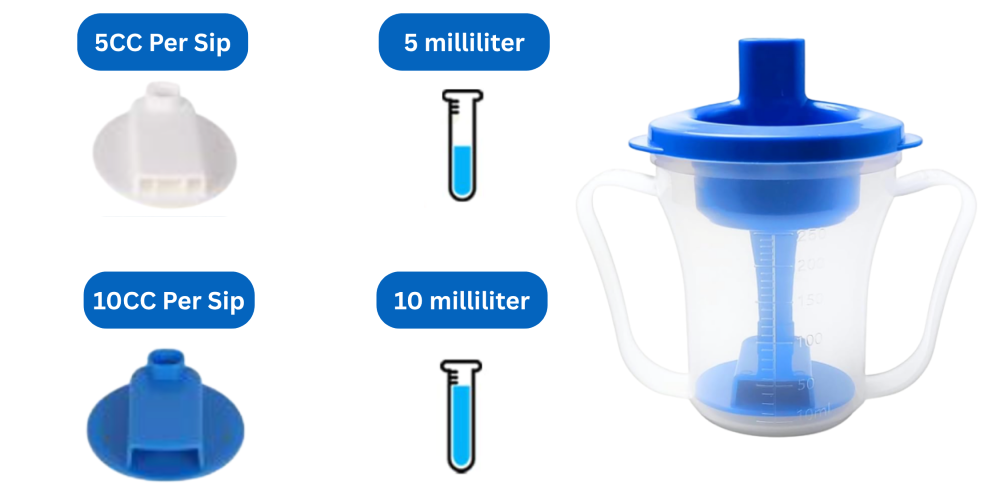
A small beaker insert sits inside the main cup body. When the cup is tilted to drink, only the liquid held inside the insert beaker reaches the spout — a fixed volume determined by which insert is in place. When the cup returns to upright, the insert refills from the main reservoir within a few seconds, ready for the next sip.
The insert size determines the sip volume:
- 5cc = approximately one teaspoon — a small, cautious sip, appropriate for significant swallowing difficulty
- 10cc = approximately two teaspoons — a moderate sip, the most commonly used daily option
- 15cc = approximately one tablespoon — a fuller sip for milder difficulty
The person could tilt the cup at any angle or speed and still receive only the volume the insert allows. This is what makes these cups genuinely flow-regulating rather than just spill-resistant.
The Provale uses the same insert-beaker principle but comes pre-fixed to one volume at purchase rather than offering interchangeable inserts.
The Four Cups We Have Compared
1. EHUCONELDEX — 5cc / 10cc / 15cc Inserts
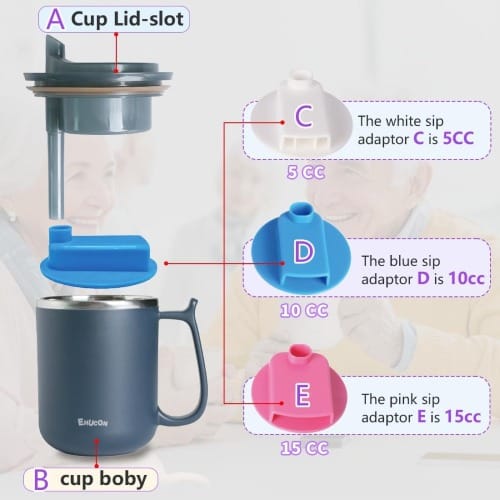
The EHUCONELDEX is the budget entry point in this comparison — a straightforward insert-beaker cup offering all three volumes at the lowest price point of the group.
IDDSI levels: IDDSI Level 0 (thin liquids) only. The product listing explicitly states it is not suitable for thickened liquids. If your loved one is on Level 1 or Level 2 with thickener, this cup is not appropriate.
Inserts: Three beakers included (5cc, 10cc, 15cc). The tallest insert delivers the smallest sip — counterintuitive but consistent across all insert-beaker cups. The volume is marked on the base of each insert.
Handles: Multiple removable handle attachment points. Three handles included, allowing different grip configurations for self-managed or caregiver-assisted drinking.
Nosey design: Yes — the lid accommodates the nose to allow a neutral chin position without tilting the head back.
Cleaning: Dishwasher safe to 60°C. The inserts are small — a mesh parts bag or small basket on the top rack prevents loss.
Transparency: The body is not fully transparent — monitoring liquid level requires checking from above or marking the outside.
Best for: Caregivers managing thin liquids only who want to trial the insert-beaker system at a lower price before committing to a more expensive option. Also, a practical backup cup to keep as a spare.
Watch out for: Thin liquids only — this is the most significant restriction. Confirm IDDSI Level 0 with your SLP before purchasing. Also worth noting: the EHUCONELDEX has multiple similar product listings under slightly different model names (EHUCONMOV, EHUCONELDEX, Ehucon) — make sure the listing you purchase includes all three insert sizes (5cc, 10cc, 15cc), as some variants only include 5cc and 10cc.
Practical note: The insert volume markings are on the base of each beaker. Check which insert is in place before each use — it is easy to use the wrong one by feel alone, particularly in a rushed morning routine.
2. DysphagiaLiving Cup — 5cc / 10cc / Inserts
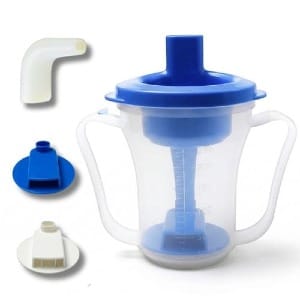
The DysphagiaLiving cup is the mid-range option — an upgrade from the EHUCONELDEX in terms of IDDSI compatibility and build, at a price point between budget and premium. It's also the cup that already appears in our main dysphagia cups guide — this is the newer version that includes all three insert sizes, a meaningful improvement over the earlier two-insert model.
IDDSI levels: IDDSI Levels 0, 1, and 2 — the widest liquid compatibility of any insert-beaker cup in this comparison. If your loved one is on mildly thickened liquids (Level 2) and needs flow control, the BaseSmall is the appropriate insert-beaker option at this price point.
Inserts: two beakers included (5cc, 10cc). Similar insert-beaker mechanism as EHUCONELDEX and SavvyBloom.
Handles: Simpler handle design than the SavvyBloom but functional for both self-managed and assisted drinking.
Nosey design: Yes — adequate nose clearance on the lid for neutral head positioning.
Cleaning: Dishwasher safe. The same small-parts caution applies to inserts.
Transparency: Transparent — allows visual monitoring of liquid level.
Best for: People on thin to mildly thick liquids (IDDSI 0–2) who need a reliable insert-beaker cup without the premium price of the SavvyBloom. A strong practical choice for daily home use when thickened liquids at Level 1 or 2 are involved and a budget-tier cup is not appropriate.
Practical note: Level 1–2 thickened liquid compatibility is the key differentiator from the EHUCONELDEX. If you are currently using the EHUCONELDEX and your SLP has introduced mild thickening, this is the natural next cup without jumping to the SavvyBloom's price point.
3. SavvyBloom — 5cc / 10cc / 15cc Inserts
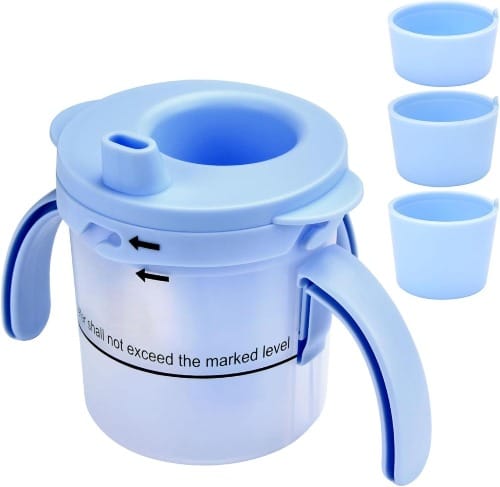
The SavvyBloom is the premium consumer option in this comparison and the most fully featured insert-beaker cup available at this price point. We've reviewed it in detail separately — see our full SavvyBloom review for the complete breakdown, including regulator-to-IDDSI matching. Here's how it compares within this group.
IDDSI levels: IDDSI Levels 0–3 — the broadest range of any cup in this comparison. The 5cc insert is most appropriate for Level 0–1; the 10cc and 15cc for Level 2–3. This is the only insert-beaker cup in this group that covers moderately thick liquids at Level 3.
Inserts: Three beakers included (5cc, 10cc, 15cc). Same mechanism as the others but with tighter manufacturing tolerances — the inserts seat more securely and the refill action is more consistent in practice.
Nose nook: The SavvyBloom lid has a built-in nose nook — a small indentation that accommodates the nose for neutral head positioning. It works best seated upright at approximately 45 degrees; less effective fully reclined.
Handles: Three removable handles at different height positions — one for each configuration of patient and caregiver grip. The most versatile handle system of the four cups.
Transparency: Clear body — allows caregivers to monitor fluid intake and confirm the insert is correctly seated at a glance. The only fully transparent cup in this comparison is the Provale.
Spiral silicone seal: The lid contains a spiral silicone ring that prevents leakage around the insert — a build quality feature not present in the budget options.
Cleaning: Dishwasher safe to 60°C. Same insert care applies.
Capacity: Approximately 7.4 oz (220 ml) — slightly less than the BaseSmall and Provale.
Best for: People on moderate to thick liquids (Level 2–3), or anyone who needs the most complete insert-beaker system for home caregiving. The transparent body, silicone seal, and versatile handle system make it the strongest daily-use option for a caregiver managing the cup themselves. Also, the best choice when the SLP has not specified a brand and the caregiver wants the most reliable consumer insert-beaker cup available.
Watch out for: The lid requires correct alignment before pressing down — one side at a time will not seal properly. Takes a few days to learn and then becomes quick. The slightly smaller capacity means more frequent refilling for longer drinks.
Practical note: The SavvyBloom has the largest body of real-world caregiver reviews of any cup in this comparison, which means there is more practical feedback available to draw on. The consistent finding across reviews is that once the lid technique is learned, it is the most reliable insert-beaker cup in day-to-day use.
4. Provale — Fixed 5cc or Fixed 10cc
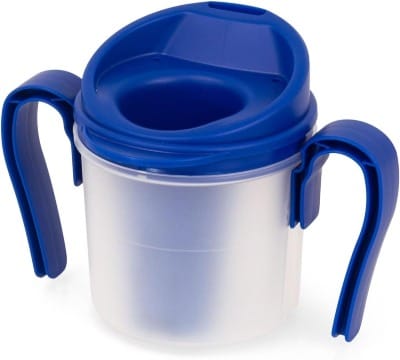
The Provale is the original. It was the first clinically validated flow-regulating cup developed specifically for dysphagia — designed with SLP and OT input, FDA-cleared, and used in hospitals, rehabilitation centres, and long-term care settings for longer than any other cup in this comparison. The other three cups in this article exist because the Provale's mechanism worked. If your SLP recommended a "regulating cup" or a "Provale cup" by name, this is the clinical reference point they had in mind.
IDDSI levels: Thin liquids (Level 0) only — water, juice, nutritional supplements. Not recommended for thickened liquids. This is the most significant clinical restriction in this comparison.
Mechanism: Insert-beaker system — but the Provale comes pre-fixed to one volume at purchase. The blue cup delivers exactly 5cc per sip. The brown cup delivers exactly 10cc per sip. There are no interchangeable inserts. If the prescribed volume changes, a different cup is needed.
Anti-suck mechanism: The Provale has a patented feature that prevents over-delivery of liquid between sips — the person cannot draw additional liquid through suction between drinking motions. None of the other three cups in this comparison explicitly replicate this feature. In clinical settings where consistent delivery control and auditability matter, this is the defining advantage of the Provale.
Nosey clearance: Generous nose clearance built into the lid — the most ample of the four cups, allowing comfortable neutral head positioning for a wider range of face shapes.
Handles: One or two removable easy-grip handles. Simpler than the consumer-oriented options — functional rather than configurable.
Transparency: Clear body — same visual monitoring advantage as the SavvyBloom.
Cleaning: Institutional dishwasher safe. Important note: replacement insert cups are not available separately. If the insert is damaged or lost, the entire cup must be replaced.
Capacity: 8 oz (237 ml) — the largest of the four cups.
Best for: Anyone whose SLP has specifically recommended the Provale by name. Rehabilitation settings where clinical accuracy, auditability, and the anti-suck mechanism are priorities. Post-stroke recovery, where a clinically validated thin liquid management tool is needed. Long-term care settings where consistent delivery across multiple caregivers matters.
Watch out for: No flexibility — 5cc or 10cc at purchase with no ability to adjust. Thin liquids only, with no thickened liquid option. The most clinical appearance of the four cups — looks like medical equipment rather than a travel mug, which matters for some people in social settings. Replacement inserts unavailable.
Practical note: The colour coding — blue for 5cc, brown for 10cc — is the most immediately useful design detail in this comparison. In a care home or hospital setting with multiple caregivers, colour-coded cups eliminate the risk of using the wrong volume. For home use, it removes the need to check which insert is in place.
Head-to-Head Comparison
| EHUCONELDEX | BaseSmall | SavvyBloom | Provale | |
|---|---|---|---|---|
| Mechanism | Insert beakers | Insert beakers | Insert beakers | Insert beakers |
| Sip volumes available | 5cc / 10cc / 15cc | 5cc / 10cc / 15cc | 5cc / 10cc / 15cc | 5cc OR 10cc (fixed at purchase) |
| IDDSI levels | Level 0 only | Levels 0, 1, 2 | Levels 0, 1, 2, 3 | Level 0 only |
| Thickened liquids | No | Yes (up to Level 2) | Yes (up to Level 3) | No |
| Anti-suck mechanism | No | No | No | Yes (patented) |
| Transparent body | No | Partial | Yes | Yes |
| Nosey design | Yes | Yes | Yes (nook) | Yes (generous) |
| Handles | 3 removable | Removable | 3 removable | 1–2 removable |
| Silicone lid seal | No | No | Yes | No |
| Replace insert if lost | Yes — buy new inserts | Yes — buy new inserts | Yes — buy new inserts | No — full cup replacement |
| Capacity | ~220ml | ~220ml | ~220ml | 237ml |
| Dishwasher safe | Yes (60°C) | Yes (60°C) | Yes (60°C) | Yes (institutional) |
| FDA cleared | No | No | No | Yes |
| Price range | $ | $$ | $$$ | $$ |
Which Cup for Which Situation
| Situation | Best Choice |
|---|---|
| SLP prescribed the Provale or a "regulating cup" by name | Provale |
| Thin liquids only, budget is primary consideration | EHUCONELDEX |
| Thin to mildly thick liquids (Level 0–2), mid-range budget | BaseSmall |
| Moderately thick liquids (Level 3) with flow control needed | SavvyBloom only |
| Best all-rounder for home caregiver daily use | SavvyBloom |
| Institutional or care home setting, multiple caregivers | Provale — colour-coded volumes eliminate mix-ups |
| Person is sensitive about clinical-looking equipment | SavvyBloom — most like normal drinkware |
| Currently using EHUCONELDEX and SLP has introduced thickener | Upgrade to BaseSmall or SavvyBloom depending on level |
| Consistent auditable delivery control is required | Provale — anti-suck mechanism and FDA clearance |
The Important Distinction: Consumer vs Clinical
Three of these cups — EHUCONELDEX, BaseSmall, SavvyBloom — are consumer products. They use the same insert-beaker mechanism as the Provale but are not FDA-cleared, have not been clinically validated in published research, and do not have the anti-suck mechanism. That doesn't make them unsafe — it means they are home-use tools rather than clinical devices.
The Provale is a clinical device used in hospitals and rehabilitation centres. For home caregiving of someone with moderate dysphagia on thin liquids, the SavvyBloom or BaseSmall are entirely appropriate and significantly more practical in daily use. For someone in active rehabilitation, or where an SLP has made a specific clinical recommendation, the Provale is the appropriate choice.
What to Ask Your SLP Before Buying
Has a specific sip volume been prescribed? If yes, does it align with 5cc, 10cc, or 15cc? If you need a volume between these — say 7cc or 12cc — none of these four cups can deliver it precisely. A different type of regulating cup with continuous adjustment would be needed.
What IDDSI liquid level is prescribed? Level 0 only: all four cups work. Level 1–2: BaseSmall or SavvyBloom. Level 3: SavvyBloom only. Level 4: no cup is appropriate — use a spoon.
Is the Provale specifically recommended? If your SLP has named the Provale, use the Provale. If they have said "a flow-regulating cup" without specifying a brand, the SavvyBloom or BaseSmall are appropriate consumer equivalents depending on the IDDSI level.
Frequently Asked Questions
What is the difference between the Provale and the SavvyBloom?
Both use an insert-beaker mechanism to deliver a fixed sip volume. The Provale is FDA cleared, has a patented anti-suck mechanism preventing over-delivery between sips, and is the original clinically validated version — but it only comes in fixed 5cc or 10cc, works with thin liquids only, and replacement inserts are not available. The SavvyBloom offers three interchangeable insert sizes, works up to IDDSI Level 3 including thickened liquids, has a silicone seal, and is designed for home caregiving use. The Provale is the clinical standard; the SavvyBloom is the more practical home option for most caregivers.
What does 5cc actually look like in practice?
5cc is approximately one teaspoon — a small, deliberate sip. 10cc is approximately two teaspoons. 15cc is approximately one tablespoon — a fuller sip comparable to what most people take from a standard cup. Most caregivers start with 5cc and move to 10cc once the person is managing consistently well. Always start with the smaller volume and increase only with SLP guidance.
Can these cups be used with hot drinks like tea or coffee?
The Provale is explicitly rated for hot and cold liquids. The SavvyBloom and BaseSmall are rated to 60°C maximum — sufficient for a warm drink but not boiling. The EHUCONELDEX has similar temperature restrictions. Always check the liquid temperature before serving and confirm with the product's care instructions.
Do flow-regulating cups eliminate the need for thickeners?
For some people on thin liquids, yes — the controlled sip volume may allow safe thin liquid drinking without thickening. The Provale is specifically marketed on this basis. However, whether thickeners can be eliminated depends entirely on the individual's swallowing profile and must be confirmed by SLP assessment. Do not change thickener use without clinical guidance.
Which cup is easiest to clean?
The Provale is the simplest to clean — disassemble, top rack dishwasher, reassemble. However, replacement inserts are unavailable if damaged. The SavvyBloom, BaseSmall, and EHUCONELDEX all have small insert parts that need careful handling in the dishwasher. A mesh parts bag prevents inserts from going missing. The SavvyBloom's silicone seal requires checking that residue hasn't accumulated in the groove over time.
Which is best for someone with Parkinson's disease?
Parkinson's typically involves slow swallow initiation, tremor, and progressive deterioration. The SavvyBloom is the strongest choice for most Parkinson's patients — it covers IDDSI Levels 0–3 as the condition progresses, has a transparent body for caregiver monitoring, and the three handle positions accommodate changing grip strength. If thickened liquids are not yet needed and budget is a consideration, the BaseSmall covers Levels 0–2 at lower cost.
Which is best for post-stroke recovery?
Post-stroke dysphagia often improves significantly over weeks to months — meaning the appropriate sip volume and IDDSI level may change during recovery. For a rehabilitation setting the Provale is the standard. For home management during recovery, the SavvyBloom's interchangeable inserts allow adjustment without replacing the cup as the prescribed volume changes. Starting with the 5cc insert and progressing to 10cc and 15cc as swallowing improves is a practical approach under SLP guidance.
References
American Speech-Language-Hearing Association. (n.d.). Adult dysphagia (Practice Portal). https://www.asha.org/practice-portal/clinical-topics/adult-dysphagia/
IDDSI Framework. (2019). Complete framework and detailed definitions. https://www.iddsi.org/framework
Robbins, J., et al. (2008). Comparison of 2 interventions for liquid aspiration on pneumonia incidence. Annals of Internal Medicine, 148(7), 509–518. https://pmc.ncbi.nlm.nih.gov/articles/PMC7746115/
VitalCare Technology. (n.d.). Provale Cup dysphagia drinking cup — FDA approved, developed with SLP and OT input. https://www.vitalcaretechnology.com/shop-products/p/provale-cup-dysphagia-drinking-cup