IDDSI Framework PDF: Free Printable Poster, Handouts & Testing Cards
Download the official IDDSI framework poster, level handouts, and testing cards - free to print and share.

Last updated June 2026 — all downloads link to the most current official IDDSI versions
Latest Source and language selection: IDDSI.
If you've been handed a sheet with IDDSI levels on it — or if your speech-language pathologist mentioned the framework and you want to understand it properly — this page is your starting point.
Below you'll find the official IDDSI framework poster, individual-level handouts, and testing cards — all free to download, print, and share. We've also explained what each resource is for and who it's most useful for, because the official IDDSI website has everything, but makes it harder than it needs to be to find.
What Is the IDDSI Framework?
The IDDSI (International Dysphagia Diet Standardisation Initiative) framework is the internationally recognised system for describing modified food textures and drink thicknesses for people with swallowing difficulties. It covers 8 levels — from Level 0 (thin liquid, like water) to Level 7 (regular food) — and replaces the old inconsistent terminology like "nectar-thick" and "honey-thick" that varied between countries and hospitals.
The IDDSI Framework provides a common terminology to describe food textures and drink thickness, with levels identified by numbers, text labels, and colour codes.
Every article on this site references IDDSI levels. Every recipe is built to a specific IDDSI level. Understanding the framework — and having a printed copy nearby — makes every other part of dysphagia management clearer.
Download 1: The IDDSI Framework Poster (Adult) — The Most Important One
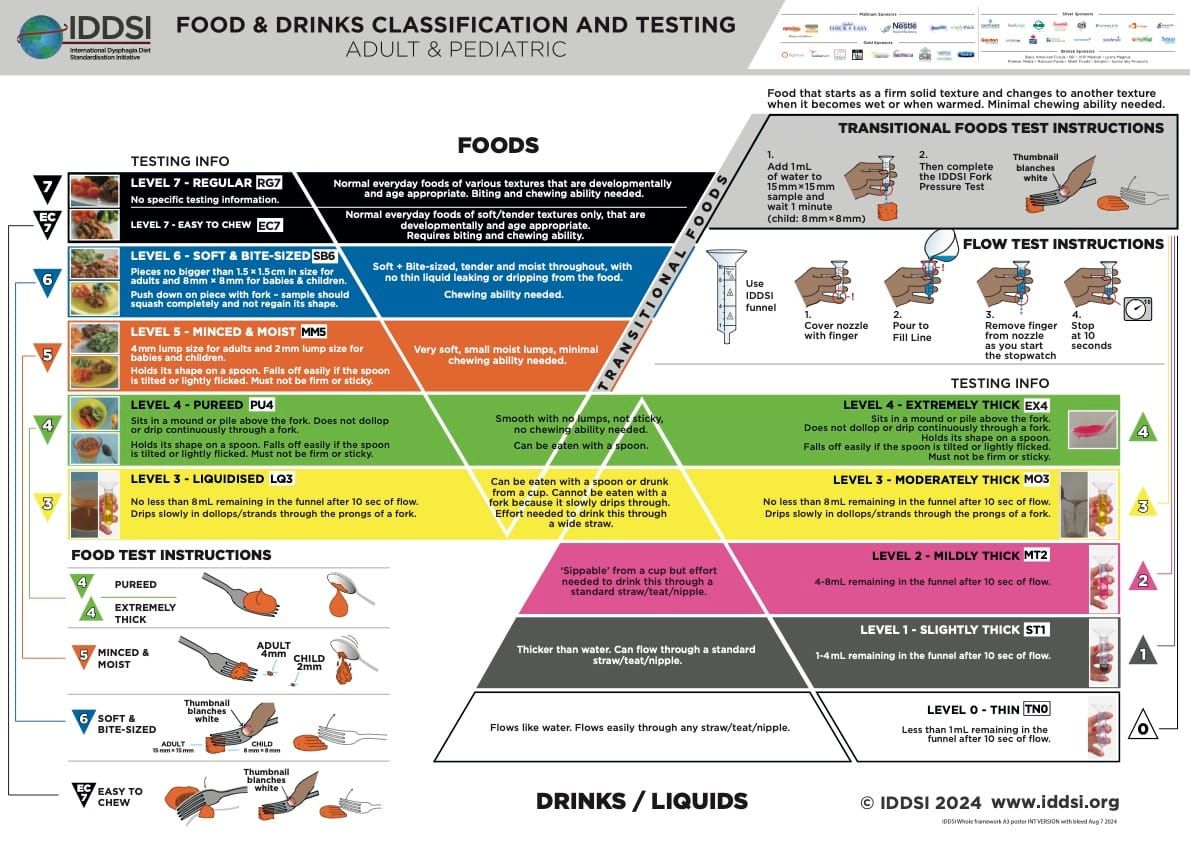
What it is: A single A4/letter-sized page showing all 8 IDDSI levels for both foods and drinks, with the testing methods for each level illustrated visually. This is the poster most caregivers and SLPs keep on the kitchen wall or in the care folder.
Who it's for: Anyone managing dysphagia at home who wants a quick visual reference for all levels. Also used in care homes, hospitals, and rehabilitation settings as a wall poster.
How to use it: Print on A4 or US Letter paper. Laminate if you plan to use it in the kitchen — it survives daily use much better. Keep one in the kitchen and one in the care folder.
The PDF you uploaded above is this poster — the official IDDSI 2020 Adult Food and Drinks Classification and Testing poster. You can download it directly here:
⬇ Download: IDDSI Framework Poster — Adult (PDF),
Source: iddsi.org — licensed under Creative Commons Attribution-ShareAlike 4.0. Free to print and share with attribution.
Download 2: Individual Level Handouts — One Per Level
What they are: IDDSI has created these handouts in consultation with clinicians and patients. They can be used by people who have feeding, chewing, or swallowing problems, their caregivers, and clinicians. The handouts provide easy-to-read information about each IDDSI level, including testing methods, food examples, and textures to avoid.
Who they're for: These are the handouts your SLP may give you at discharge — one page covering the specific level prescribed, with practical food examples. If you didn't receive one, download the level that applies and print it.
Download the level you need:
Download the Level You Need
| Level | Name | Download |
|---|---|---|
| Level 0 | Thin | ⬇ Download PDF |
| Level 1 | Slightly Thick | ⬇ Download PDF |
| Level 2 | Mildly Thick | ⬇ Download PDF |
| Level 3 | Moderately Thick | ⬇ Download PDF |
| Level 3 | Liquidised | ⬇ Download PDF |
| Level 4 | Extremely Thick | ⬇ Download PDF |
| Level 4 | Puréed | ⬇ Download PDF |
| Level 5 | Minced and Moist | ⬇ Download PDF |
| Level 6 | Soft and Bite-Sized | ⬇ Download PDF |
| Level 7 | Easy to Chew | ⬇ Download PDF |
| Level 7 | Regular | ⬇ Download PDF |
| Transitional Foods | — | ⬇ Download PDF |
| All Levels Combined | Complete pack | ⬇ Download All Levels PDF |
All handouts are available in multiple languages on the IDDSI patient handouts page — including Spanish, French, Mandarin, Japanese, Arabic, and more.
Not sure which level applies to your loved one? The IDDSI level is prescribed by a speech-language pathologist — check the discharge letter or SLP assessment report. If you don't have this information, request it at the next medical appointment before downloading.
Download 3: IDDSI Testing Cards
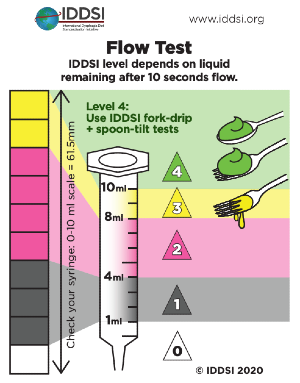
What they are: Tools for caregivers and patients to follow the IDDSI Testing Method guidelines, designed to be printed at a professional printer facility. These are laminated reference cards showing exactly how to perform the syringe flow test and fork pressure test — the two tests used to verify consistency at home.
Who they're for: Caregivers who regularly test food and drink consistency at home and want a quick-reference card near the kitchen counter rather than opening a phone or computer each time.
Download Testing Cards from iddsi.org
Note: IDDSI recommends printing these at a professional printer and not resizing — the syringe scale illustration on the flow test card is accurate at the printed size. Resizing changes the scale.
How to Use the Poster in Practice
Once printed, here is how most caregivers use it:
Kitchen wall — the most common location. Laminated A4 next to the preparation area. Quick reference before serving any modified meal or thickened drink. The testing methods on the poster are the same ones used in our IDDSI flow test guide.
Care folder — a copy in the folder or binder that travels with the person to medical appointments, hospital visits, and care consultations. Saves explaining the level from scratch to every new clinical contact.
Handout for family members — when a family member takes over mealtime responsibility for the first time, handing them the level-specific handout alongside a verbal explanation is significantly more effective than trying to explain the framework verbally alone.
For visiting carers or respite workers — anyone stepping in to prepare meals or drinks should have a copy of both the general poster and the level-specific handout for the person they're caring for. Consistency across all caregivers is a direct safety measure.
Understanding the Colour Coding
One of the most practical features of the IDDSI framework is its colour coding — every level has a distinct colour that appears on the poster, the handouts, and on commercial dysphagia products:
| Level | Colour | Level | Colour |
|---|---|---|---|
| 0 — Thin | White | 4 — Puréed / Extremely Thick | Pink |
| 1 — Slightly Thick | Grey | 5 — Minced and Moist | Orange |
| 2 — Mildly Thick | Pink-red | 6 — Soft and Bite-Sized | Blue |
| 3 — Moderately Thick / Liquidised | Yellow | 7 — Regular | Green |
When you see IDDSI-certified products at the pharmacy or online — Thick-It, GentleFoods, SimplyThick — the colour on the packaging corresponds to the level. The framework poster shows these colours for every level.
The Four Tests — Quick Reference
The framework poster shows four tests. Here's what each one is for:
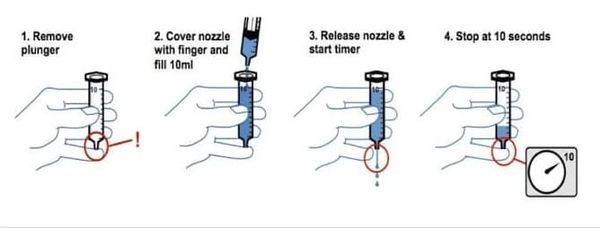
Syringe Flow Test (Levels 0–4 liquids): Fill a 10ml BD Slip Tip syringe, hold it horizontally for 10 seconds, and measure how much liquid remains. The amount remaining tells you the level. Full instructions in our syringe flow test guide.
Fork Drip Test (Levels 1–3 liquids): Dip a fork in the liquid and lift it horizontally. Observe how liquid flows through the tines — fast and continuous (Level 0–1), slow dollops (Level 2–3), or not at all (Level 4).
Spoon Tilt Test (Levels 3–5 foods): Load a teaspoon with the food and tilt sideways. The food should slide off in one cohesive movement — not pour like liquid and not stick firmly.
Fork Pressure Test (Levels 5–6 foods): Press the side of a fork against a piece of food. It should yield and mash under gentle thumb pressure — equivalent to tongue pressure against the roof of the mouth.
Thumbnail Pressure Test (Levels 6–7 foods): Press a thumbnail against a piece of food. The thumbnail should blanch white under the pressure needed to squash the food. If more force is required — the food is too hard for Level 6.
Our Level-Specific Diet Guides
If you're looking for practical food lists, meal plans, and cooking guidance for a specific level, we've written a complete diet guide for each level:
- IDDSI Level 4 Diet: Complete Food List and 7-Day Meal Plan
- IDDSI Level 5 Diet: Minced and Moist Guide
- IDDSI Level 6 Diet: Soft and Bite-Sized Guide
- IDDSI Levels 0–7: Plain-Language Guide for Caregivers
Frequently Asked Questions
Is the IDDSI framework free to download and share?
Yes. The IDDSI Framework and Descriptors are licensed under the Creative Commons Attribution-ShareAlike 4.0 International License — which means anyone can download, print, copy, and share them freely, provided they attribute IDDSI correctly and do not modify the framework content. Commercial use requires permission from IDDSI.
Is this the most current version?
The poster uploaded on this page is the 2024 Adult version. The most current English version is dated 7 August 2024 and is available directly from iddsi.org. We link to the official IDDSI site for all downloads to ensure you always access the most current version. Link here
Are these handouts available in other languages?
Yes — there are separate handouts for adults and for babies and children, and IDDSI has produced translations in multiple languages. The full list of available language versions is on the IDDSI patient handouts page.
Can I give these handouts to my mother's care home or hospital?
Yes — this is exactly what they're designed for. The individual-level handouts were created in consultation with clinicians and patients specifically to be shared in care settings. Print as many copies as needed.
What is the difference between the poster and the individual-level handouts?
The poster shows all 8 levels on one page — useful as a wall reference showing the whole picture. The individual level handouts cover one level each in more detail — with specific food examples, foods to avoid, and testing instructions for that level. Most caregivers use both: the poster for quick daily reference and the specific handout for the prescribed level.
What syringe do I need for the flow test?
The BD Slip Tip 10ml syringe is the IDDSI-validated syringe. Other 10ml syringes have different internal bore diameters that affect flow rate — results are not directly comparable to IDDSI benchmarks. Our full syringe test guide covers everything, including where to buy it.
References
International Dysphagia Diet Standardisation Initiative. (2019, updated 2024). IDDSI Framework and Descriptors V2.2. Licensed under Creative Commons Attribution-ShareAlike 4.0. https://www.iddsi.org/framework
International Dysphagia Diet Standardisation Initiative. (2019). Patient handouts — adult and paediatric. https://www.iddsi.org/resources/patient-handouts
International Dysphagia Diet Standardisation Initiative. (2019, updated 2026). Testing cards. https://www.iddsi.org/resources/testing-cards
Cichero, J. A. Y., et al. (2017). Development of international terminology and definitions for texture-modified foods and thickened fluids used in dysphagia management. Dysphagia, 32(2), 293–314. https://doi.org/10.1007/s00455-016-9758-y