Dysphagia Severity Scale: DSS, FOIS, and PAS Explained
DSS, FOIS, and PAS — three scales used to assess dysphagia severity, each measuring something different. Here's what each score means and what it means for daily life at home.


When you or your loved one is first diagnosed with dysphagia, your doctor or specialist will typically recommend various tests to determine how severe the swallowing difficulties are, including the Dysphagia Severity Scale (DSS).
When the SLP first hands you a sheet with numbers and scales after a swallowing assessment, it is all very confusing. DSS Level 4. PAS Level 6. FOIS Level 3. Each number comes from a different tool measuring a different aspect of swallowing, the three separate scales, each answering a different clinical question.
This article explains what each scale actually measures, how they relate to each other, and — most importantly — what the scores mean for the person eating at your table. This instrument has several versions from different researchers and experts. The most widely used are the DSS Scale by Waxman et al. (1990), FOIS, and PAS.
Different Types of Dysphagia Severity Scale (DSS) Instruments
Healthcare providers usually use these Dysphagia Severity Scale instruments to check how severe someone's dysphagia is. Each scale looks at different aspects of swallowing, and the results will help the healthcare providers figure out the best treatment plan and safety recommendations. Let's dive into some known instruments that have been used for years.
1. DSS Scale
The Dysphagia Severity Scale (DSS), created by Waxman et al. (1990), provides an overall severity classification of swallowing function across seven levels — from normal swallowing to complete inability to eat or drink by mouth. It is typically used to guide the overall management plan and communicate severity between members of the care team.
| Level | Description |
| Level 1 | Normal swallowing ability with no restrictions |
| Level 2 | Functional swallowing with minimal symptoms |
| Level 3 | Mild dysphagia requiring diet modifications |
| Level 4 | Moderate dysphagia with increased aspiration risk |
| Level 5 | Moderate-severe dysphagia requiring significant modifications |
| Level 6 | Severe dysphagia with minimal oral intake |
| Level 7 | Profound dysphagia requiring alternative nutrition |
2. FOIS
The Functional Oral Intake Scale (FOIS) focuses on what someone can eat and drink in real life, making it useful for tracking progress and setting realistic goals over time.
The key difference between DSS and FOIS is their approach to assessment. While DSS evaluates overall swallowing function and considers multiple factors like feeding independence and aspiration risk, FOIS specifically measures functional oral intake without getting into the technical details of how swallowing works.
| Level | Description |
| Level 1 | Nothing by mouth |
| Level 2 | Tube dependent with minimal attempts at food or liquid |
| Level 3 | Tube dependent with consistent oral food or liquid |
| Level 4 | Total oral diet of a single consistency |
| Level 5 | Total oral diet with multiple consistencies, but requiring special preparation |
| Level 6 | Total oral diet with multiple consistencies without special preparation, but with specific food limitations |
| Level 7 | Total oral diet with no restrictions |
3. PAS
The Penetration-Aspiration Scale (PAS) focuses specifically on airway safety during swallowing, providing detailed information that helps healthcare teams make informed decisions about eating safety.
What makes PAS different from both DSS and FOIS is its focus on one important thing: whether food or liquid goes down the wrong pipe into the airway and how the body reacts to it. While DSS looks at overall swallowing ability and FOIS measures what someone can eat and drink, PAS focuses specifically on breathing safety during swallowing. This makes PAS especially useful for checking if it's safe for someone to eat and drink normally.
| Level | Description |
| Level 1 | Material does not enter the airway |
| Level 2 | Material enters the airway, remains above the vocal folds, ejected |
| Level 3 | Material enters the airway, remains above the vocal folds, not ejected |
| Level 4 | Material enters the airway, contacts the vocal folds, ejected |
| Level 5 | Material enters the airway, contacts the vocal folds, not ejected |
| Level 6 | Material enters the airway, passes below the vocal folds, ejected |
| Level 7 | Material enters the airway, passes below the vocal folds, not ejected despite effort |
| Level 8 | Material enters the airway, passes below the vocal folds, no effort to eject |
How the Three Scales Work Together
These three scales are not interchangeable — they measure different things and are used at different points in the assessment process. Understanding the relationship between them helps caregivers make sense of what different specialists are measuring and why.
The DSS gives an overall severity classification — a single number that summarises the global picture and guides the management plan. Think of it as the headline finding.
The FOIS measures functional oral intake — what the person can actually eat and drink in daily life. Unlike DSS and PAS, which are used in formal assessments, FOIS is also used as a progress monitoring tool over time. A FOIS score at discharge from the hospital compared to a FOIS score three months later shows whether oral intake has improved in practice.
The PAS is specifically about airway safety — whether material is entering the airway during swallowing and how the body responds. A PAS score is typically generated from a VFSS or FEES assessment, where the clinician can directly observe whether penetration or aspiration is occurring and whether the person coughs it clear. A PAS Level 8 — silent aspiration with no effort to eject — is the most clinically significant finding and warrants immediate management changes.
A person might have a DSS Level 4 (moderate dysphagia), a FOIS Level 3 (tube-dependent with some oral intake), and a PAS Level 6 (material passing below the vocal folds but ejected) simultaneously. Each number answers a different question about the same swallowing difficulty.
How Dysphagia Severity Is Assessed
Getting properly assessed for dysphagia involves working with healthcare professionals who use specific evaluation methods. While this assessment can't be done at home, a professional evaluation provides valuable information for managing swallowing difficulties safely.
1. Clinical Assessment
This is typically where the assessment process begins, with healthcare providers gathering information about swallowing challenges and determining which tests would be most helpful.
a) History and Symptoms Severity
The healthcare team will want to understand the patient's experience:
- When did the swallowing difficulty problems start?
- What makes the condition worse?
- How does the swallowing difficulty affect daily activities?
This conversation helps determine which assessment tools will provide the most useful dysphagia severity scale information for the situation.
b) Water Swallow Test
This straightforward test involves drinking measured amounts of water while the clinician observes for signs of swallowing difficulty. It provides initial insights into swallowing safety and helps determine if more detailed testing is needed.
c) Volume-Viscosity Swallow Test (V-VST)
This test involves trying different amounts and thicknesses of liquids, giving the healthcare team information about which consistencies work best for the patient. The results help create a plan based on the dysphagia severity scale assessment.
2. Instrumental Assessment
When more detailed information is needed, these specialized evaluations provide comprehensive insights into the swallowing process and help determine precise severity levels.
a) Videofluoroscopic Swallowing Study (VFSS)
Often considered the gold standard for dysphagia assessment, VFSS uses real-time X-ray imaging to observe the entire swallowing process. The patient consumes various textures mixed with a safe contrast material, and imaging captures the swallowing mechanics. This detailed evaluation helps identify specific problems and provides accurate dysphagia severity scale placement.
b) Fiberoptic Endoscopic Evaluation of Swallowing (FEES)
FEES uses a thin, flexible camera inserted through the nose to provide direct visualization of throat structures during swallowing. This assessment method offers clear views of laryngeal function and can detect swallowing problems that other methods might miss. Combined with other assessment findings, FEES helps establish a comprehensive understanding of dysphagia severity.
What the Scores Mean in Practice
Clinical scores only become useful when they connect to daily life. Here's what different score ranges typically mean at the table:
DSS Levels 1–2 — Normal to functional swallowing. The person may have occasional mild symptoms but manages most foods and drinks without modification. Regular monitoring is appropriate, but significant dietary changes are unlikely to be needed at this stage.
DSS Levels 3–4 — Mild to moderate dysphagia. Texture modification is typically required for some or all foods and liquids. An IDDSI level will have been prescribed — our IDDSI Level Guide explains what each level means in practical terms. Mealtimes require closer supervision, and positioning is important.
DSS Levels 5–6 — Moderate-severe to severe dysphagia. Oral intake may be significantly restricted. Many people at this level rely partly on nutritional supplements or tube feeding alongside whatever oral intake is safe. Mealtimes require close caregiver involvement, and the risk of aspiration pneumonia is a genuine daily consideration.
DSS Level 7 — Profound dysphagia. Alternative nutrition — typically a PEG tube — is the primary nutrition source. Oral intake, if any, is for comfort or pleasure only and is managed with extreme care under SLP guidance.
PAS Levels 1–2 — Material does not enter the airway, or enters but is cleared above the vocal folds. Generally manageable with appropriate texture modification and positioning.
PAS Levels 3–5 — Material reaches or contacts the vocal folds. Significant aspiration risk — texture modification, thickened liquids, and close supervision are typically required.
PAS Levels 6–7 — Material passes below the vocal folds. Serious aspiration risk. Management changes are usually immediate and significant.
PAS Level 8 — Silent aspiration. Material passes below the vocal folds with no cough response. This is the most clinically significant PAS finding. If your loved one has been given a PAS Level 8 score, close SLP involvement and conservative management are essential — this is the swallowing profile most associated with aspiration pneumonia.
What To Do After Knowing Your Dysphagia Severity Level
Learning where someone falls on the dysphagia severity scale is the starting point — not the destination. The score tells you and the care team how significant the swallowing difficulty is and what level of modification is needed. From there, the practical focus is on implementing those changes safely and sustainably at home.
The most important first step is understanding the IDDSI level that has been prescribed alongside the DSS assessment. The IDDSI framework translates the clinical severity score into practical food and drink standards — what textures are safe, how to test consistency at home, and what to avoid. If no IDDSI level has been communicated alongside the DSS score, ask the SLP directly — the two pieces of information belong together.
Keep Meals Interesting with Texture Changes and a Meal Plan
Finding out someone's position on the dysphagia severity scale doesn't mean giving up favorite foods; it's about learning how to enjoy them safely. The key is creating weekly meal plans that match your required thickness levels with foods you actually like eating.
Start by listing favorite meals, then learn how to modify their textures while keeping the flavors. For example, chicken curry can be blended with extra sauce to maintain taste while meeting pureed consistency needs.
Once you've figured out these modifications, you can learn to create a periodical meal plan to avoid stressing out about what foods/drinks on the next meal. Aside from that, creating a structured weekly meal plan helps you stay organized and even prepare the foods/drinks as early as possible. Here's an example of what a week might look like for someone requiring IDDSI level 4 food/drink consistency:
| Day | Breakfast | Lunch | Snack | Dinner |
|---|---|---|---|---|
| Monday | Puréed oatmeal with banana | Blended chicken and vegetable soup | Smooth yogurt | Puréed beef stew with mashed potatoes |
| Tuesday | Smooth scrambled eggs | Puréed tuna with mayonnaise — served in bowl, no crackers | Smooth pudding | Blended pasta with meat sauce — strained smooth |
| Wednesday | Puréed fruit smoothie | Creamy tomato soup — no bread | Puréed applesauce | Puréed fish with mashed vegetables |
| Thursday | Puréed oat porridge with honey | Blended lentil soup | Smooth yogurt | Puréed chicken curry with blended rice |
| Friday | Puréed breakfast bowl | Creamy mushroom soup | Smooth custard | Blended meatloaf with gravy — strained smooth |
| Saturday | Smooth porridge | Puréed sandwich filling — served in bowl, no bread | Milkshake thickened to IDDSI Level 4 | Blended stir-fry with sauce — strained smooth |
| Sunday | Blended egg custard with vanilla | Creamy potato soup | Smooth custard | Puréed roast dinner |
Always verify each item with the spoon tilt test before serving — the preparation method affects the final IDDSI level. Remove Jello, crackers, soft bread, and standard pancakes from any Level 4 meal plan — these do not achieve a safe Level 4 consistency.
Learn to Do the Flow Test at Home
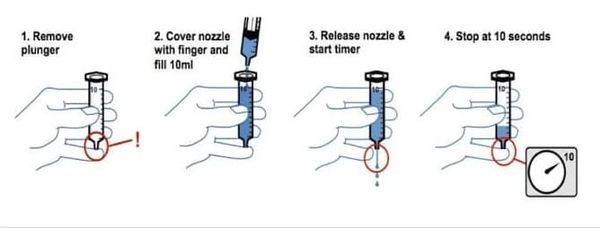
Learning how to do IDDSI flow tests at home helps you check liquid thickness independently, which is useful as you work with different levels of the dysphagia severity scale. You just need a 10ml syringe, a timer or stopwatch, and a flat surface to perform these tests.
We already created a full guide on how to do an IDDSI flow test at home using these tools. You can check it here.
Understanding where your loved one sits on the dysphagia severity scale gives you the clinical foundation — but the day-to-day work of managing dysphagia at home is where most of the real effort happens. Our complete guide to managing dysphagia at home covers the practical side in detail — from kitchen setup to mealtime positioning to caregiver wellbeing. And if you have questions about specific foods or consistency testing, our recipe section has dishes built specifically for IDDSI Levels 4–6, each with at-home consistency checks built in.
Frequently Asked Questions
What is a normal dysphagia severity scale score?
On the DSS scale, Level 1 represents normal swallowing with no restrictions. On the FOIS, Level 7 represents a total oral diet with no restrictions. On the PAS, Level 1 means material does not enter the airway at all. In clinical practice, a score at the "normal" end of any scale means no dietary modification is needed — but even a score of Level 2 on any scale warrants monitoring, particularly in progressive neurological conditions where function can decline over time.
What is the difference between DSS and FOIS?
The DSS evaluates overall swallowing function and severity — it considers the mechanism of the swallow, aspiration risk, and independence. The FOIS measures only functional oral intake — what the person is actually eating and drinking in real life. The two scales often align but can diverge: a person might have moderate dysphagia on the DSS (significant swallowing difficulty) but a FOIS Level 5 or 6 (still eating a full oral diet with modifications) if they are managing well with the right food textures and support.
What does PAS Level 8 mean?
PAS Level 8 means material enters the airway, passes below the vocal folds, and the person makes no effort to eject it — there is no cough response. This is silent aspiration in its most significant form. It is the PAS finding most closely associated with aspiration pneumonia because the material enters the lungs repeatedly without any protective mechanism. If your loved one has been given a PAS Level 8 score, close SLP involvement and conservative management are essential.
Can dysphagia severity improve over time?
Yes — depending on the cause. Post-stroke dysphagia often improves significantly in the weeks to months following the stroke, particularly with SLP-guided therapy. DSS and FOIS scores improve as swallowing function recovers. In progressive neurological conditions like Parkinson's or dementia, scores typically worsen over time as the underlying condition advances. Age-related dysphagia (presbyphagia) can often be stabilised or improved with targeted exercise and modification. Regular reassessment with an SLP tracks changes in severity over time.
Who administers the dysphagia severity scale?
All three scales — DSS, FOIS, and PAS — are administered by speech-language pathologists. The PAS in particular requires instrumental assessment (VFSS or FEES) to observe airway events directly. These assessments cannot be performed at home. If you feel your loved one's swallowing has changed since their last assessment, request a re-referral to an SLP through your GP or the treating medical team.
References
- Waxman, M. J., Durfee, D., Moore, M., & Morantz, R. A. (1990). Nutritional aspects and swallowing function of patients with Parkinson's disease. Nutrition in Clinical Practice, 5(5), 196-201. Available at: https://doi.org/10.1177/011542659000500502
- Cichero, J. A., Lam, P., Steele, C. M., Hanson, B., Chen, J., Dantas, R. O., ... & Stanschus, S. (2017). Development of international terminology and definitions for texture-modified foods and thickened liquids used in dysphagia management: The IDDSI framework. Dysphagia, 32(2), 293-314. Available at: https://doi.org/10.1007/s00455-016-9758-y
- Rosenbek, J. C., Robbins, J. A., Roecker, E. B., Coyle, J. L., & Wood, J. L. (1996). A penetration-aspiration scale. Dysphagia, 11(2), 93-98. Available at: https://doi.org/10.1007/bf00417897