Eating Out with Dysphagia: A Practical Guide for Caregivers
A real caregiver's guide to eating out with dysphagia — what to pack, what to order, how to talk to restaurant staff, and how to handle air travel. Written from lived experience.

The first time I took my mother to a restaurant after her dysphagia diagnosis, I spent two hours beforehand googling which places nearby served soups — just soups, nothing adventurous. I packed a small food box just in case. When we arrived, the server asked if we had any allergies. I tried to explain dysphagia. She had never heard the word. She went to ask the chef. The chef hadn't heard it either. The meal was fine in the end — we managed — but I drove home, realising I had been completely unprepared for the gap between what I needed and what the restaurant world was equipped to provide.
That gap hasn't closed much. But knowing it exists — and having a plan for it — changes everything.
This guide is for caregivers who want to keep eating out, attending family gatherings, and travelling without turning every outing into a clinical exercise. It covers what to prepare, what to look for on a menu, how to talk to restaurant staff in a way that actually works, and what to do when things don't go to plan.
The Honest Starting Point: Restaurants Aren't Built for Dysphagia
Most restaurant staff have never heard of dysphagia. If you call ahead and use the word, the conversation will almost certainly end in confusion. If you arrive and explain it at the table, the server will ask if it's an allergy — because that's the framework they have. It isn't their fault. Dysphagia awareness in food service is almost nonexistent.
A 2026 research review of the menus of the three largest US airlines — American, United, and Delta — found no clearly identifiable mildly or moderately thick liquid options (IDDSI Level 3) across any of their economy-accessible menus. If the aviation industry hasn't addressed this, the average restaurant certainly hasn't either.
This means the responsibility falls entirely on the caregiver. The good news is that responsibility is manageable — once you know what you're working with.
Know Your Level Before You Go
Your loved one's IDDSI level determines what is and isn't safe at a restaurant, and it changes what you're looking for on a menu.
IDDSI Level 3 (Moderately Thick / Liquidised): All foods with lumps, seeds, husks, or fibrous pieces are prohibited. Foods should be smooth and free of any bits, and any liquid within the food must not have separated off. At this level, restaurant options are limited but not impossible — smooth soups, blended dishes, and well-puréed options are the primary targets.
IDDSI Level 4 (Puréed): Thicker than Level 3 — holds shape on a spoon. Examples include smooth soups, blended meat with thick gravy, liquidised casseroles, puréed fruit with cream, smooth yogurt, and custard. Fewer natural menu options than Level 3 — most Level 4 meals require some modification at the table or need to be brought from home.
IDDSI Level 5 (Minced and Moist) and Level 6 (Soft and Bite-Sized): Significantly more restaurant options are available — more mainstream menus can accommodate these levels with minor modifications.
If you're unsure which level applies, confirm with your SLP before any outing. Our IDDSI Level Guide explains each level in practical terms.
What to Look for on a Menu
The key question for every restaurant is: Does this menu have anything that is naturally at or close to the right IDDSI level, or does everything need significant modification?
Restaurant Types That Work Best for Level 3
Asian restaurants — and specifically:
Congee (rice porridge): Naturally liquidised at the right consistency for Level 3. Found at most Chinese, Vietnamese, and Cantonese restaurants. Ask for it plain or with a smooth protein — avoid versions with intact garnishes, spring onion pieces, or fried toppings. A reliable standby in LA's extensive Asian dining scene.
Ramen and pho broth: The broth itself is Level 0 — you'd need to add thickener. But many ramen restaurants will blend the egg and softer toppings into the broth on request. Use this as a base to work from rather than a ready-made solution.
Smooth tofu dishes: Silken tofu in a smooth sauce is naturally close to Level 4–5. Japanese miso soup with silken tofu sits at approximately Level 3, depending on preparation.
Soup-focused restaurants: A restaurant whose menu is built around soups — bisques, cream soups, puréed vegetable soups — is the most practical choice for a Level 3 diner. Avoid chunky soups, minestrone, or anything described as "hearty" or "rustic." Ask specifically: "Is this soup completely smooth or does it have pieces in it?"
Indian restaurants: Dal (lentil soup), smooth curries, and raita are all potentially Level 3 depending on preparation. Saag (spinach) dishes blended smoothly are a reliable option. Avoid dishes described as having chunks of vegetables or meat unless you can blend them at the table.
Italian restaurants: Bisque-style soups, smooth pasta sauces blended through a fork (messy but possible), panna cotta, and tiramisu for dessert. Avoid pasta with intact pieces — focus on smooth sauces and creamy dishes.
Smoothie and juice bars: For Level 3 drinks specifically, a smoothie bar can be your best friend — most will blend to order, and you can add your own thickener at the table. Ask for no ice (which creates variable consistency) and no whole seeds or fruit pieces.
Restaurant Types That Are Harder
Steakhouses and grill restaurants: Almost nothing on the menu works for Level 3 without significant modification. The food culture is fundamentally incompatible. Avoid unless you're bringing your own meal.
Sushi restaurants: Raw fish and rice are unsafe for Level 3. Miso soup is manageable but barely a meal. A last resort.
Fast food: Almost entirely incompatible with Level 3. The closest option — a milkshake with added thickener — is possible, but not a meal.
How to Talk to Restaurant Staff
Forget the word "dysphagia" when talking to staff. It seldom lands. Instead, use language they understand:
What to say instead:
"My mother has a swallowing condition and needs food that is completely smooth — no lumps or pieces at all. Completely blended. Can the kitchen do that?"
"She can't swallow anything with texture. Is your soup completely smooth, or does it have bits in it?"
"Could the kitchen blend this dish until it's completely smooth? No pieces of any kind."
The key words are: completely smooth, no lumps, no pieces, blended. These are concepts any kitchen understands, even if they don't know what dysphagia means.
Before you go — the phone call that works:
Rather than explaining the medical condition, call ahead and frame it as a simple preparation request:
"Hi, I'm bringing my mother in for lunch on Saturday. She has a medical condition that means she needs completely smooth, blended food — no pieces or lumps at all. I wanted to check whether your kitchen can accommodate that, and whether there are dishes on your menu that would work well. We're happy to keep it simple."
Most restaurants are willing to accommodate when the request is specific and framed as a preparation note rather than a medical issue. Chefs respond to instructions they can act on.
What to do when it goes wrong:
It will go wrong sometimes. The soup arrives with croutons. The blended dish has a piece of vegetable in it. The staff reassures you it's fine when it isn't.
The response that works: "I'm sorry — I can see this has some pieces in it. Could you blend it again until it's completely smooth? It's not a preference, it's a medical necessity." The phrase medical necessity changes the tone of the conversation more reliably than any other.
If it can't be fixed, you have your backup food. Use it without apology. Order something for yourself, let your mother eat what you brought, and enjoy the outing anyway. The goal is being out together — the restaurant is just the setting.
The Travel Kit: What to Actually Bring
The most practical approach to eating out is not to rely entirely on the restaurant. The travel kit changes a potentially stressful outing into a manageable one because you always have a safe option available.
The essentials:
Your loved one's dysphagia cup — don't leave home without it. A standard restaurant glass or cup is not appropriate for Level 3. Bring your preferred flow-control cup. It looks enough like a normal cup that it doesn't draw attention at the table. Can check the review of dysphagia cups here: Flow Regulating Dysphagia Cups Comparison
Thickener sachets — individual SimplyThick gel packets or Nutilis Clear sachets. Pre-measured, pocket-sized, and discreet. One packet per drink. Keep five or six in your bag as standard — you'll use them for water, juice, anything the restaurant serves. This is the single item that makes any restaurant visit manageable for a Level 3 diner. Best Food Thickeners for Dysphagia: Starch, Gum, and Gel Options Compared.
A small food box — pre-prepared food from home in a sealed container, at the right IDDSI level, ready to serve at the table if the restaurant can't accommodate. Yes, it feels like carrying baby food. Yes, other diners might notice. The person eating it doesn't have to eat hospital food alone at home — they're at the table with the family, and that matters more than what's in the container.
A spoon — your own spoon, not the restaurant's. A maroon spoon or a teaspoon, you know works well for Level 3.
Wet wipes — Level 3 eating can be messier than standard. Wipes in the bag, not just at the table.
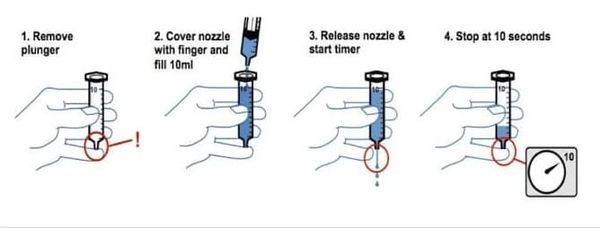
Optional: the IDDSI testing syringe — for longer outings where you're preparing thickened drinks away from home. Overkill for a local lunch; worth having for a full day out or a trip. IDDSI Flow Test at Home: Step-by-Step Guide With Photos
Family Gatherings: The Different Problem
A restaurant at least has a kitchen and staff who can try to accommodate requests. A family gathering often has a host who has spent three days cooking and doesn't know what to do with your request.
Call the host before, not on the day. Explain what's needed simply: "Mum needs completely smooth food — anything blended smooth works. I'll bring her main course, but if there's a soup or a smooth dessert, I can let you know what she can have."
Bring food that looks like food. A Tupperware box of beige purée at Christmas dinner is isolating. A portion of the same dish that everyone else is eating — blended smooth and served on a proper plate — is different. If you can make it to the gathering, the host will often save a portion of the meal before serving it for you to blend.
Have a simple explanation ready for the extended family. Relatives who haven't seen your mother since the diagnosis will ask questions — often loudly, at the table, at exactly the wrong moment. A one-sentence response that closes the conversation: "Mum has a swallowing condition that means food needs to be blended. She's fine — let's eat."
Air Travel: Bring Your Own Food
A 2026 study reviewing publicly available menus from American, United, and Delta found no clearly identifiable IDDSI Level 2–3 options across any of the three carriers. Special meal options — diabetic, vegan, low-sodium, soft — do not align with IDDSI levels and were not designed for dysphagia management. Reference: NCBI,
The instinct to bring your own food on a plane is correct. Here's how to do it practically:
Security: Thickened liquids and puréed foods are subject to TSA liquid rules in the US. Thickened drinks above 3.4 oz (100 ml) may be questioned at security. The most reliable approach is to carry your thickener sachets separately and add them to purchased drinks airside — past security, in the gate area, or on the plane. Puréed solid food in a sealed container is generally not restricted.
On the plane: Pre-prepared food in a sealed container, thickener sachets in your carry-on, and your loved one's cup in the bag. A flight attendant will usually provide a cup of water on request — add thickener at the seat. Avoid ordering drinks from the trolley unless you have a thickener to add immediately.
For longer flights: Consider pre-ordering a baby food jar or smooth soup from the airline's special meal options as a supplementary option — not as the primary plan, but as a backup if your food runs out. The quality and IDDSI compliance will be inconsistent, but it provides something at least.
Timing meals around the flight: For short flights under two hours, eating before boarding is the simplest strategy. The stress of eating on a plane — turbulence, limited space, unfamiliar staff — adds variables that don't exist at home. A proper meal in the airport before boarding is significantly easier than managing Level 3 at 35,000 feet.
The Emotional Side
There is a version of this that is just logistics — the kit, the phrases, the menu knowledge. And those things matter. But the harder part is the emotional dimension of eating out with dysphagia, and it deserves to be named.
For the person with dysphagia: eating used to be one of the pleasures of daily life. Now it requires planning, equipment, and sometimes bringing your own food to a restaurant. That loss is real. The goal isn't to pretend it isn't different — it's to make it as normal as possible within what's manageable. Being out, being at the table, being part of the social ritual of a meal matters enormously — even if what's in the bowl is different from everyone else's.
For the caregiver: The fatigue of being the person who always thinks ahead — the one who Googled restaurants for two hours, packed the food box, called ahead, managed the conversation at the table — is real and cumulative. It's worth acknowledging rather than normalising. The preparation gets faster with practice. The first ten outings are the hardest. After that, the kit is packed automatically, and the menu questions come without thinking.
On using equipment at the table: A dysphagia cup at a restaurant table will occasionally attract attention. Most people are kinder than you expect. The best response to curious looks is confident indifference — the cup is there because it's needed, and that's enough.
Quick Reference: What Works for IDDSI Level 3 at Restaurants
| Restaurant Type | Safe Options | Watch Out For |
|---|---|---|
| Chinese / Cantonese | Congee, smooth tofu dishes, smooth broth | Garnishes, spring onion, fried toppings, intact pieces |
| Vietnamese | Plain congee, smooth broth | Bean sprouts, herbs, solid toppings in pho |
| Japanese | Miso soup with silken tofu, chawanmushi (egg custard) | Rice, noodles, anything with intact pieces |
| Indian | Smooth dal, blended curry, raita, lassi with thickener | Chunky curries, rice, bread, unblended vegetables |
| Italian | Cream soups, smooth bisque, panna cotta | Pasta pieces, chunky sauces, anything with texture |
| American diner | Smooth cream soups, smooth mashed potato (blended further) | Almost everything else |
| Smoothie bar | Blended smoothies with thickener added | Ice, whole seeds, fruit pieces |
| Avoid | Steakhouses, sushi, fast food | Incompatible menu formats for Level 3 |
Your Pre-Outing Checklist
Before leaving home, run through this quickly:
- Thickener sachets packed (minimum 5–6)
- Dysphagia cup in bag
- Food box prepared if needed
- Spoon packed
- Restaurant called or menu checked online
- Arrival time allows for unhurried eating — no time pressure at the table
- Person seated upright before any food or drink is served
Frequently Asked Questions
Can someone with dysphagia eat at a restaurant safely?
Yes — with preparation. The key is knowing the IDDSI level, identifying restaurants with menu options that work at that level, carrying thickener sachets, and having a backup food option. Level 3 and Level 4 require more preparation than Level 5 or 6, but eating out remains possible at all levels with the right approach.
Should I tell the restaurant about dysphagia before arriving?
A phone call ahead is worth making, but frame it as a preparation request rather than a medical explanation — staff respond better to specific instructions ("completely smooth, no pieces") than to a medical term they don't know. See the script above.
Can I bring my own food to a restaurant?
In most cases, yes — and for Level 3 and Level 4 diners, bringing backup food is simply practical. Most restaurants are understanding when the situation is explained simply. The alternative — staying home — is not the goal.
What if thickened drinks look strange at the restaurant table?
Clear gum-based thickeners like SimplyThick or Nutilis Clear stay clear in most drinks and are barely visible once mixed. Starch-based thickeners turn drinks cloudy. For restaurant outings where appearance matters, gum-based thickeners are significantly less conspicuous. Our thickener comparison guide covers the differences.
Can I take a thickener through airport security?
Thickener sachets (powder or gel) are generally fine in carry-on luggage. Pre-mixed thickened drinks follow liquid rules — above 3.4oz may be questioned. The practical solution is to carry dry sachets and mix them with purchased drinks after security.
What cuisines work best for dysphagia?
Asian cuisine — particularly Chinese, Vietnamese, and Japanese — offers the most naturally Level 3–4 compatible dishes on a standard menu. Congee, smooth broths, silken tofu, and egg custard dishes are the most reliably safe options across multiple IDDSI levels. Indian cuisine's smooth dals and blended curries are a close second.
References
Cino, K., Shashikumar, R., Troxell, L., Seeley, H., & Seshadri, S. (2026). Enabling equitable and inclusive travel experiences for dysphagia patients: a call to action for the aviation industry. Frontiers in Rehabilitation Sciences. https://pmc.ncbi.nlm.nih.gov/articles/PMC13079311/
IDDSI Framework. (2019, updated 2026). Complete framework and detailed definitions V2.2. https://www.iddsi.org/framework
American Speech-Language-Hearing Association. (n.d.). Adult dysphagia (Practice Portal). https://www.asha.org/practice-portal/clinical-topics/adult-dysphagia/
Zuraw, M., et al. (2025). Identifying unmet needs of dementia caregivers managing dysphagia. Innovation in Aging. https://pmc.ncbi.nlm.nih.gov/articles/PMC12761992/eating