Thickened Liquids and Liquidised Food: IDDSI Levels, Examples and Differences
Thickened liquids and liquidised foods aren't the same thing — even when they look identical in a bowl. Here's what the IDDSI difference means in practice.

The first time a discharge letter mentioned both "thickened liquids" and "liquidised foods" in the same paragraph, I assumed they were the same thing described two different ways. They're not — and the distinction matters more than it might seem when you're standing at the kitchen counter trying to work out whether to blend or thicken.
Both terms describe modified textures designed for safer swallowing. Both sit within the IDDSI framework. But they start from different places — one starts as a liquid that gets thickened, the other starts as food that gets liquidised — and they serve different purposes at the table depending on the meal, the consistency level, and what has been prescribed.
This article explains what thickened liquids and liquidised food actually are, what each IDDSI level looks like in practice, where the two overlap, and how to know which one applies to your situation.
What Are Thickened Liquids?
Thickened liquids are drinks — water, juice, tea, coffee, milk — that have had a commercial thickener added to slow their flow. The thickener increases the viscosity of the drink, giving the swallowing reflex more time to respond safely before the liquid reaches the airway.
Thin liquids — Level 0 — are the hardest consistency for most people with dysphagia to manage. They flow too fast for a compromised swallow reflex to coordinate a safe response. Adding thickener slows that flow down to a level the person can manage safely.
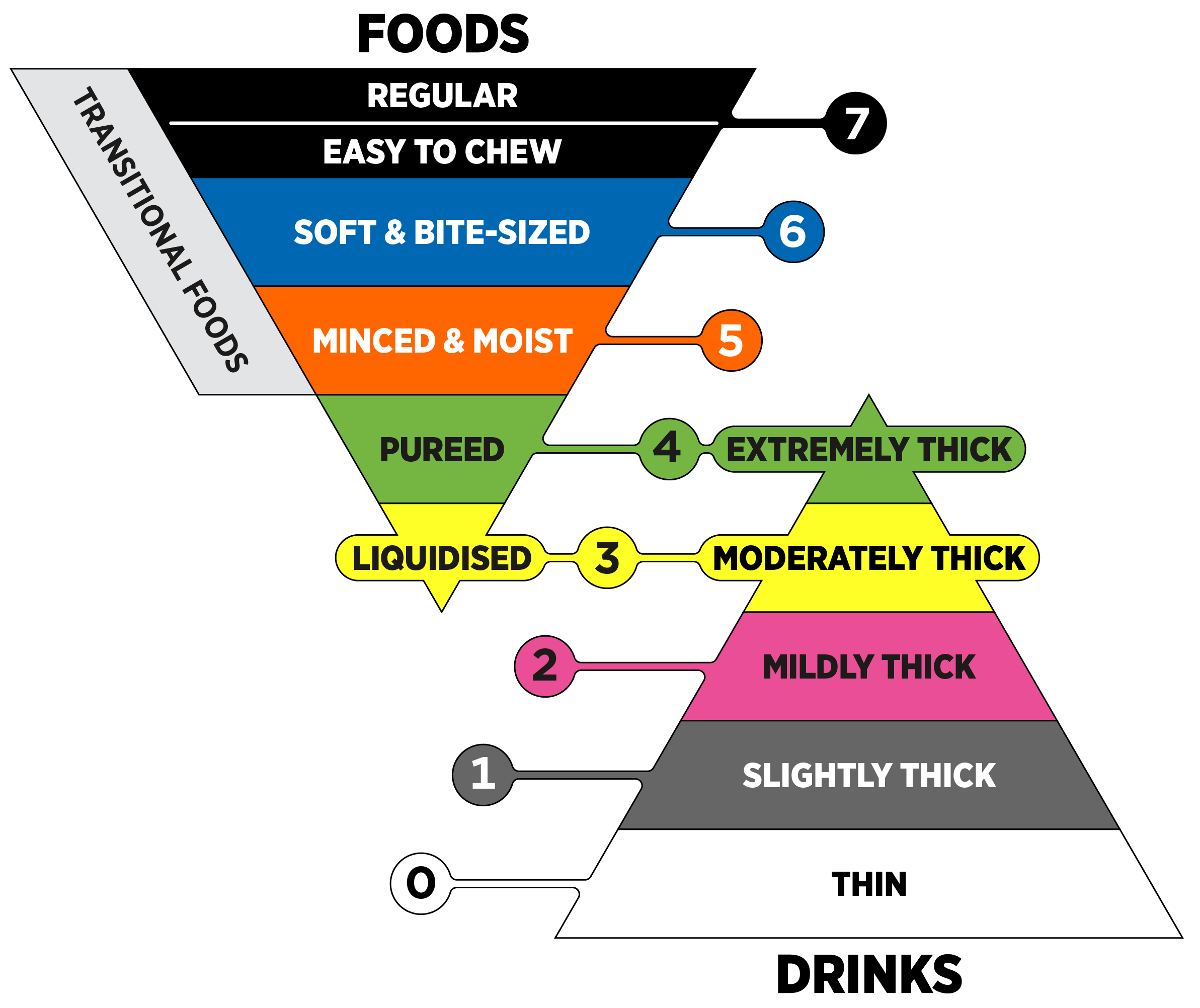
Thickened liquids cover IDDSI Levels 0 through 4. Here is what each level actually looks like:
| IDDSI Level | Name | What It Looks Like | Real Example |
|---|---|---|---|
| 0 | Thin | Flows freely — like water poured from a glass | Water, black coffee, apple juice, beer |
| 1 | Slightly Thick | Flows slower than water — barely noticeable difference | Tomato juice, some meal replacement drinks, eggnog |
| 2 | Mildly Thick | Pours in a slow, steady ribbon from a spoon | Thickened water with a small amount of commercial thickener |
| 3 | Moderately Thick | Drips slowly through fork prongs in separate dollops — not a stream | Thickened juice, drinking yogurt, smooth drinkable smoothie |
| 4 | Extremely Thick | Holds shape on a spoon — does not pour or flow — taken by spoon | Thickened custard, very thick thickened drink |
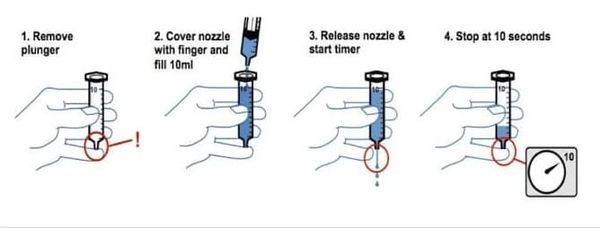
Testing thickened liquids at home: The IDDSI syringe flow test uses a 10ml BD Slip Tip syringe to measure how much liquid remains after 10 seconds of flow. Level 0 leaves less than 1ml. Level 4 barely flows at all. Our IDDSI syringe flow test guide covers the full process step by step with photos.
Choosing a thickener: Not all thickeners behave the same way in all drinks. Starch-based thickeners are widely available and affordable but can break down in acidic drinks and with saliva. Gum-based thickeners like SimplyThick or Nutilis Clear are more consistent and stay stable. Our gum-based thickener guide and drink-specific thickener guide cover the practical combinations in detail.
What Is Liquidised Food?
Liquidised food is solid food — a meal, a vegetable, a protein — that has been blended until completely smooth and reaches an IDDSI Level 3 or Level 4 consistency. It starts as food and becomes something that flows or holds shape depending on how it is prepared.
Liquidised food covers IDDSI Levels 3 and 4 only — unlike thickened liquids, which cover the full range from 0 to 4. Here is what each food level looks like:
| IDDSI Level | Food Name | What It Looks Like | Real Example |
|---|---|---|---|
| 3 | Liquidised | Completely smooth, flows slowly — can be drunk from a cup or eaten with a spoon | Smooth blended soup, smooth okayu congee, drinkable yogurt, smooth fruit purée |
| 4 | Puréed | Completely smooth, holds shape on a spoon — slides off in one cohesive movement | Smooth hummus, thick mashed potato, puréed chicken in sauce, smooth custard |
Testing liquidised food at home: The spoon tilt test is the primary check for Level 3 and Level 4 food. Load a teaspoon and tilt sideways — Level 3 flows and spreads, Level 4 slides off in one cohesive movement. The fork drip test confirms Level 3 — slowly separate dollops through the prongs.
Where They Overlap — And Why It Causes Confusion
This is the part that confuses almost every caregiver — and understandably so.
At Levels 3 and 4, the IDDSI framework covers both thickened liquids and liquidised food with the same level number. A Level 3 thickened liquid and a Level 3 liquidised food test identically — both must pass the same syringe test and fork drip test. A Level 4 extremely thick liquid and a Level 4 puréed food test identically — both must pass the same spoon tilt test.
The numbers are the same because the physical properties are the same. What differs is what the substance started as before modification.
Is Moderately Thick Liquid the Same as Puréed Food?
This is the most common confusion in IDDSI — and it comes from the fact that Level 3 and Level 4 appear on both the liquid side and the food side of the framework.
Level 3 Moderately Thick liquid and Level 3 Liquidised food test identically — but they are not the same thing.
A moderately thick drink is water, juice, or another liquid that has had thickener added until it drips slowly through a fork in separate dollops. A liquidised food is a meal — soup, blended chicken, puréed fruit — that has been processed until it flows at the same consistency. Both pass the same IDDSI test at Level 3. Both look similar in a bowl. But one started as a drink, and the other started as food.
The same applies at Level 4. Extremely thick liquid and puréed food both hold their shape on a spoon and pass the same spoon tilt test — but one is a thickened drink taken by spoon, the other is puréed food.
Why does this matter in practice?
Because your loved one may be prescribed different levels for food and liquid. A person prescribed Level 3 moderately thick liquids and Level 5 minced and moist food has two separate prescriptions — one for every drink, one for every meal. The numbers don't need to match. The food texture level and the liquid consistency level are always assessed and prescribed separately by the SLP.
For the full explanation of how food and liquid prescriptions work together — including a table of the most common combinations — see our IDDSI Food and Liquid Levels Guide.
Can Someone Have a Regular Diet and Still Need Thickened Liquids?
Yes — and this combination is more common than most people realise.
Someone can eat completely normal food at Level 7 Regular while all their drinks need to be thickened to Level 2 or Level 3. Swallowing difficulty doesn't always affect food and liquid equally — some people manage solid food without difficulty but struggle with the speed of thin liquids. Others need modified food but manage thin liquids safely.
Common combinations prescribed by SLPs:
| Food Level | Liquid Level | What This Means |
|---|---|---|
| Level 7 Regular | Level 2 Mildly Thick | Normal meals — all drinks slightly thickened |
| Level 7 Regular | Level 3 Moderately Thick | Normal meals — all drinks significantly thickened |
| Level 6 Soft and Bite-Sized | Level 1 Slightly Thick | Soft tender food — drinks barely thickened |
| Level 5 Minced and Moist | Level 3 Moderately Thick | Finely minced meals — drinks thickened |
| Level 4 Puréed | Level 3 Moderately Thick | Completely smooth food — drinks thickened |
| Level 4 Puréed | Level 4 Extremely Thick | Completely smooth food — drinks also by spoon |
The SLP assesses both independently and prescribes what is appropriate for each. Always confirm the exact combination with the SLP after the swallowing assessment rather than assuming one number applies to both.
Preparation Methods — Blending vs Thickening
Thickened liquids require a commercial thickener added to a drink. Measure according to the manufacturer's instructions for the prescribed level, stir or shake thoroughly, wait the full hydration time (60–90 seconds for gum-based, up to 15 minutes for starch-based), and verify with the syringe test before serving. Quick to prepare once the routine is established.
Liquidised food requires a blender — ideally a high-powered one for Level 4. The food is cooked until tender, blended with a liquid (stock, milk, cream — not water if possible, as it dilutes calories), and sieved to remove any fibres or lumps. Level 3 liquidised food flows more freely and may require a stick blender and sieve. Level 4 puréed food holds its shape and requires a high-powered blender for a reliably smooth result.
Both approaches can use commercial thickeners — adding a gum-based thickener to a blended soup, for example, can help it reach Level 3 consistency more reliably than blending alone. However, the dose needed for food is different from the dose for drinks — always test with the appropriate IDDSI test rather than relying on the dose alone.
Do You Need a Commercial Food Thickener?
The decision to use commercial thickeners needs careful consideration. While thickened liquids improve swallow safety, thickeners can affect medication effectiveness — some medications may be retained in the thickener rather than absorbed normally. Always check with a pharmacist before mixing medications with thickened liquids. Our dysphagia medication guide covers this in detail.
Commercial thickeners:
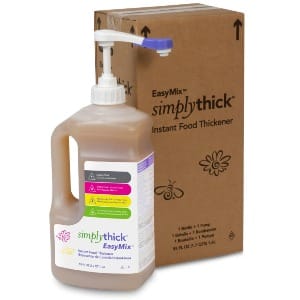
Here is an example of a commercial thickener, like SimplyThick. These products can be really helpful because they give consistent results every time. You measure, mix, and know exactly what thickness you're getting.
Pros: consistent thickness every time, clinically tested, quick to prepare, long shelf life.
Cons: can affect medication absorption, may taste artificial, ongoing cost.
Naturally thick foods as an alternative:
For Level 4 food specifically, many foods are naturally at or close to the right consistency without any thickener — smooth hummus, thick smooth yogurt, well-made smooth mashed potato, smooth custard, smooth avocado. Using naturally thick foods reduces the need for commercial thickeners in meals while maintaining the correct IDDSI level.
DIY food thickeners (flour, cream, butter):
Pros: better taste acceptance, more flexibility, cost-effective.
Cons: consistency is less predictable than commercial options, requires practice, and shelf life once prepared is shorter.
Regardless of which approach you use — always verify the final consistency with the IDDSI tests before serving. The method of preparation does not guarantee the level. The test confirms it.
Quick Summary — Thickened Liquid vs Liquidised Food
| Aspect | Thickened Liquid | Liquidised Food |
|---|---|---|
| What it starts as | A drink | Solid food |
| IDDSI levels | 0, 1, 2, 3, 4 | 3, 4 |
| How it's made | Add thickener to drink | Blend food until smooth |
| Testing method | Syringe flow test + fork drip test | Spoon tilt test + fork drip test |
| Taken with | Cup (Levels 0–3) or spoon (Level 4) | Spoon |
| Chewing required | No | No |
| Can they look the same? | Yes — at Levels 3 and 4 | Yes — at Levels 3 and 4 |
| Are they interchangeable? | No — different origins, different purposes | No |
Frequently Asked Questions
What is the difference between liquidised food and thickened liquid?
Liquidised food starts as solid food that has been blended to a smooth, flowing consistency — think puréed soup, blended stew, or smooth mashed potato with added liquid. Thickened liquid starts as a drink — water, juice, tea — that has had a commercial thickener added to increase its viscosity. At IDDSI Levels 3 and 4, the two overlap in terms of consistency requirements — both must meet the same IDDSI test at that level — but they differ in origin, preparation method, and typical use.
Can you use the same thickener for food and drinks?
Most commercial thickeners — both starch and gum-based — can be used in both foods and drinks. However the dose required differs because foods often have a higher base viscosity than drinks. Always check the manufacturer's guidance for food use specifically and confirm the final consistency with the spoon tilt test rather than relying on the standard drink dose. Our food thickeners guide covers the main options in detail.
Is a smoothie a thickened liquid or a liquidised food?
Technically a smoothie sits in the liquidised food category — it starts as solid fruit that has been blended with liquid. However at IDDSI Level 3 or 4, a well-blended smoothie and a thickened drink of the same consistency are clinically equivalent — both must meet the same IDDSI test. The practical difference is that smoothies may contain fruit fibres or seeds that need to be strained out to achieve a safe Level 4 consistency.
Does liquidised food have the same nutritional value as the original food?
The blending process does not significantly reduce the nutritional content of most foods. However liquidised food often needs added liquid — water, stock, cream — to achieve the required consistency, which can dilute the caloric density of the meal. This is one of the reasons unintentional weight loss is a risk in dysphagia — the same volume of food may contain fewer calories after modification. A dietitian can advise on how to maintain caloric density in modified meals, including the use of nutritional supplements.
Who decides whether someone needs liquidised food or thickened liquids?
A speech-language pathologist determines the appropriate IDDSI level and whether food modification, liquid thickening, or both are needed based on a formal swallowing assessment. The choice between liquidised food and thickened liquid for a specific meal or drink is then a practical decision made by the caregiver within those prescribed parameters. If in doubt about whether a specific food or drink meets the prescribed level, the spoon tilt test and IDDSI syringe test provide at-home verification.
Is moderately thick the same as puréed?
No — though they test identically at Level 3. Moderately thick is a liquid consistency (IDDSI Level 3 liquid). Puréed is a food texture (IDDSI Level 4 food). They share similar physical properties — both flow slowly and drip in dollops from a fork — but one is a drink and the other is food. They are not interchangeable and are prescribed separately.
References
- Cichero, J. A. Y., Lam, P., Steele, C. M., et al. (2017). Development of international terminology and definitions for texture-modified foods and thickened fluids used in dysphagia management: The IDDSI framework. Dysphagia, 32(2), 293–314. https://doi.org/10.1007/s00455-016-9758-y
- Clavé, P., De Kraa, M., Arreola, V., et al. (2013). Thickening agents used for dysphagia management: effect on bioavailability of water, medication and feelings of satiety. Nutrition Journal, 12(1), 54. https://pubmed.ncbi.nlm.nih.gov/23634758/
- International Dysphagia Diet Standardisation Initiative. (2019, updated 2024). Complete framework and detailed definitions V2.2. https://www.iddsi.org/framework
- American Speech-Language-Hearing Association. (n.d.). Adult dysphagia (Practice Portal). https://www.asha.org/practice-portal/clinical-topics/adult-dysphagia/