Suction Toothbrush for Dysphagia: How to Use One at Home

The first time I tried to brush my mother's teeth after her stroke, I did what I had done for myself every day of my life. Brush, rinse, "now spit." She couldn't. The foam and water sat in her mouth, and I watched her try to swallow it. That was the moment I understood that for someone with dysphagia, the dangerous part of brushing isn't the brush. It's the ending.
In our oral care guide, we covered what to buy. This article is about what happens once the box arrives: how a suction toothbrush works, what it connects to, which head to choose, and how to use it without frightening anyone, including yourself.
Almost everything I found on this was written for nurses in hospitals and care homes. It assumes you already own a suction machine, know what a Yankauer tip is, and have a clinician standing next to you. Most of us are at the kitchen table at 8 pm, trying to work out which tube goes where. This guide is for that moment.
One honest thing up front: a suction toothbrush is a useful tool, not a miracle one. It handles fluid. It makes the routine easier to keep up. It has not been shown to clean better than a regular soft toothbrush.
Before you start: ask your speech-language pathologist (SLP), nurse or dental hygienist to show you the technique on your family member and to set the suction pressure. Our swallowing assessment guide covers how to get that input, and our treatment guide explains the SLP's wider role.
Why the Rinse-and-Spit Step Is the Risk
Water, mouthwash, and toothpaste foam all behave like a thin liquid, IDDSI Level 0. Many people with dysphagia are prescribed thickener precisely to avoid that consistency (our IDDSI liquid levels guide explains why). So the usual way to finish brushing asks them to manage the one thing they can't.
A suction toothbrush removes fluid, foam, and loosened debris while you brush, so there is nothing left to swallow or inhale. The head, bristles, or a sponge is attached by a hose to a vacuum. Critical-care nursing guidance now says suction should be used alongside brushing for anyone with dysphagia or at risk of aspiration.
What the Evidence Actually Says
The only trial in adults with dysphagia was small: 22 people in a care home, cleaned twice a day for a year, half with a suction brush and half with an ordinary soft brush. Both groups' mouths got healthier. Neither did better than the other.
What made the difference was the routine, not the brush: a professional clean at the start, trained caregivers, and two minutes twice a day, every day. The researchers' own view was that the suction brush may help caregivers keep going with that routine.
That matches what I've seen at home. Mouth care is one more task on a day already built around mealtimes and medication. Anything that makes it less of a struggle is the thing that gets done. Our caregiver burden guide goes into why that matters, and our aspiration pneumonia guide explains why mouth bacteria are such a big deal.
What You Need at Home
The suction side
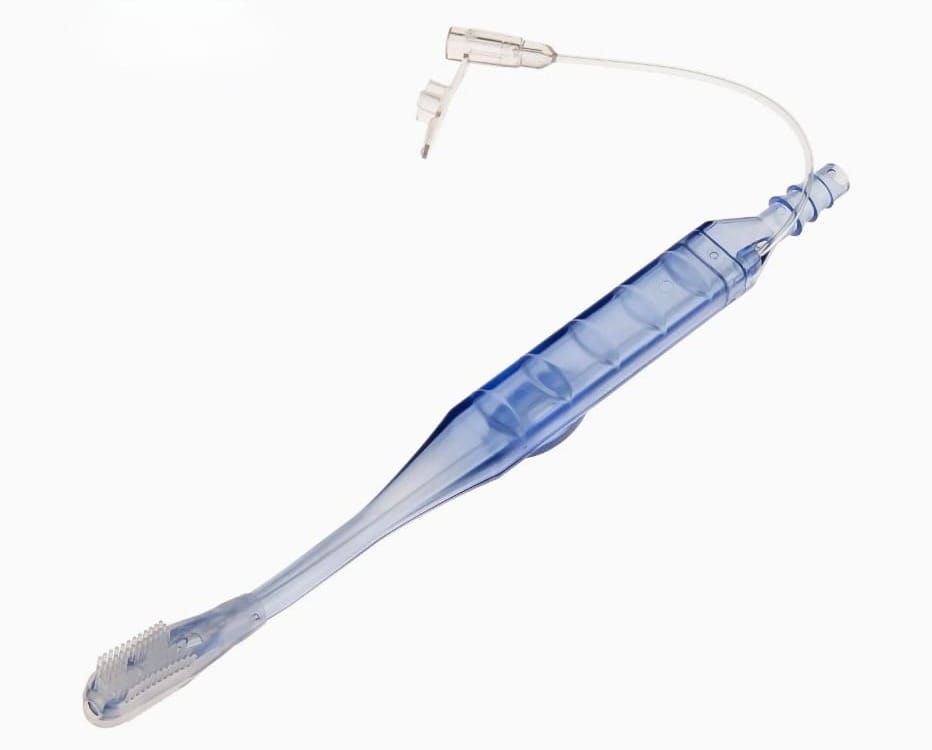
- Suction brush. A brush head with a small hole on the handle, called the thumb port. Cover it with your thumb and turn the suction on at the head; lift your thumb, and it stops. No thumb, no suction. It took me a few sessions to stop forgetting this.
- Tubing. Connects the brush to the machine.
- Suction machine. The bottle collects what's suctioned, and the dial shows the pressure. (In hospitals, wall suction does this job.)
Everything else
- A cup of clean water, to test suction before you start and flush the brush afterwards
- Gloves
- Eye protection, because splatter happens
- A towel or water-resistant bib
- The pressure setting your clinician gave you, written down where you can see it
- Optional: a mouth prop, if your loved one can't keep their mouth open or might bite. Ask the clinician whether it's appropriate and how to use it.
What goes on the brush
Keep it damp, never wet. Water, an alcohol-free or fluoride rinse, or a small amount of non-foaming toothpaste are the usual choices. Dab off the excess before it goes in, and make sure nothing is left pooled in the mouth at the end. Regular foaming toothpaste isn't suitable for anyone who can't manage thin liquids.
If your loved one is drowsy or unresponsive, skip toothpaste altogether. A water-based moisturising gel, applied with the brush, is a gentler alternative. Dry mouth is common with some medications (see our medication guide) and often goes hand in hand with low fluid intake (see our dehydration guide).
Bristles or Sponge: Which Head to Use?
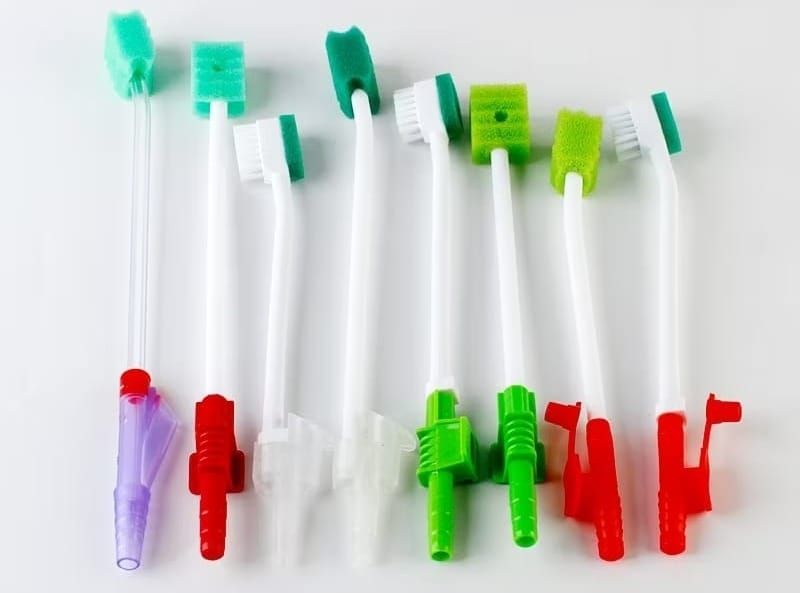
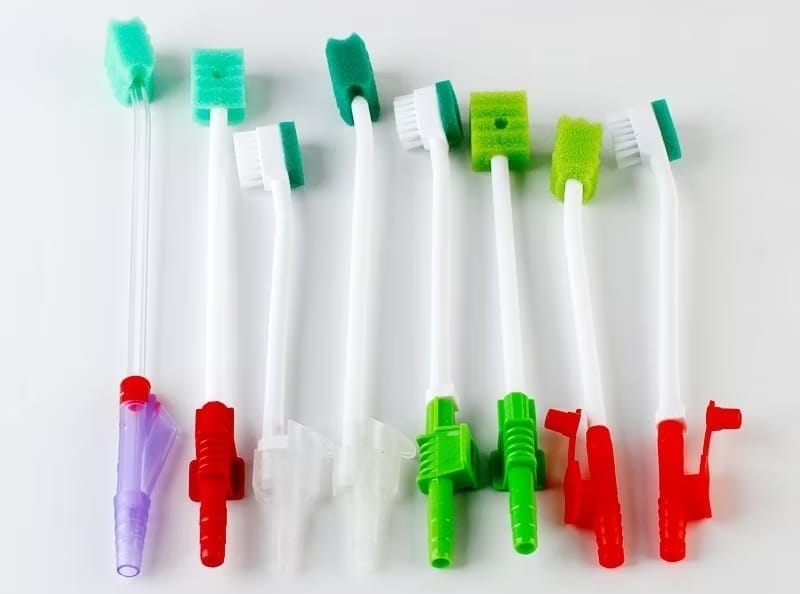
Suction heads come with either bristles or a swab (a sponge). They do different jobs, and the label on the pack usually tells you which.
Bristle Head
What it is: a brush head with soft bristles and a suction opening that pulls fluid away as you brush. It comes as single-use (for example, the suction toothbrush)
Pros:
- Removes plaque, the sticky bacterial film on teeth
- Cleans the gumline, tongue, cheeks, and palate with a real brushing action
- In the care-home trial, it matched a soft manual toothbrush for oral health
- Reusable versions exist, so you aren’t restocking packs
Cons:
- Needs more technique. One controlled trial found that how well a brush removes plaque depends on the user’s technique.
- Can be uncomfortable on a sore, inflamed, or bleeding mouth, and minor bleeding can happen
- Reusable versions must be cleaned and dried after every use
Who it suits: daily cleaning for most people who need assisted oral care, unless your clinician says otherwise.
Sponge (Swab) Head
What it is: a foam pad on a stick, connected to suction. Packs are often pre-moistened. As this example from Qyoswab Store.
Pros:
- Gentler. Cancer-care guidelines name a swab as the fallback when brushing is too painful, gums bleed and won’t stop, or platelet counts are very low. Ask your clinician first.
- Needs less dexterity.
- Single-use and often pre-moistened, so there’s nothing to clean
- Useful after brushing. Can use the swab for additional cleansing.
Cons:
- Removes less plaque than a toothbrush and can’t reach sheltered areas of teeth. Swabs are considered “not as effective” as a soft brush.
- Foam swabbing alone increased plaque and gingivitis over a one-week trial
- Foam can shed. Check that the foam is intact after use and remove any pieces from the mouth, which matters when swallowing is unsafe.
- Each swab is used once and discarded, so you restock packs
Who it suits: an add-on after brushing, or a fallback when bristles hurt. A swab alone shouldn’t be the whole routine.
Bristle vs Sponge at a Glance
| Bristle Head | Sponge (Swab) Head | |
|---|---|---|
| Plaque removal | Yes, listed on labels | Not claimed; studies show less |
| Best for | Daily cleaning | Add-on, or fallback |
| Sore or bleeding mouth | May irritate | Gentler fallback |
| Technique needed | More | Less |
| Safety check | Bristle wear; minor bleeding | Check foam is intact |
| Reusable? | Single-use or reusable | Single-use |
Why are most Suction Toothbrush Heads Disposable?
People assume suction brushes are all disposable. They aren’t, and head type and disposability are separate choices.
Single-use heads exist for infection control. In hospitals and care homes, anything that touches the mouth and attaches to suction lines is either thrown away or kept for one person only, so nothing is carried between people. Manufacturers’ patents also describe foam heads clogging and being discarded. That reasoning comes from manufacturer and protocol text, not home-care research.
Single-use pros:
- Nothing to clean or dry
- Sealed, often pre-moistened packs
- Nothing carries over between sessions
Single-use cons:
- You restock every time, and the cost adds up with daily use
- More waste
- Foam heads need checking after every use
Reusable pros:
- One brush lasts, so there are fewer packs to restock
- Soft bristles that can reach the gumline
Reusable cons:
- Must be rinsed and air-dried after every use
- Needs replacing when worn, after an illness, or if secretions can’t be rinsed out
- Must never be shared
Care instructions say to rinse the bristles, suction water through the brush and tubing, and store it bristle-end up in an open container to air dry, never in a sealed tube. Hydrogen peroxide solution may be suctioned through for extra cleaning. Fraser Health’s standard for toothbrushes in general is to replace them at least every three months, sooner if worn or after an infection. At home, there is one user, so reusable is often the practical choice.
Do You Need to Buy a Suction Machine?
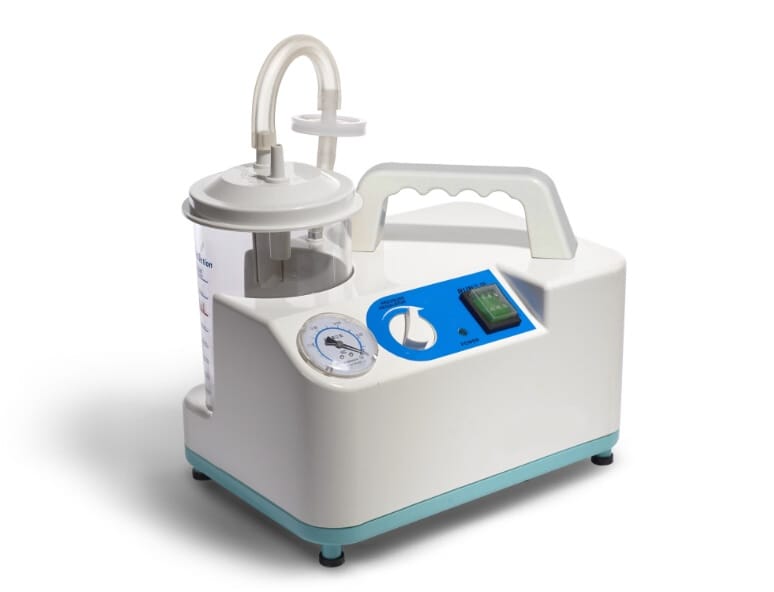
Suction machines are clinician-issued equipment. Families managing ALS/MND, as in our ALS guide, or home ventilation are more likely to have one already.
- If you have one: ask the team that issued it whether it suits oral care, then buy a brush that attaches firmly to your tubing.
- If you don’t: ask your SLP, GP, or nurse first. Rules on availability, funding, and prescriptions vary by country, and we found no reliable general rule.
Three Ways to Get Suction
Option 1: Brush Plus an Electric Suction Machine
What it is: a brush on tubing, connected to a portable electric suction machine.
Example brush attachment: Oral Swab Suction Toothbrushes
Pros:
- If a machine is already in the house, you only buy brushes
- It mirrors the setup in clinical protocols, so clinicians can teach it
- It is modular, so you can replace the brush, tubing, or filter separately
Cons:
- Several parts to assemble, clean, and replace.
- Needs power or a charged battery
- Two purchases if you have no machine
- The pressure must be set and checked each time
Who it suits: families who already have a machine, or who also need saliva suction.
Option 2: All-in-One Handheld
What it is: a single device with the suction pump built into the handle, so there is no tubing and no separate machine.
Example product - Bluereo Electric Suction Toothbrush
Manufacturer materials describe integrated suction, sonic-vibration brushing, a built-in light, and washable parts. These are manufacturer claims.
Pros:
- One device, with no tubing, bottle, or separate machine
- Portable around the house
- A built-in light helps you see what you’re cleaning
- Washable parts
Cons:
- We found no independent comparison against the brush-plus-machine route
- Generally the more expensive route
- A battery to keep charged, and replacement heads to buy
Who it suits: people with no machine and no wish to manage tubing.
Option 3: A Regular Soft Toothbrush With Separate Suction
What it is: a soft, small-headed regular toothbrush, with suction applied throughout each step of oral care.
Pros:
- Any soft, small-headed brush works, and it costs far less
Cons:
- Suction must be applied throughout, so in practice you need two hands or two people
- It is a hospital guideline, so ask your SLP whether it suits your home
- You still need a suction machine
Who it suits: families who already have a machine and want to keep the brush simple.
Connecting It, Step by Step
- Wash your hands and put on gloves.
- Assemble the machine as its manual shows, with the bottle, filter, and tubing in place.
- Check that the pressure is set to the setting your clinician gave you, and write that number down. But start low and increase only if needed.
- Push the brush’s connector firmly onto the free end of the tubing.
- Turn the machine on, cover the thumb port, and suck up a little clean water to test.
If there is no suction at the brush, check that the port is covered, the machine is on, and the tubing is firmly attached.
The Brushing Routine
- Position. Sit them as upright as is safe, with the head upright or leaning slightly forward and never tipped back. Our home care guide covers positioning. In bed, raise the head of the bed to 30° or 90°. Lie on the side if sitting up isn’t possible. These are different settings, so ask your clinician which applies.
- Brush gently. Use short strokes along the gumline, cheeks, tongue, and palate. Cover the thumb port in short bursts to clear fluid, never more than 10 seconds at a time. Keep the brush away from the inside of the cheek and tongue, because holding suction on one spot can grab the tissue. Pause for 10 to 15 seconds now and then so they can breathe and swallow.
- Clear the mouth. Suction away leftover liquid and debris.
- Flush. Suction clean water through the brush and tubing.
For timing, the dental guideline gives about one minute for a single-use swab. For people at high aspiration risk, oral care is recommended at least twice a day, plus before and after meals. Ask your SLP what suits your family member.
Safety: When to Stop
- Stop if you see coughing, gasping, difficulty talking, pale or blue colour, a rapid pulse, gurgling sounds, or watery eyes. Rest for 5 to 10 minutes and don’t continue until breathing and pulse are back to normal. If they don’t settle, or you’re worried, call the care team or emergency services.
- Keep suction to the front of the mouth. Do not go past the back teeth or toward the throat.
- Don’t use suction to remove food or objects from the throat. If someone is choking, call emergency services.
- Keep the pressure low and increase it only as your clinician advised.
- Minor bleeding can happen. Report heavy or sustained bleeding to the care team.
Cleaning and Caring for the Equipment
- After every use: suction clean water through the brush and tubing, turn off the machine, disconnect the brush, empty and clean the bottle, let it dry, and store the brush upright.
- Weekly: disinfect the bottle and tubing in a 1:3 vinegar-to-water solution for 60 minutes, then air-dry them. Check your machine’s manual first.
- Monthly: the same protocol; change the tubing and filter.
- Battery: keep portable machines charged.
When the Person Resists, Is Drowsy, or Is Near the End of Life
Resistance to oral care is common, particularly in dementia. See our dementia guide and the resistance section of our oral care guide. Try an individualised daily oral care plan, using the least restrictive method that protects the person’s dignity.
For someone drowsy or unresponsive, position them so excess moisture can flow out, use a mouth prop if needed, and don't use toothpaste. Give oral care as often as needed to keep the mouth clean and moist.
At the end of life, focus on comfort. Repeat care as often as needed, moisten the mouth with a brush soaked in fluid or an alcohol-free rinse, and apply a water-soluble lubricant gently. Our late-stage guide covers what that stage looks like. Ask the clinical team how to adapt oral care at this stage.
Summary: What to Remember
- A suction toothbrush removes fluid as you brush. The best evidence we found shows equal oral health results to a soft manual brush, so its value is fluid control and an easier routine, not proven fewer pneumonia cases.
- Bristles are the usual choice for daily cleaning. A sponge is an add-on or fallback when brushing hurts, so ask your clinician.
- Head type and disposability are separate choices. Reusable single-person brushes exist, so not every suction brush is disposable.
- Don’t assume you have a suction machine. Ask your care team first, then choose between a machine, an all-in-one, or a regular brush with separate suction.
- Use a damp brush or non-foaming toothpaste, and ask your SLP before using any dry mouth spray.
- Sit them upright, test the suction with water, never suction for more than 10 seconds at a time, and keep it to the front of the mouth. Stop at any sign of distress.
- Clean the equipment after every use, replace worn heads, and change tubing and filters on schedule.
- Get a clinician to demonstrate before you start, and have them set the pressure.
Frequently Asked Questions
Is a suction toothbrush better than a regular soft toothbrush?
Not proven. In the one adult dysphagia trial, both gave equal oral health results. The suction brush’s advantage is handling fluid as you brush, and its authors say it may help caregivers succeed with daily care.
Can I use a regular toothbrush with separate suction?
AACN’s hospital guidance accepts a soft, small-headed regular toothbrush if suction is applied throughout each step. In practice, that needs a second person or hand. That guidance is for hospital patients, so ask your SLP whether it suits home.
Can I use a sponge swab instead of a brush?
A swab is best as an add-on, or as the fallback when brushing hurts or gums bleed. Swabs remove less plaque than brushing, so don’t rely on one alone. Ask your clinician.
Which toothpaste should I use?
A damp brush, or non-foaming toothpaste if your SLP agrees. Regular foaming toothpaste isn’t suitable for people who can’t handle thin fluids.
How often and how long should I brush?
Fraser Health’s protocol for people at high aspiration risk is at least twice a day, plus before and after meals. The care-home trial used two minutes twice daily. Ask your SLP what suits your family member.
Is bleeding normal?
Minor bleeding can happen and should lessen as the gums heal. Report heavy or sustained bleeding.
What pressure should I use?
Ask your clinician to set it, and write it down. Never guess, and never start high.
Where do I get a suction machine?
Ask your SLP, GP, or nurse. Rules vary by country. Machines are also sold online, but ask about suitability and settings first.
References
Yakiwchuk, C. A., Bertone, M., Ghiabi, E., Brown, S., Liarakos, M., & Brothwell, D. J. (2013). Suction toothbrush use for dependent adults with dysphagia: A pilot examiner blind randomized clinical trial. Canadian Journal of Dental Hygiene, 47(1), 15–23. https://www.cdha.ca/pdfs/profession/journal/2168.pdf
NHS England / Mini Mouth Care Matters. (2023). A user guide for mouth care products (PAR1514). Written for children and young people in special educational settings. https://www.england.nhs.uk/wp-content/uploads/2023/10/PAR1514-oral-health-user-guide-for-mouth-products.pdf
Fraser Health. (2017). Clinical protocol: Oral health, adult. Integrated standards for residential care facilities and group homes. https://www.fraserhealth.ca/-/media/Project/FraserHealth/FraserHealth/Health-Professionals/Student-Practice-Education/201810_clinical_protocol_oral_health_adult_integrated_standards_for_residential_care.pdf
Hull University Teaching Hospitals NHS Trust. (2025). Oral suction: Information for patients and carers (HEY1312/2025). https://www.hey.nhs.uk/patient-leaflet/oral-suction-information-for-patients-and-carers/
SickKids AboutKidsHealth. (2020). How to perform oral suctioning. https://www.aboutkidshealth.ca/how-to-perform-oral-suctioning
American Association of Critical-Care Nurses. (2026). AACN practice alert: Implementing effective oral care practices for acutely and critically ill patients. Critical Care Nurse, 46(1), e1. https://aacnjournals.org/ccnonline/article/46/1/e1/32945/AACN-Practice-Alert-Implementing-Effective-Oral
Sage Products. Oral cleansing and suctioning system (Toothette): Product label. DailyMed. https://dailymed.nlm.nih.gov/dailymed/fda/fdaDrugXsl.cfm?setid=3b467496-dde7-6c24-418f-68843a8acce5
BC Cancer. Symptom management guidelines: Oral mucositis. https://www.bccancer.bc.ca/nursing-site/documents/12.%20oral%20mucositis.pdf
Royal Children’s Hospital Melbourne. Mouth care of the paediatric oncology patient. Paediatric guideline. https://www.rch.org.au/rchcpg/hospital_clinical_guideline_index/Mouth_Care_of_the_paediatric_oncology_patient/
OncoLink. (2026). Mucositis (mouth sores) and oral care tip sheet. https://www.oncolink.org/support/side-effects/gastrointestinal-side-effects/mucositis/mucositis-mouth-sores-oral-care-tip-sheet
SwallowStudy.com. How to perform effective oral care. https://swallowstudy.com/perform-effective-oral-care/
A controlled trial to compare the ability of foam swabs and toothbrushes to remove dental plaque (2002). https://www.researchgate.net/publication/11212562_A_controlled_trial_to_compare_the_ability_of_foam_swabs_and_toothbrushes_to_remove_dental_plaque
Carewell. (2026). Plak-Vac suction toothbrush: Product description and FAQ. https://www.carewell.com/product/plak-vac-suction-toothbrush/
Rehabmart. Plak-Vac suction toothbrush: Product page (retailer; source for the hand-powered listing). https://www.rehabmart.com/product/plakvac-suction-toothbrush1-29878.html
Bluereo. (2025). The best portable suction machine is a toothbrush. Manufacturer claims only. https://bluereo.com/blogs/weekly-blog/portable-suction-machine