The IDDSI Level 3 Diet: Liquidised Foods & a 7 Day Meal Plan
What to eat and drink at IDDSI Level 3 and how it differs from Level 4 . Plus a 7-day family-friendly meal plan.


Level 3 is the level I encounter most often in my caregiving work — and the one that requires the most consistent daily attention to get right.
In my experience, families who have managed Level 4 or Level 5 sometimes assume Level 3 is easier because the food flows. It isn't easier — it's different. The flow that makes Level 3 manageable for some swallowing profiles is exactly what makes it more demanding to prepare consistently. A Level 4 purée holds shape and gives you clear visual feedback. Level 3 sits in a narrower band — thick enough not to pour freely, thin enough to drip slowly through a fork — and temperature, cooking time, and the liquid you use to blend all affect whether you're inside that band or outside it.
I've also seen more dehydration at Level 3 than at any other level. Thickened drinks at this consistency are genuinely unpleasant for many people — and when someone stops drinking, the decline is faster than most families anticipate. This guide covers both the food and the drink side of Level 3, because managing one without the other leaves a significant gap.
What IDDSI Level 3 Actually Means
IDDSI Level 3 is used to describe either foods, drinks, or both. It is described as smooth and moderately thick, eaten with a spoon or in a cup. They cannot be eaten with a fork because they will fall through the prongs.
Level 3 foods and drinks are very different but have many similarities — having overlap in the descriptions for dysphagia is very important. Liquidised foods start as solids but need to be altered so they can be drunk or eaten with a spoon.
In plain terms: Level 3 is the thickest consistency that still flows. It pours slowly, drips through a fork in dollops, and can be drunk from a cup — but slowly and with effort. A Level 4 food holds its shape on a plate. A Level 3 food slowly spreads and settles. That difference in how it behaves is the most practical way to tell them apart.
Why Level 3 Is the Hardest Level to Get Right
In my experience, Level 3 is harder to achieve consistently than Level 4 — and here's why: Level 4 has clear visual feedback. If it holds shape on the spoon, it's right. If it runs, it's wrong. Level 3 sits in a narrower band — thick enough not to pour like water, thin enough to drip slowly through a fork. Both ends of that band are wrong, and the middle is what you're aiming for every single time.
Temperature makes it harder. A Level 3 soup that is perfect at 60°C will thicken as it cools — and may be Level 4 by the time it reaches the table. I check consistency at serving temperature, not preparation temperature. Every time.
Level 3 as a Liquid vs Level 3 as a Food
This is the part that confuses most caregivers — and it confused me for months.
When your SLP prescribes Level 3, they may mean:
Level 3 Moderately Thick (liquid): A drink that has been thickened to Level 3 consistency. Water, juice, tea, coffee — all thickened with a commercial thickener until they flow slowly and drip through a fork in dollops. Not all at once — slowly, in separate drops.
Level 3 Liquidised (food): Food that has been blended until completely smooth and reaches a Level 3 consistency. A smooth soup, a blended stew, a liquidised meal — all flow like Level 3.
Both: Many people on Level 3 have both food and liquid prescribed at this level — all food is liquidised, and all drinks are thickened to moderately thick.
Food levels 3 (Liquidised) and 4 (Pureed) overlap with liquid levels 3 (Moderately Thick) and 4 (Extremely Thick) because they have similar flow and texture characteristics.
The simplest way to think about it: a smooth soup and a moderately thick drink should behave identically in the syringe flow test and fork drip test. If one passes and the other doesn't, one of them is wrong.
The Two Tests That Confirm Level 3
The Syringe Flow Test — For Liquids and Liquid-Consistency Foods
After 10 seconds of flow, there will be 8ml or more remaining in the syringe for Level 3.
Fill a 10ml BD Slip Tip syringe, hold horizontally, release, and time 10 seconds. 8ml or more remaining = Level 3 or above. Less than 8ml = Level 2 or below. If nothing flows at all — you're at Level 4.
Our complete syringe flow test guide covers this step by step with photos.
The Fork Drip Test — The Visual Check
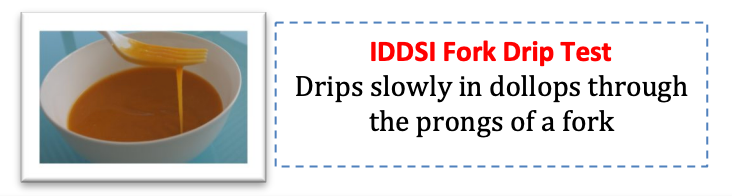
Dip a fork into the food or drink and lift it horizontally. If you scoop an IDDSI Level 3 food or drink with a fork, it will fall through the prongs slowly in dollops.
Not a continuous stream — that's Level 2 or below. Not staying on the fork — that's Level 4. Slow, separate dollops dripping through. That's Level 3.
This is the test I do at the table before every meal. It takes five seconds and catches consistency problems before they reach my mother.
Check the IDDSI guideline here. ,
What Makes Level 3 Different From Level 4
This is the question I had for months before I genuinely understood the answer.
Level 3 flows — Level 4 holds shape.
A Level 4 food sits on a plate and holds a mound. It slides off a tilted spoon in one cohesive movement. A Level 3 food slowly spreads across the plate. It drips through a fork. It can be drunk from a cup.
Level 3 can be drunk — Level 4 cannot.
At Level 3, the person can bring a cup to their mouth and drink the food like a thick drink. At Level 4, this is not possible — the consistency is too thick to flow from a cup. This is clinically significant: a person on Level 3 has more flexible eating options than Level 4, including cup drinking and sipping from a spoon.
Level 3 is thinner — which means it moves faster.
The flow speed of Level 3 gives the swallowing reflex less time to respond than Level 4. This is why Level 3 is not automatically easier or safer than Level 4 — it depends on the individual's swallowing profile. Your SLP prescribes the level based on what the VFSS or FEES assessment shows, not based on general preference.
The Golden Rule of Level 3 Cooking
Always liquidise foods with extra liquids such as gravy, milk, single cream, or stock. Try not to use water, as this reduces the goodness in the food.
This is the single most important cooking principle at Level 3 — and I wish someone had told me this in the first week. Using water to thin food to Level 3 works technically, but it dilutes the caloric density of every meal. Over weeks and months, that dilution contributes directly to the malnutrition risk that already exists on liquidised diets.
Use stock for savoury dishes. Use full-fat milk or single cream for sweet dishes, porridge, and dairy-based meals. Use the cooking juices from meat and vegetables — they carry flavour and nutrition that water doesn't.
The consistency goal and the nutrition goal should be met simultaneously. Every tablespoon of liquid you add to achieve Level 3 should be a tablespoon that adds something — not just water.
The Level 3 Food List
✅ Foods That Work Well at Level 3
The defining characteristic of every Level 3 food: completely smooth, has no bits of any kind, and flows slowly from a cup.
Soups — the backbone of Level 3 cooking
Smooth blended soups are the most practical and versatile Level 3 food. Almost any soup can be made Level 3 with thorough blending and sieving. The soup must be thick enough to pass the fork drip test — it should drip in slow dollops, not pour freely.
Best soups for Level 3:
- Butternut squash — naturally thick and smooth
- Tomato — blend and sieve thoroughly to remove skin and seeds
- Leek and potato — creamy and naturally thickens well
- Pea and mint — blend and sieve to remove husks
- Cauliflower cheese — blend the cauliflower into the cheese sauce
- Carrot and coriander — naturally smooth-blending
- Lentil — red lentils break down into a perfectly smooth consistency without sieving
- Chicken and vegetable — blend until completely smooth, sieve to remove fibres
Add flavour with mustard or curry powder, soy sauce, lemon juice, Bovril, Marmite, or spices. Avoid using dried herbs — dried herbs leave small flecks that fail the Level 3 requirement.
The consistency trap with soups: A soup that is correct immediately after blending may thicken to Level 4 by the time it's served. Always check at serving temperature. If it has thickened, add a small amount of warm stock and retest.
Liquidised meals — the same dinner, differently prepared
The most important discovery I made in the first year was that my mother could eat a version of the same meal as the rest of the family — just liquidised at the end. Roast chicken and vegetables, blended with the cooking juices. Beef stew, blended smooth. Salmon with cream sauce, blended until completely smooth.
The key is to cook everything until very tender, blend with enough liquid to reach Level 3 consistency, and sieve to remove any fibres. The result is a recognisable flavour — the same meal — in a safe consistency.
Best liquidised meals for Level 3:
- Chicken and gravy — blend thigh meat with thick gravy and soft vegetables until completely smooth. Sieve.
- Beef stew — slow-cooked beef with vegetables blended smooth with cooking juices. The collagen from long-cooked beef helps achieve a naturally thicker, more cohesive Level 3 consistency.
- Salmon with cream sauce — blend with the sauce until smooth. Pass through a fine sieve to remove any skin fibres.
- Lamb and lentil — blend together with stock. The lentils thicken the liquid naturally.
- Vegetable curry — blend until smooth with coconut cream. Sieve to remove any remaining fibres.
- Fish in white sauce — blend fish and sauce together. Sieve carefully — fish retains fine fibres even after blending.
Breakfast options
Smooth porridge or equivalent, such as Ready Brek. Wheat biscuit cereal, such as Weetabix, well soaked with milk, fully absorbed. Milkshakes made with puréed fruit — a thickener may need to be added. Smooth yoghurt or fromage frais. Peeled and puréed tinned or fresh fruit such as peaches and pears. Fruit smoothies.
Practical Level 3 breakfasts:
- Ready Brek or fine oat porridge — naturally thickens to approximately Level 3 when made with full-fat milk. Check consistency — too thick with less liquid, add more warm milk and retest.
- Weetabix fully soaked in warm milk — drain all excess milk before serving. The fully soaked consistency is approximately Level 3.
- Smooth yogurt drinks — full-fat drinking yogurt. Check with syringe test — some brands are Level 2, some Level 3, depending on fat content.
- Blended fruit smoothie — blend fruit smoothly with full-fat yogurt or cream. Add thickener if needed to reach Level 3. Sieve to remove seeds and fibres.
- Liquidised scrambled eggs — blend smooth scrambled eggs with cream. Level 3 when blended with enough cream. Pass through a fine sieve.
Drinks thickened to Level 3
Every drink prescribed at Level 3 must be thickened. Level 3 liquids are not typically naturally occurring. You will need to start with a thin or slightly thick liquid and add a powdered or gel thickener and stir or shake.
Practically: follow the manufacturer's instructions for Level 3 consistency, mix thoroughly, wait the full hydration time (60–90 seconds for gum-based, up to 15 minutes for starch-based), and verify with the syringe test before serving.
Our complete drink thickening guide covers which thickeners work best for which drinks at Level 3.
Best drinks at Level 3:
- Thickened tea or coffee — gum-based thickener (SimplyThick, Nutilis Clear) preserves flavour best
- Thickened fruit juice — gum-based only, as acidic drinks break down starch thickeners
- Thickened full-fat milk — start with half the recommended dose, as dairy increases base viscosity
- Fruit smoothie thickened to Level 3 — blend fruit smooth first, then add thickener if needed
- Thickened nutritional supplement drinks (Ensure, Fortisip) — check with a dietitian first, as protein content affects thickener behaviour
Desserts
Level 3 desserts are actually where the diet shines — many desserts are naturally close to this consistency and need minimal modification.
- Smooth yogurt — full-fat, no pieces. Greek yogurt is typically too thick for Level 3 — add a small amount of full-fat milk and retest.
- Smooth custard — thinner than Level 4 custard. Should flow slowly from a spoon. Our cinnamon apple custard recipe can be served at Level 3 by reducing the cornflour slightly and checking the consistency.
- Smooth mousse — chocolate or fruit mousse blended completely smooth.
- Smooth fromage frais — naturally approximately Level 3. Check with the fork drip test.
- Liquidised fruit with cream — puréed peach, pear, or mango with single cream stirred through to achieve Level 3 consistency.
- Smooth milkshake — full-fat milk blended with ice cream or banana. Add thickener if below Level 3.
❌ Foods Not Appropriate for Level 3
Anything with texture, lumps, or bits:
Food that has a smooth texture with no bits — no lumps, fibre, husk, bits of shell or skin, particles of gristle or bone.
- Any food with detectable pieces — no matter how small
- Dried herbs and spices with visible particles
- Seeds of any kind — including very small seeds
- Fruit or vegetable skin — even thin tomato skin
- Fibrous vegetables — celery, leek green parts, stringy beans
- Gristle, bone, or connective tissue from meat
- Whole or chopped nuts
- Crunchy or chewy foods of any kind
Foods that are below Level 3 (too thin):
- Plain water or juice without thickener
- Thin broth or stock
- Standard milk without thickening
- Ice cream — melts to a thin liquid in the mouth
- No ice cream or jelly unless advised as suitable by a speech and language therapist. Jelly presents an additional risk — it melts from a solid to a thin liquid in the mouth, creating an unpredictable mixed texture.
Foods that are above Level 3 (too thick):
- Level 4 puréed food that holds shape on a spoon
- Any food that does not flow slowly — even if smooth
Mixed textures:
- Any liquid that has separated from the food it was blended with
- Yogurt with a thin liquid layer on top — drain or stir thoroughly before serving
- Soups that have separated during standing — always blend again after reheating
The Consistency Trap — The Most Common Level 3 Mistake
I want to spend a moment on this because it took me too long to understand, and it directly affects safety.
Level 3 food thickens as it cools. What is perfect at 65°C may be Level 4 by the time it reaches the table at 45°C. This is especially true for:
- Starchy soups (potato, lentil, butternut squash) — starch continues to thicken as temperature drops
- Porridge — thickens significantly as it cools
- Dishes with cream or butter — fat solidifies slightly as temperature falls
My rule: prepare slightly thinner than Level 3 target, knowing it will thicken to Level 3 by serving temperature. Then check the temperature the person will actually eat it — not when you take it off the heat.
A thickener may be added to maintain thickness if the consistency drops below Level 3 during standing or reheating. Add thickener, stir thoroughly, wait the hydration time, and retest before serving.
Nutrition at Level 3 — The Same Concern as Level 4
The same malnutrition risk that exists at Level 4 exists at Level 3 — and for the same reason. Liquidising food requires adding liquid. Adding liquid dilutes caloric density. Over time, a person eating three Level 3 meals a day without fortification is almost certainly receiving fewer calories per meal than the same food would provide at a higher texture level.
Fortification strategies that work at Level 3:
For savoury dishes — blend with full-fat milk, single cream, or double cream instead of water. Add butter to soups and liquidised meals. Use full-fat coconut cream in Asian-inspired dishes. Blend a tablespoon of cream cheese into savoury soups for protein and calories.
For sweet dishes and drinks — use full-fat dairy throughout. Add honey, syrup, or smooth nut butter to fruit purées and smoothies. Use enriched milk (full-fat milk with 4 tablespoons of dried skimmed milk powder stirred in) as the liquid base for porridge, custard, and smoothies.
Monitor weight weekly. Any unexplained weight loss warrants dietitian review — not just an adjustment to what you're cooking but a formal assessment of whether caloric and protein targets are being met.
The Flow Control Cup at Level 3
Level 3 foods and drinks can be drunk from a cup — which means the cup choice matters. At Level 3, the flow is slow but present. A standard cup delivers an uncontrolled amount of liquid per sip. A flow-control cup limits each sip to a specific, safe volume.
For someone on Level 3 who is drinking thickened liquids from a cup, the SavvyBloom with the 10cc or 15cc regulator insert is the most appropriate flow-control option — the regulator controls the sip volume even at Level 3 consistency. Our flow-regulating cups comparison covers the options in detail.
7-Day Level 3 Meal Plan
Every item has been checked against Level 3 criteria. Everything flows slowly — not pours, not holds shape. Always verify with the syringe test or fork drip test before serving. Check at serving temperature.
Monday
Breakfast: Ready Brek made with full-fat milk and a small amount of cream. Add honey. Check consistency — should drip slowly through a fork, not hold shape.
Morning snack: Full-fat smooth yogurt drink — check with fork test before serving.
Lunch: Smooth butternut squash soup blended with double cream. Stock is used as the liquid base. Check at serving temperature — butternut squash soups thicken as they cool.
Afternoon snack: Smooth fromage frais.
Dinner: Liquidised chicken with gravy — chicken thigh blended smooth with thick gravy and liquidised soft carrot. Check consistency — should pour slowly, not hold shape.
Dessert: Smooth custard — slightly thinner than the Level 4 version. Should drip slowly through a fork.
Tuesday
Breakfast: Weetabix fully soaked in warm full-fat milk — drain all excess milk. Check consistency with the fork drip test.
Morning snack: Smooth full-fat yogurt.
Lunch: Smooth red lentil soup — lentils naturally break down to Level 3 without sieving. Add stock and single cream. Check at serving temperature.
Afternoon snack: Blended banana smoothie with full-fat yogurt. Add thickener if below Level 3.
Dinner: Liquidised beef stew — slow-cooked beef blended smooth with cooking juices. Sieve to remove fibres. Check consistency.
Dessert: Smooth mousse — chocolate blended smoothly with cream.
Wednesday
Breakfast: Fine oat porridge with full-fat milk and cream. Add honey. Check — porridge thickens significantly as it cools, so check at the temperature you serve it.
Morning snack: Smooth fruit yogurt — no pieces. Check.
Lunch: Smooth tomato soup — blend and sieve thoroughly to remove skin and seeds. Add cream. Check.
Afternoon snack: Liquidised peach purée with single cream — peel, stone, blend, sieve.
Dinner: Liquidised salmon with cream sauce — blend fish with sauce until completely smooth. Sieve carefully for fibres.
Dessert: Smooth fromage frais with liquidised mango stirred through.
Thursday
Breakfast: Ready Brek with full-fat milk. Liquidised stewed apple with honey stirred through — peel, cook, blend, sieve.
Morning snack: Smooth yogurt drink.
Lunch: Smooth leek and potato soup with cream. Blend thoroughly — leek strings can survive blending. Sieve.
Afternoon snack: Smooth yogurt.
Dinner: Liquidised lamb and lentil — blend with stock. The lentils assist natural thickening. Sieve to confirm no fibres remain.
Dessert: Smooth custard with liquidised pear stirred through — peel, cook, blend, sieve.
Friday
Breakfast: Fine oat porridge with enriched milk (full-fat milk with dried milk powder). Honey.
Morning snack: Fruit smoothie thickened to Level 3 — blend fruit smooth, add thickener if needed, sieve, verify.
Lunch: Smooth pea and mint soup — blend and sieve thoroughly to remove pea husks.
Afternoon snack: Smooth fromage frais.
Dinner: Liquidised chicken curry — blend mild curry with coconut cream until smooth. Sieve. Check consistency.
Dessert: Smooth chocolate mousse — blend with cream. Check.
Saturday
Breakfast: Weetabix well soaked in warm milk. Drain excess milk. Fork drip test.
Morning snack: Smooth full-fat yogurt.
Lunch: Smooth cauliflower cheese soup — blend cauliflower into the cheese sauce until completely smooth. Check.
Afternoon snack: Liquidised mango with single cream.
Dinner: Liquidised fish in white sauce — poach fish, blend with sauce until smooth, sieve carefully. Check.
Dessert: Smooth custard.
Sunday
Breakfast: Ready Brek with full-fat milk and honey.
Morning snack: Smooth yogurt drink.
Lunch: Smooth carrot and coriander soup — naturally smooth-blending. Add cream. Check at serving temperature.
Afternoon snack: Smooth fromage frais.
Dinner: Liquidised roast dinner — blend chicken or beef with gravy and soft liquidised vegetables. The Sunday meal the whole family eats, prepared separately and blended at the end. Same flavours, same occasion, Level 3 consistency.
Dessert: Smooth fruit smoothie with yogurt — blended smooth, thickened if needed, sieved, verified.
Ready-Made Level 3 Options
This is where Level 3 is underserved compared to Level 4. Most commercially prepared dysphagia foods — Thick-It, Thick & Easy — are Level 4. Level 3 ready-made options are limited.
GentleFoods (Singapore) covers Level 3 in their IDDSI-certified range — soups, congee, and smooth mains. For readers in Singapore, this is the most practical ready-made Level 3 option. See our ready-made food comparison for details.
For everywhere else: The practical approach is to keep a supply of smooth Level 3-compatible soups — commercial smooth blended soups from the supermarket can sometimes reach Level 3 consistency, but always verify with the syringe test before serving. Many commercial smooth soups are Level 2 rather than Level 3.
Thick-It Level 4 products can occasionally be thinned to Level 3 by adding warm stock — but this is less reliable than preparing fresh. Test every time.
The Emotional Reality of Level 3
I want to name something that I observe consistently in families managing Level 3 — and that most clinical guides don't address.
Level 3 is the hardest level to accept visually. At Level 4, the food clearly looks modified — it's a smooth purée, and everyone understands what it is. At Level 6, the food looks nearly normal — small pieces, recognisable textures. Level 3 sits in an uncomfortable middle — it doesn't look like food, and it doesn't look like a drink. It looks like something has gone wrong.
I've watched people refuse Level 3 meals that were perfectly prepared and clinically appropriate simply because they looked wrong. Presentation matters more at this level than at any other. Serving warm food in a proper bowl at a properly set table — with the same care as any other meal — signals that this is dinner, not a medical procedure.
The other thing I tell families: name the food. Not "here's your liquidised dinner" — but "here's the chicken casserole." The same dish as everyone else, described the same way, served at the same time. The familiar flavour connects to something the person recognises, even when the texture is completely different. That connection matters for appetite, for dignity, and for how willingly the person engages with the meal.
For a full explanation of how food and liquid levels work separately and together, see our IDDSI Food and Liquid Levels Guide.
Frequently Asked Questions
What is IDDSI Level 3 in plain terms?
IDDSI Level 3 is described as smooth and moderately thick, eaten with a spoon or cup. It cannot be eaten with a fork because it falls through the prongs slowly in dollops. It is the thickest consistency that still flows — and the only IDDSI level that applies equally to food (liquidised) and drink (moderately thick).
What is the difference between Level 3 and Level 4?
Level 3 flows — slowly, in dollops through a fork. Level 4 holds its shape on a spoon and does not flow. Level 3 can be drunk from a cup. Level 4 cannot. Level 3 has more flexibility in how it can be consumed but flows faster, giving the swallowing reflex less time to respond than Level 4.
Can someone on Level 3 drink from a cup?
Yes — Level 3 is thick enough to drink safely from a cup for the right swallowing profile. However, a flow-control cup is significantly safer than a standard cup, as it limits the volume of liquid per sip regardless of how the cup is tilted. See our flow-regulating cups guide for options.
How do I know if my soup is Level 3?
The syringe flow test and fork drip test both confirm Level 3. In the syringe test, 8 ml or more remains after 10 seconds. In the fork test, liquid falls through the prongs slowly in separate dollops — not a continuous stream and not held on the fork. Check at serving temperature, not preparation temperature. Our syringe test guide covers both tests.
Can I use water to liquidise food to Level 3?
Technically, yes — but it's not recommended. Try not to use water, as this reduces the goodness in the food. Use stock, full-fat milk, cream, or cooking juices instead. The nutritional difference over weeks and months is meaningful.
What drinks need to be thickened to Level 3?
Level 3 liquids are not typically naturally occurring — you will need to start with a thin or slightly thick liquid and add a powdered or gel thickener. All standard drinks — water, juice, tea, coffee, milk — need a commercial thickener added to reach Level 3. Our drink thickening guide covers which thickener works best for each drink.
Is there a difference between moderately thick liquid and liquidised food at Level 3?
They look similar and test identically — but they start differently. Moderately thick liquid is a drink that has had a thickener added. Liquidised food is solid food that has been blended until it reaches Level 3 consistency. Both must pass the same syringe and fork tests. In practice, a well-made liquidised soup and a correctly thickened drink should behave identically in both tests.
References
IDDSI Framework. (2019, updated 2024). Level 3 — Liquidised / Moderately Thick: Descriptors and testing. https://www.iddsi.org/framework
Cambridge University Hospitals NHS Foundation Trust. (n.d.). Liquidised food IDDSI Level 3. https://www.cuh.nhs.uk/patient-information/liquidised-food-iddsi-level-3/
IDDSI International. (2018). IDDSI Level 3 Liquidised / Moderately Thick — UK handout. https://www.iddsi.org/images/AroundTheWorld/UnitedKingdom/Handouts/iddsi_3_yellow_liquidised.pdf
Honeycomb Speech Therapy. (2022). About IDDSI Level 3 (Moderately Thick / Liquidised). https://honeycombspeechtherapy.com/wp-content/uploads/2022/04/IDDSI-Level-3.pdf
Dysphagia Dietitian. (2024). IDDSI Level 3 — Separating foods and drinks. https://dysphagiadietitian.com/blog/iddsi-level-3/
Cichero, J. A. Y., et al. (2017). Development of international terminology and definitions for texture-modified foods and thickened fluids used in dysphagia management. Dysphagia, 32(2), 293–314. https://doi.org/10.1007/s00455-016-9758-y
American Speech-Language-Hearing Association. (n.d.). Adult dysphagia (Practice Portal). https://www.asha.org/practice-portal/clinical-topics/adult-dysphagia/